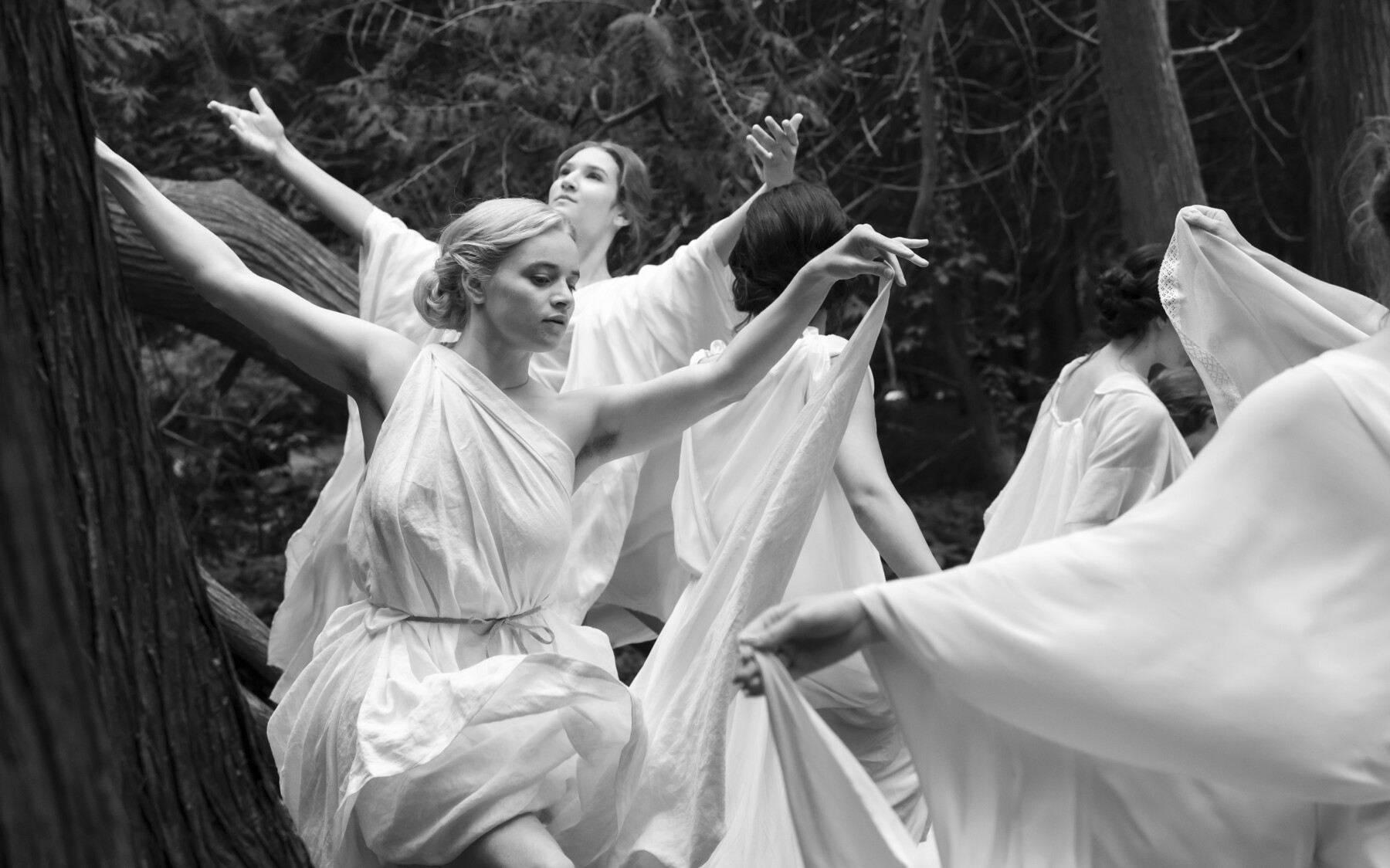


An elegant, enigmatic examination of humanity’s connection to the natural world, Silent Friend is the latest film from Hungarian auteur Ildikó Enyedi, and her highest-profile effort, perhaps, since her 1989 feature debut My Twentieth Century. Silent Friend centers on an enormous ginkgo biloba tree that has been growing on the campus of the University of Marburg in Germany since at least 1832, the date embossed on a plaque embedded in its trunk. Enyedi uses it as a fulcrum around which three separate stories wind, each separated by time but connected by place and theme. That theme, though ultimately ineffable, has to do with the idea or possibility that plants have aspects of perception, communication, and even consciousness that we have collectively barely begun to fathom.
If all that sounds abstract and woo-woo, rest assured that the film has sensuous pleasures as well, beginning with the always beguiling visage of the great Tony Leung, who plays an academic from Hong Kong visiting Marburg as a lecturer in neurology. Specifically, he has been studying the brain patterns of babies when presented with various stimuli and what that tells us about how they see the world. (He does trot out the rusty cliché that “Babies are high all the time,” but we can forgive that.) Turns out this is all happening in 2020, and when the COVID pandemic shuts down the university and strands Leung in Germany on its abandoned campus, he embarks on another research project involving that majestic tree.
“Meanwhile,” in the late 19th century, a young woman named Greta (Luna Wedler) has applied to the university, enduring an unsurprisingly but infuriatingly misogynistic interrogation by the admissions board before being reluctantly allowed inside the ivory tower to study botany. And in the heady 1970s, a student, Hannes (Enzo Brumm), becomes embroiled in both radical politics and a relationship with a young woman performing experiments on a geranium. Enyedi gives us extended introductions to each of these, and uses different film stocks for each era: crisp digital video for 2020, grainy 16mm for the 1970s, and gorgeous black-and-white 35mm for the 1800s (giving those segments a vaguely Michael Haneke vibe). But as Silent Friend continues, the shifts between them become more frequent and allusive. Goethe’s “The Metamorphosis of Plants” makes an appearance in more than one timeline, and after Leung’s character has a Zoom correspondence with another scientist played by Léa Seydoux, he outfits the ubiquitous ginkgo with a gizmo along the line of Hannes’ girlfriend’s invention.
Richard Powers’ 2018 Pulitzer Prize-winning novel The Overstory is a reference point here, as is the 1973 pseudoscience sensation The Secret Life of Plants and its trippy 1979 documentary adaptation. But Enyedi isn’t making a case for the literal truth of, say, the proposition that taking peyote lets you talk to trees or that you can train a geranium to open a garden gate. She, and the film, ask us instead to contemplate the possibility that, even as the technologies we use to investigate the natural world around us become more and more complex, our relationship to that world remains ultimately inexplicable and mysterious.
Enyedi has directed six features between My Twentieth Century and Silent Friend (as well as a passel of shorts and TV work), but none of them, including the 2017 Oscar-nominated On Body and Soul, are available to stream. Here’s hoping that this new film piques enough interest in her work to convince The Criterion Channel or MUBI to remedy that situation, because from what I’ve seen she’s two-for-two in well-crafted, thoughtful films that tackle weighty issues from a unique perspective and with a disarming wit. (Opens Friday 5/22 at Cinema 21 and Salem Cinema)
The rise of Vladimir Putin from an East German KGB post to the premiership of post-Soviet Russia and status as one of the world’s most perfidious leaders is a fascinating tale that should be better known. And yet The Wizard of the Kremlin, despite an impressive international pedigree, is an unsatisfying effort that leaves as many questions unanswered as it addresses. The wizard of the title is Vadim Baranov (Paul Dano), a political operative in 1990s Russia who bears witness to, and helps navigate others through, the corrupt, turbulent years following the collapse of the Soviet Union, as state assets were sold off and the oligarch class established its hold on power. Baranov sees in Putin (well if confusingly played by Jude Law) a vehicle for his ambitious plans.
Baranov tells his tale in flashback as he’s interviewed in 2019 by an American journalist played by Jeffrey Wright, and the moral of his story seems to be an age-old one: thinking they had found the perfect puppet in Putin, Baranov and the rest of the oligarchs who engineered his succession of Boris Yeltsin as Russia’s leader eventually realized that the monster they created could no longer be controlled by them. The film takes pains to note that it is a work of fiction, but the imaginary Baranov is clearly inspired by Vladislav Surkov, Putin’s actual spin doctor and consigliere until he left the government in 2020. The Hollywood talent involved is impressive: alongside the miscast, unconvincing Dano and the devious late-career Law, Oscar winner Alicia Vikander appears as Baranov’s girlfriend. The director, bizarrely enough, is the French veteran Olivier Assayas, making what I think is his first primarily English-language feature. It’s an awkward fit for a filmmaker whose usual concerns are the intricacies of romantic and familial relationships, and whose usually refined visual sense is mostly absent here. While this is an admirable attempt to pull back the curtain on the history of an enigmatic global villain, the definitive cinematic portrait of Putin has yet to be made. (Currently playing at Living Room Theaters)

Also this week
The 2026 Portland EcoFilm Festival continues with a shorts program of New Indigenous Films, including the hour-long The River Remembers, which follows the efforts by indigenous members of the Elwha and Klamath River communities to bring about the largest dam removal projects in American history. (Tuesday 5/26, Clinton)
In what looks like a surreal take on What Ever Happened to Baby Jane?, a pair of aging actresses linger in their Parisian apartment surrounded by fading glory in 1974’s Femmes Femmes, (Wednesday 5/27, Church of Film at Clinton)
Dueling projectionists craft a unique program of free-associated cinema in the latest 16mm Nyback Showdown, featuring selections from the late Portland collector’s vast archive. (Thursday 5/28, Clinton)
Now at home
Maggie Gylenhaal’s righteous, rage-filled, unjustly dismissed take on the Frankenstein mythos, The Bride, is available to watch on HBO Max.
Repertory highlights
The great Gena Rowlands delivers perhaps her greatest performance in John Cassavetes’ 1974 A Woman Under the Influence (5/22-5/28, Academy)…Peter Fonda stars in and directs the rarely-screened 1971 counter-culture Western The Hired Hand (5/22-5/28, Academy)…the Hollywood Theatre offers a handful of 35mm classics including James Cameron’s Terminator 2: Judgment Day (5/22-5/26), Martin Scorsese’s Taxi Driver (5/23-5/24), and Cameron’s Aliens (5/23 & 5/27)…the Mad Max quintet also satisfies that summer movie itch at Cinemagic (5/22-5/28), while the Z-grade 1985 ripoff Wheels of Fire at least has cars and a desert (5/22, Cinemagic)…Warren Beatty made his film debut opposite Natalie Wood in 1961’s Splendor in the Grass (5/24, Salem)…the 2005 film that kick-started the careers of indie-film stalwarts Jay and Mark Duplass, The Puffy Chair (5/26-5/28, Living Room)…last year’s scathing satire of the entertainment-military-industrial complex, Atropia (5/28, Tomorrow, reviewed here)
Also this week
Boots Riley elevates shoplifting to an art form in I Love Boosters, his first film in eight years…the artist formerly known as Baby Yoda hits the big screen in The Mandalorian and Grogu…a demonic force ruins a bunch of people’s road trips in the horror flick Passenger