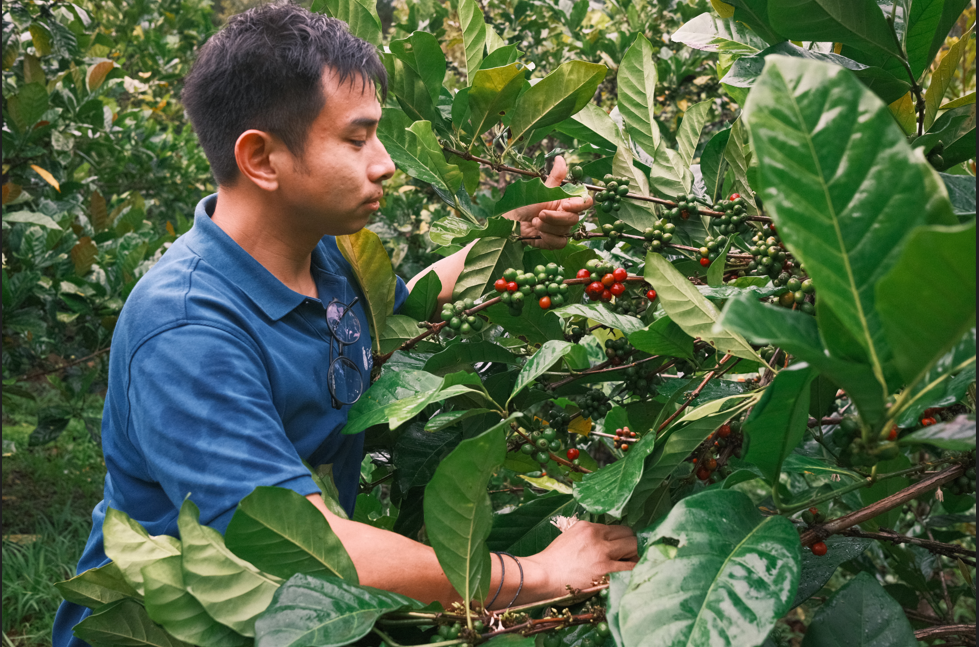
Study author Kenny Wee Ting Lee with “libex” coffee in the Upper Baram Valley, Sarawak, Malaysia. Photo by Rave Sun Kwok, courtesy of Royal Botanic Gardens, Kew.
Researchers from the Royal Botanic Gardens, Kew, have proposed the formal name Coffea × libex for hybrids of the liberica and excelsa coffee species, arguing that the cross could provide a commercially viable pathway for coffee production as climate change intensifies.
Published in Scientific Reports as an early-access article on May 14, the study notes that coffee growers in Sarawak, Malaysia, and parts of Southeast Asia, India and Central America have been cultivating the hybrid for years without identifying it as such.
Aaron P. Davis, a Royal Botanic Gardens, Kew scientist and corresponding author of the new paper, also led a 2025 Nature Plants study that helped define liberica and excelsa as separate species. Excelsa had historically been treated as a variety of liberica, while arabica and robusta together continue to account for more than 99.99% of the world’s coffee.
Combined, the studies suggest liberica, excelsa or their newly named hybrid, libex, may offer targeted alternatives to the world’s two dominant commercial coffee species, arabica and robusta, as climate change reshapes global coffee production.
The New Research
The new study involved genomic analysis of 7,618 single nucleotide polymorphisms — tiny variations in DNA that act as genetic fingerprints — across 113 plant samples collected from farms and germplasm collections on three continents.
The team confirmed extensive hybridization between liberica and excelsa in cultivated plants, despite wide separation between the species’ wild populations, suggesting that the libex hybrid emerged through cultivation, seed movement or both.
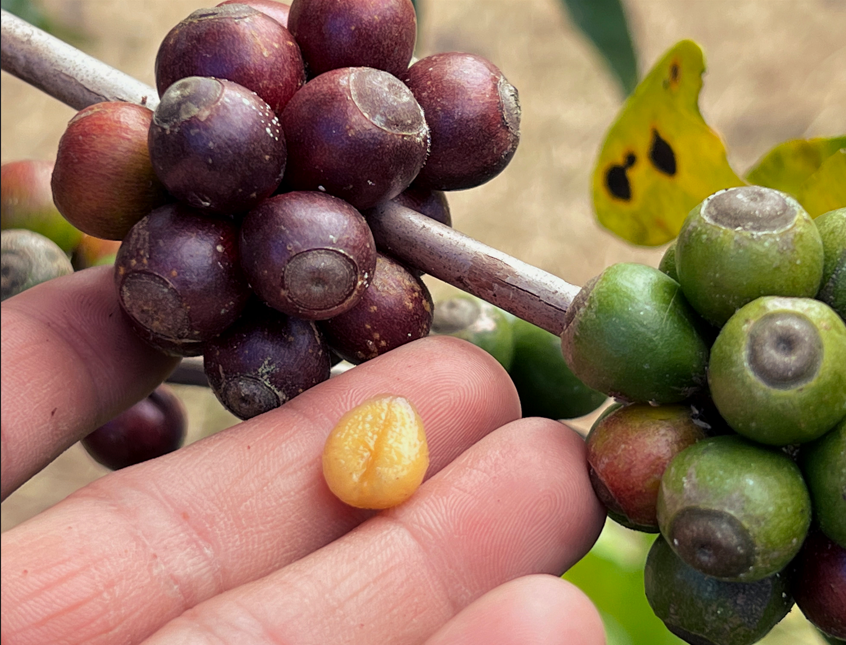
Libex coffee with dark red fruits and teardrop-shaped seed. Photo by Kenny Wee Ting Lee, courtesy of Royal Botanic Gardens, Kew.
The prevalence of admixture — the technical term for the proportion of each parent’s genetic material in a hybrid — was especially prominent on farms studied in Sarawak, Malaysia.
Of the 45 Sarawak accessions labeled as liberica, 40 showed measurable excelsa admixture, and 28 exceeded 12% admixture. Only five were genetically “pure” liberica. Admixed plants were also found in India, Indonesia, Costa Rica and Uganda, suggesting multiple independent hybridization events or the spread of hybridized seeds and plants across regions.
Understanding Libex
Size and Processing Requirements
Field observations in Sarawak showed that plants with high levels of excelsa admixture had more flowers and fruits per branch, thinner fruit pulp and smaller seeds than typical liberica. According to the research team, such properties could be manipulated through hybridization to improve variables such as yield, post-harvest processing requirements and “outturn,” the conversion ratio of picked cherry to green coffee.
As a practical example, a libex hybrid that inherits excelsa’s naturally thinner parchment or pulp might improve outturn and reduce post-harvest processing time, potentially improving farmer profitability.
Climate Resilience
As for climate resilience, liberica is regarded as more tolerant of certain hot, wet and low-elevation growing conditions where arabica or robusta may struggle. Excelsa is more productive and easier to process but appears less tolerant of extreme conditions.
According to the researchers, a hybrid with traits from both could potentially be grown in environments where neither parent alone would succeed.
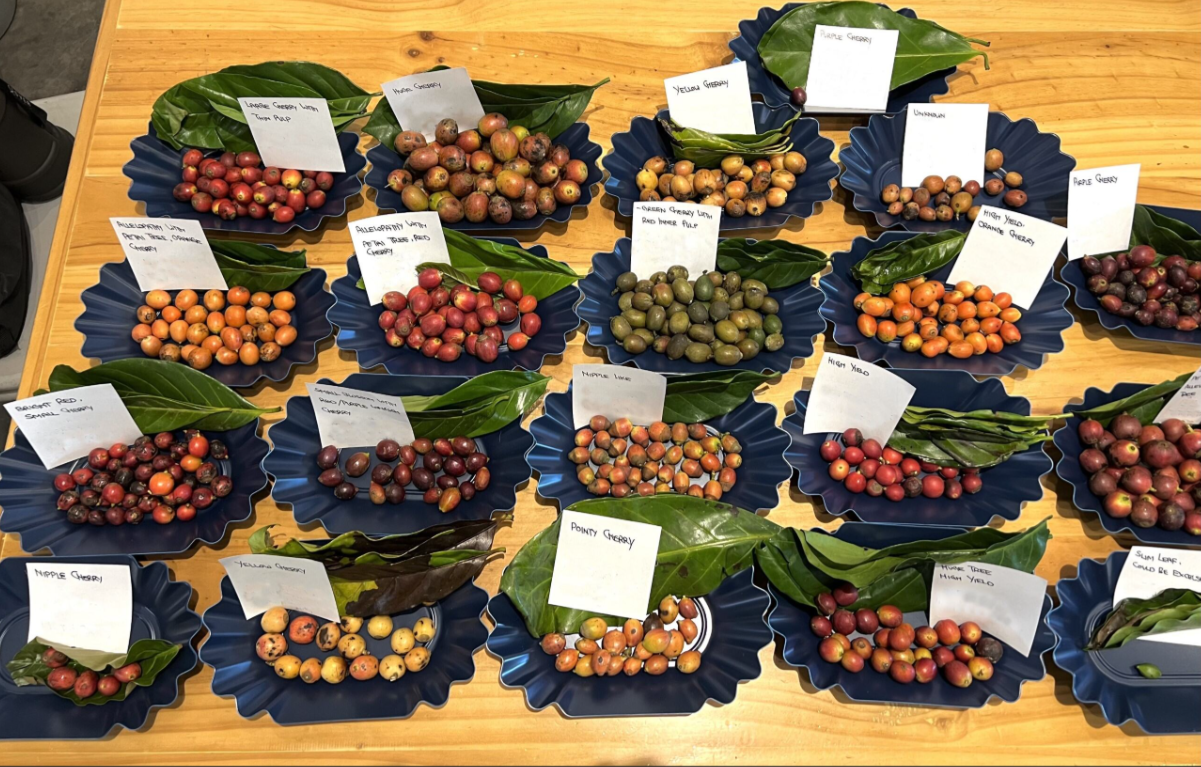
Variation in libex coffee hybrids. Photo by Kenny Wee Ting Lee, courtesy of Royal Botanic Gardens, Kew.
Disease Resistance
On disease, the paper is cautiously optimistic. Liberica carries the SH3 gene, believed to provide resistance to most strains of coffee leaf rust. Field observations in Sarawak showed zero to negligible rust incidence on both pure liberica and libex plants, despite growing conditions that would favor rust development.
Whether that resistance would consistently transfer through hybridization remains a question — one identified by the authors for future work.
Flavor and Cup Qualities
In a media summary of the paper, the authors noted that liberica has an unfamiliar flavor that can be “challenging” to many coffee drinkers. The paper notes that it is often identified by bold tropical fruit flavors with low acidity and high sweetness. Meanwhile, excelsa coffee is “dominated by notes of dark, dried fruits (currant, prune, plum, fig), chocolate (cacao nibs, dark and milk chocolate), and spices” with low to medium acidity and low bitterness.
The researchers said libex coffees from Sarawak appeared to combine flavor qualities from both parent species while muting their extremes. However, the researchers noted that “rigorous sensory evaluation across multiple environments and processing methods will be required to substantiate these initial impressions.”
Comments? Questions? News to share? Contact DCN’s editors here. For all the latest coffee industry news, subscribe to the DCN newsletter.
Nick Brown
Nick Brown is the editor of Daily Coffee News by Roast Magazine.