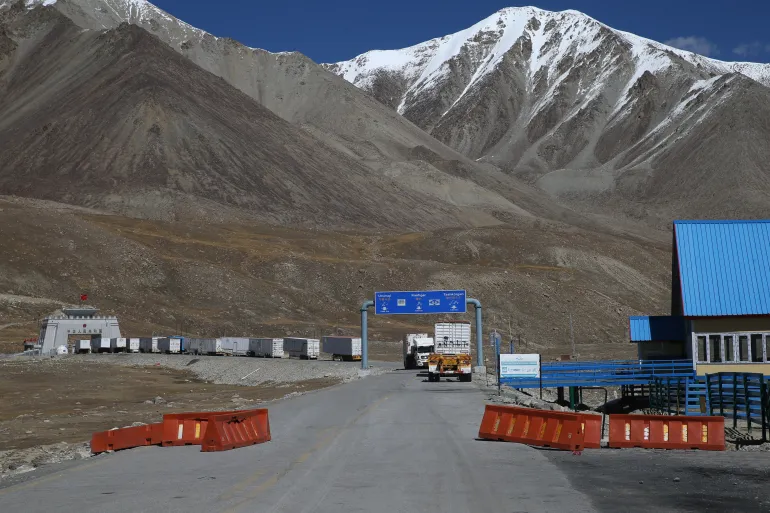
Islamabad, Pakistan – Nations and empires have fought each other over territory for centuries. In March 1963, Pakistan did something rare: It offered land five times the size of Hong Kong to another country, China.
Under a boundary agreement with Beijing, Pakistan transferred control of the Shaksgam Valley, roughly 5,180 square kilometres (2,000 square miles) in the Karakoram range, territory India considers part of disputed Kashmir.
Recommended Stories
list of 4 itemsend of list
There was a strategic logic to that deal. Pakistan did not possess uncontested sovereignty over the area, and the dispute remains unresolved today. But China had defeated India in their 1962 border war just three months earlier. Pakistan’s leadership concluded that Chinese control over the contested mountains made more sense than trying to fend off Indian claims itself.
On May 21, as Pakistan and China celebrate 75 years of their diplomatic relationship, that episode more than six decades ago stands as an early pointer to the rare trust – glued together in good part by shared enmity with India – that has bound two unlikely partners: An avowedly communist and atheist nation, and a country born on the basis of religion.
Earlier this week, Pakistani parliamentarians gathered as Deputy Prime Minister and Foreign Minister Ishaq Dar addressed a Chinese parliamentary delegation seated in the Senate’s visitors’ gallery. Dar spoke of a “converging vision”, of symbols of friendship “spread across Pakistan’s geography”, and of a relationship that had grown “from strength to strength”. The Senate subsequently adopted a unanimous resolution titled “Re-affirming China-Pakistan Friendship and Brotherhood” to mark 75 years of diplomatic ties between the two countries.
And on May 23, Pakistani Prime Minister Shehbaz Sharif will fly to Beijing for a four-day state visit, accompanied by senior government and military officials.
In joint statements, communiques and public addresses marking the anniversary, both governments are expected to reach for the same vocabulary they have used for decades. Iron brothers. All-weather friendship. Higher than mountains, deeper than oceans.
What the celebrations will not capture, however, is the full story of the relationship between the neighbours.
That story includes the transfer of contested territory to China; a nuclear bargain neither side has officially acknowledged; and a diplomatic opening Pakistan helped broker in 1971, for which it received little formal credit.
Today, the relationship appears both more transactional and durable than the official narrative suggests, say analysts.
“What has actually held it together is structural complementarity, not affinity,” Maria Adele Carrai, an associate professor at the University of Oxford, told Al Jazeera. “The 75-year story is more the story of two states finding each other useful, again and again, under changing conditions.”
Born of a shared enemy
In February 1942, Muhammad Ali Jinnah, Pakistan’s founding father, met Chiang Kai-shek, the nationalist leader of wartime China, in Delhi. Chiang reportedly got on well with Jawaharlal Nehru, who would go on to become independent India’s first prime minister.

He was considerably less impressed by the All-India Muslim League leader, recording in his diary that Jinnah was “dishonest” and that “the British make use of people like this.”
As historian Rana Mitter documents in Forgotten Ally: China’s World War II, 1937-1945, his account of China’s role in the Second World War, Chiang had little patience for separatist politics.
Nine years later, however, the country Jinnah founded formally recognised the communist state that had displaced Chiang’s republic on the mainland.
Pakistan became the first Muslim-majority country, and among the first non-communist states, to recognise Beijing in January 1950, less than six months after the founding of the People’s Republic of China.
The move is often portrayed as bold and progressive. In reality, it was rooted in strategic necessity.
Pakistan needed a counterweight to India before it had fully consolidated itself as a state following independence from British rule in August 1947. Geography and threat perceptions mattered more than ideology.
Islamabad formally joined the Southeast Asia Treaty Organization (SEATO) in 1954 and the Central Treaty Organization (CENTO) in 1955, United States-led alliances designed to contain communist expansion in Asia and the Middle East, even as its diplomats quietly cultivated ties with Beijing.
Feroz Hassan Khan, a former brigadier in the Pakistani army and now a scholar at the Naval Postgraduate School in California, traces the logic of the relationship to those early years.
“The relationship with China was always the long game,” Khan said. “Pakistan understood it could not afford strategic animosity with its neighbours. The West was distant, powerful and pragmatic, but not a neighbour.”
The figure who helped crystallise this thinking in Beijing was Zhou Enlai, China’s first premier.
Pakistan was among the few Western-aligned states represented at the Bandung Conference in Indonesia in April 1955. Chinese leaders concluded that Pakistan was not an adversary. Pakistan’s principal concern, they concluded, was India, with whom it had already fought a war in 1948, while Beijing itself was growing increasingly distrustful of New Delhi.
“Without India as a shared threat, the Pakistan-China relationship would look very different,” Muhammad Faisal, a security analyst, told Al Jazeera. “That structural logic has persisted decade after decade.”
The hidden foundations
Arguably, two episodes form the true foundation of the Pakistan-China relationship. Yet neither is likely to feature prominently in the anniversary celebrations.
The first was the transfer of the Shaksgam Valley.

Zulfikar Ali Bhutto, then Pakistan’s foreign minister, led the negotiations that led to the land deal. The agreement made him a favourite of Zhou Enlai’s.
“It was a brilliant piece of statecraft,” Khan, the former brigadier, said. Pakistan was a SEATO member using a Himalayan border dispute to deepen ties with the communist state it was formally aligned against.
The second episode is one both governments still avoid discussing directly: The nuclear dimension.
China tested its first nuclear device in October 1964 at Lop Nur, becoming the first developing country to do so.
A decade later, after India’s 1974 nuclear test at Pokhran, Bhutto, by then the prime minister, responded unequivocally: Pakistan would acquire the capability, whatever the cost.
Just three years earlier, in December 1971, Pakistan had suffered a crushing defeat to India, leading to the creation of Bangladesh and the surrender of roughly 93,000 soldiers, the largest military capitulation since the Second World War. That served as the “real impetus” for Pakistan’s nuclear push, Faisal told Al Jazeera.
“Within weeks, Bhutto rallied the scientific establishment to begin the weapons programme,” he said. “The 1974 Indian test only intensified the urgency.”
Two years later, in 1976, the Chinese and Pakistani governments formalised what had until then been an informal understanding, signing a bilateral nuclear cooperation agreement that became the framework for Chinese assistance over the following decade.
United States intelligence assessments and most independent analysts point to Chinese help during that critical phase, including weapons-design information and enough enriched uranium for at least two devices, likely during the 1980s.
Officially, both governments deny it. To acknowledge it publicly would be to accept China’s role in nuclear proliferation.
But “wherever Pakistan got stuck, China would bridge the gap, in spare parts, knowledge and cooperation,” Khan said.
The exchange ran both ways. Pakistan’s centrifuge programme acquired technology through European networks, and Chinese scientists also learned from Pakistani advances.
“It was a two-way exchange,” Khan added.
When Pakistan conducted its nuclear tests in Chagai, Balochistan, in May 1998, responding to India’s own tests two weeks earlier, China blocked a United Nations Security Council statement regretting the tests.
Pakistan’s representative to the UN later said his country was grateful to China for “recognising the distinction” between India’s provocation and Pakistan’s response.
The secret channel
By the mid-1970s, though, Pakistan had also shown China its value as a strategic partner.
In July 1971, US National Security Advisor Henry Kissinger boarded a Pakistan International Airlines flight in Islamabad and disappeared. The cover story was illness. The real destination was Beijing.
The secret opening that followed, culminating in President Richard Nixon’s visit to China in February 1972, became one of the most consequential diplomatic realignments of the 20th century.

“States that enable great-power rapprochements rarely capture rewards proportional to what they enabled,” Carrai told Al Jazeera. “The moment the channel they broker becomes operational, their indispensability evaporates.”
The Nixon administration’s silence over Pakistani army atrocities in East Pakistan during 1971 was widely seen at the time as necessary to protect the Beijing channel.
Washington stayed largely quiet while hundreds of thousands died. Yet Pakistan received little formal reward for facilitating one of the Cold War’s defining diplomatic openings.
Washington was, as Carrai put it, “willing to spend Pakistan’s reputation for an outcome Pakistan itself was not centrally involved in shaping”.
Sardar Masood Khan, Pakistan’s former ambassador to China, rejects a purely transactional reading of the relationship.
“Pakistan was not a transactional broker,” he said. “For years, Beijing continued acknowledging Pakistan’s role, while praise from Washington faded with successive administrations.”
The China-Pakistan Economic Corridor (CPEC) – a 3,000km (1900-mile) long infrastructure network project that connects China to Pakistan’s Gwadar port – and the depth of current defence cooperation between the nations, he argued, may represent “a culmination of the strategic confidence built during the 1970s”. The retired diplomat insisted that the “goodwill” towards Pakistan in China was “not entirely unredeemed”.
For Carrai, however, the lesson remains uncomfortable: Enabling a great-power deal may generate rhetorical gratitude, but rarely structural advantage.
The game changer that was not
China and Pakistan had built a corridor before.
Construction of the Karakoram Highway began in the early 1960s, carving 1,300km (810 miles) of road through one of the world’s most hostile mountain terrains. The project took nearly two decades to complete.
About 810 Pakistani workers and 200 Chinese engineers died during the construction, most of them in landslides and falls. More than 140 Chinese workers are buried in a memorial cemetery in Gilgit.
The highway linked Kashgar in China’s Xinjiang region to the Arabian Sea, giving Beijing its first overland route to the Indian Ocean.
Khan, the former brigadier, calls it “the original CPEC”, a precursor to the infrastructure programme launched in 2015.
“Zhou Enlai understood that China’s western provinces were landlocked and needed sea access,” Khan told Al Jazeera. “China was thinking decades ahead.”
When Xi Jinping arrived in Islamabad in April 2015 and announced what would eventually grow into a $62bn infrastructure and energy investment, Pakistani officials hailed the CPEC as a game changer.
Stella Hong Zhang, an assistant professor at Indiana University who studies Chinese economic engagement in South Asia, argues those expectations were unrealistic from the outset.
“For a country as large and complex as Pakistan, no single externally funded programme could plausibly deliver transformative change within a few years,” she said.
The corridor’s contradictions
CPEC expanded Pakistan’s electricity generation capacity but failed to resolve the circular debt crisis that has plagued the sector since the 1990s. In some respects, it deepened it.

In Gwadar, meanwhile, plans to transform a small fishing town into a major maritime hub collided with local realities.
“The model has been exclusionary rather than inclusive,” Zhang told Al Jazeera. “The local community was left with little ownership, limiting the bottom-up initiatives essential for sustainable development.”
Those structural failures, Pakistani officials say, were compounding well before the security situation deteriorated.
“The inflection point was somewhere late 2016,” Safdar Sohail, founding executive director of the CPEC Centre of Excellence and a former senior official in Pakistan’s cabinet secretariat, told Al Jazeera.
“Industrial cooperation, agriculture, water resource management and IT have been very slow. Water resource management was outright dropped by the Chinese. China misread our hype and feared we had made CPEC as Pakistan’s national development plan,” the former government official said.
Pakistan’s original expectation, Sohail said, was considerably more modest than the headline figures suggested. The Long-Term Plan, proposed by the Chinese side, had envisaged roughly $15bn in development financing over 15 years, a fraction of the $46bn Xi Jinping announced in 2015.
He An, secretary-general of the Beijing-based Horizon Insights Centre and a former diplomat in India, argued that security has become the immediate operational constraint.
“Chinese state-owned enterprises are less averse to financial losses than to human casualties,” he said. “Projects have survived financial setbacks. The deaths of Chinese nationals are different.”
The violence has persisted. In January 2026, the Balochistan Liberation Army launched coordinated attacks across Balochistan, including in Gwadar, killing dozens of civilians and security personnel and underscoring the vulnerability of CPEC’s flagship port.

According to Pakistan’s National Counter Terrorism Authority, at least 20 Chinese nationals have been killed in attacks since 2021.
Zhang, the academic, said some of the most dynamic Chinese economic activity in Pakistan is now taking place outside the formal CPEC framework, particularly in rooftop solar and electric vehicles, driven more by market demand than state coordination.
In the 2024 fiscal year alone, solar imports from China reached 16 gigawatts, bringing cumulative installed capacity to roughly 36 gigawatts by mid-2025, equivalent to nearly three-quarters of Pakistan’s total electricity generation capacity, according to trade data compiled by KTrade Securities.
That utility, however, has come at a financial cost. According to the World Bank, China is Pakistan’s largest bilateral creditor, holding roughly $29bn in loans, about 22 percent of the country’s external debt.
The trade imbalance has widened over the CPEC decade. In 2025, Chinese exports to Pakistan rose to $20.2bn, while Pakistan’s exports to China fell to just $2.8bn. Pakistan has repeatedly relied on Chinese rollovers to manage loan repayments, including extensions worth $2bn in March 2025 and another $3.4bn in June that year.
For every dollar Pakistan earns from selling to China, it spends more than seven dollars buying Chinese goods.
Zhou Rong, director of the Global South Studies Center at the Beijing-based Grandview Institution, offered a blunt summary of China’s current thinking.
“Looking at this relationship from Beijing’s perspective, it has delivered immense strategic value,” Zhou told Al Jazeera. “A security success but deeply flawed as an economic one.
“The relationship has entered a sober phase of ‘security-first, economic consolidation’. Beijing will never let Pakistan collapse because its geopolitical utility against India remains too important.”
The military dimension
Indeed, Pakistan’s dependency on China runs deeper than finance.
According to the Stockholm International Peace Research Institute, China now supplies 80 percent of Pakistan’s arms imports, up from 73 percent in the previous five-year period and substantially higher than a decade ago.

Pakistan’s arms imports rose 66 percent between 2021 and 2025. Its military is now deeply integrated into the Chinese defence ecosystem across all three services, from the jointly produced JF-17 Thunder to frigates and HQ-9 air defence systems.
In May 2025, that integration was tested in live combat for the first time, as Pakistani and Indian forces engaged in their most serious conventional military confrontation in decades.
“The May 2025 confrontation reassured Pakistan about the credibility of Chinese hardware, and co-production is now accelerating,” Faisal told Al Jazeera. “For China, the conflict became a live demonstration of its systems against advanced Western and Russian platforms.”
Zhou, the analyst, said Chinese experts were particularly encouraged by the performance of the Chengdu J-10 and the PL-15, alongside Chinese-made early warning aircraft, drones and electronic warfare systems operating in coordination.
“Beijing officially broke from its usual strategic ambiguity to celebrate the combat success,” he said.
But the ceasefire between India and Pakistan was brokered by Washington, not Beijing.
“Chinese kit, American convening,” Carrai told Al Jazeera. “That combination captures the division of labour produced over decades.”
Analysts say China cannot function as a neutral mediator in South Asia while it remains locked in disputes with India and maintains its own strategic rivalry with New Delhi.
“When crises shift from military confrontation to escalation control,” Carrai said, “Washington still has unique standing to make calls that are answered in both Delhi and Islamabad.”
What comes after 75 years
On May 14, 2026, Pakistan issued its first Panda Bond in China’s onshore capital market, a three-year, yuan-denominated instrument worth $250m, backed by guarantees from the Asian Infrastructure Investment Bank and the Asian Development Bank.

Pakistani officials described it as a symbolic milestone: A relationship that began with the establishment of formal diplomatic ties in 1951 had now entered China’s domestic financial architecture.
The bond came as Pakistan and China remained in near-constant contact over the US-Iran conflict.
Masood Khan, who also served as Pakistan’s ambassador to the US and the UN, argued that the current moment carries greater significance than the 1971 backchannel that helped open US-China relations.
“Pakistan earned this role after first building regional consensus,” he told Al Jazeera, citing support from China, Russia, the European Council, Canada, Australia, Japan and South Korea.
Pakistan, he said, was positioning itself not as a power broker but as “a responsible regional and global stakeholder for peace and security”.
Yet the constraints remain real. Chinese nationals continue to be targeted in Pakistan. The CPEC has generated infrastructure and debt in almost equal measure. And over the past year, Beijing’s ties with New Delhi have warmed, with India and China both facing an unpredictable Donald Trump in the White House. This has introduced variables Islamabad cannot fully control.
Carrai resists a simple verdict.
The durability of the relationship, she argued, reflects two realities: The original rationale has proved robust enough to outlast governments, doctrines and crises, while the costs of failure now outweigh the returns of rupture.
“The first is more a success story than the second,” Carrai told Al Jazeera. “Most long-term bilateral relationships contain both. Pakistan-China is no exception.”