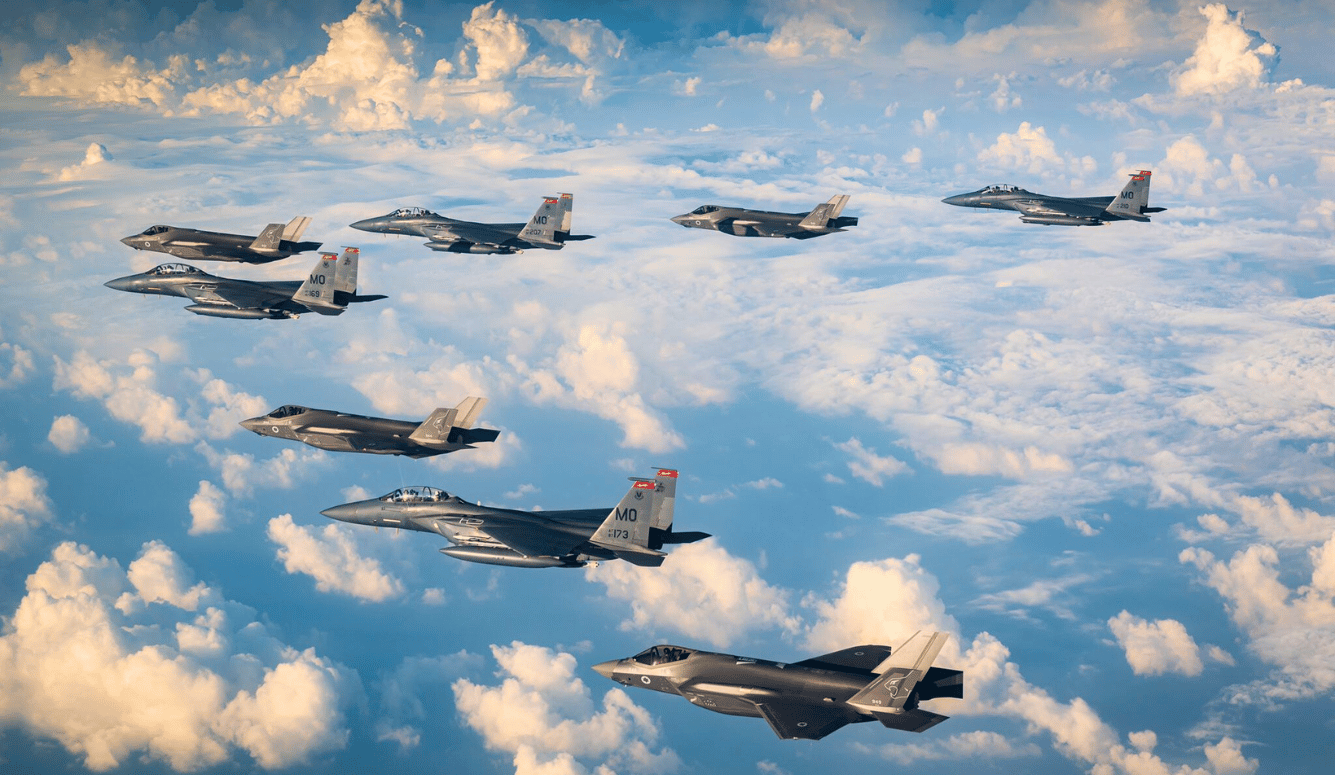
A review of The American Edge: The Military Tech Nexus and the Sources of Great Power Dominance by Seth G. Jones; 424 pages; OUP USA (February 2026)
Even before war broke out in Iran, the US military was strained. In early March, the Government Accountability Office reported that readiness had diminished over the past two decades. In the recent past, support for Ukraine, the defence of Israel, and air strikes against the Houthis have all depleted critical munitions. The present high-intensity conflict in Iran is only aggravating this already dangerous situation. There is little doubt that the United States, which faces its most consequential military challenge in the Pacific, will need to husband resources more carefully if it is to deter China in the coming years.
Full dress rehearsals for the siege and subjugation of Taiwan have raised the possibility that America may be unprepared for a clash with the world’s strongest authoritarian state. To make matters worse, should a direct confrontation with Beijing be necessary, time may not be on America’s side. In a protracted battle between great powers, as the historian Paul Kennedy put it, “victory has repeatedly gone to the side with the more flourishing industrial base.”
At this precarious historical moment, The American Edge by Seth G. Jones delivers an ominous warning but also a hopeful message. Jones, a scholar at the Center for Strategic and International Studies, wastes no time in laying out the strategic stakes. “The tragedy today,” he writes, “is that the United States is in a wartime environment, but its defence industrial base is operating on a peacetime footing.” To drive home the point, Jones channels the British naval historian Andrew Gordon who believed that policymakers in peacetime needed to act more like rat-catchers (those who effectively cut regulatory corners to win wars) and less like regulators (who tend to be stymied by excessive bureaucracy).
Consider: One of the most important weapons in the American arsenal is the Tomahawk missile. Last June, the military fired thirty of them to destroy parts of Iran’s nuclear facilities, and a further 850 have been fired during the first four weeks of the latest engagement in the Persian Gulf. In a protracted war in the Pacific, the United States would run out of Tomahawks in a matter of weeks. A recent history of inadequate and unstable procurement has caused stockpiles of high-tech precision-guided munitions to dwindle precipitously. According to a recent report in the Economist, “at current rates of procurement it will take seven years to bring America’s ammunition stocks back to where they were before military aid to Ukraine began.”
If Jones is right about the sources of great-power dominance, then the US urgently needs to enlist the dynamism and innovation of capitalism to meet the challenges now confronting the public sector. Only by harnessing the singular productivity of private enterprise, he argues, will the United States and its allies be able to repair their inadequate defences and prevail in the contest for global supremacy. The preservation of what remains of the liberal order depends on the ability of the political and business elite to produce a replenished arsenal of autonomous systems and smart weapons to deter and—if necessary—defeat adversaries.
Jones reminds us that a union of business and government originally laid the basis for US global primacy during World War II. As France was falling to the Nazi blitzkrieg, President Roosevelt appointed William Knudsen to transform the US military into a veritable fighting force. Knudsen, a Danish immigrant who had risen from the factory floor to be president of General Motors, joined forces with a select team of colleagues from other industries. Together, they fashioned the “arsenal of democracy” (a term Knudsen originally coined) that Roosevelt would later make famous in his fireside chat on 29 December 1940. The result was the greatest mobilisation of war materiel in history.
The Department of Defence is often burdened with historical amnesia, and this has allowed its industrial might to atrophy. Jones recounts that in the euphoria following V-J Day, the US rashly demobilised its armed forces before it was forced to rapidly reassert its global military posture at the outset of the Cold War. By the 1950s, America had reclaimed a dominant position over the Soviets, due in no small measure to the work of pioneering military technologists like Kelly Johnson, the Lockheed engineer who designed the F-104 Starfighter and U-2 planes.
From Terror Tunnels to Suicide Drones
Military innovations in the current Middle East conflict are changing the nature of warfare and are likely to be widely copied around the world in the future.
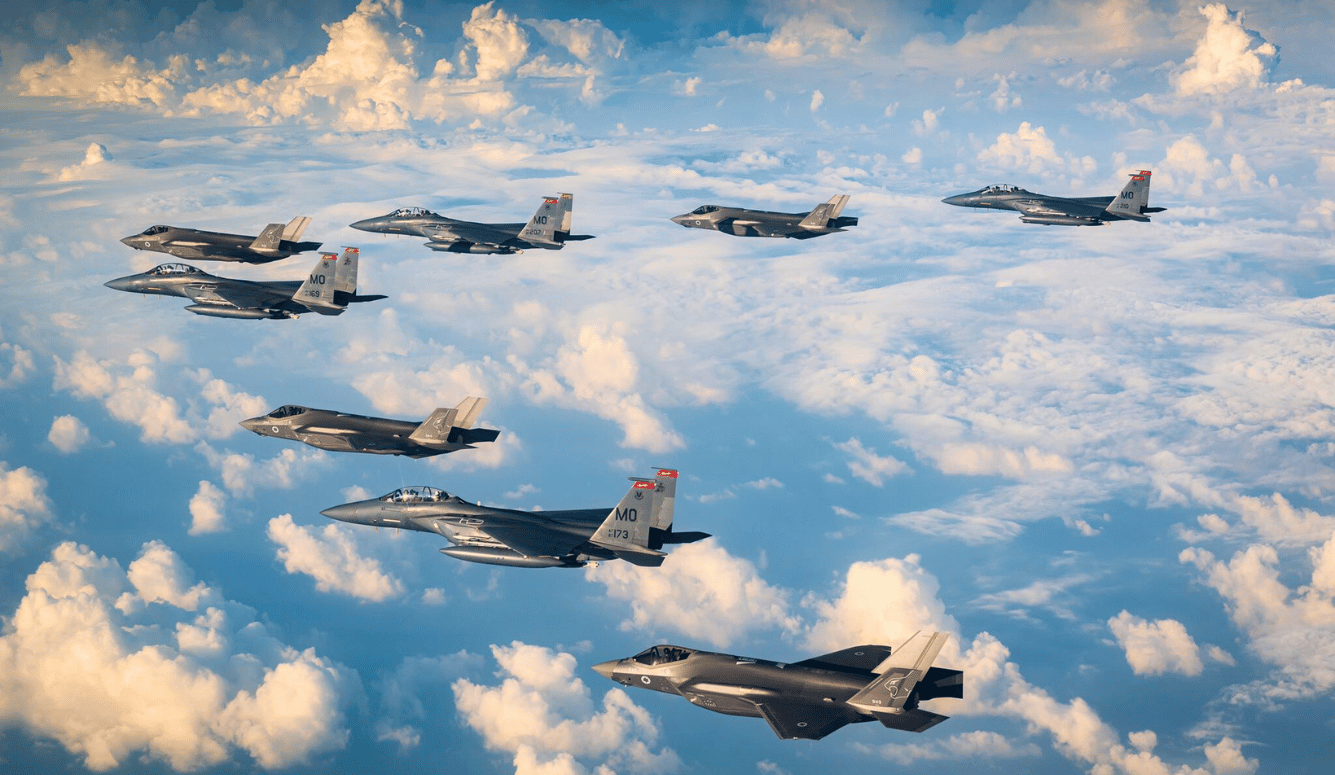
Any defence establishment worth its salt will innovate new technologies to seize and retain the strategic initiative. The costly and protracted intervention in Vietnam brought about years of underinvestment in defence that, in Jones’s telling, “significantly weakened U.S. deterrence and jeopardized U.S. national security in the midst of Soviet expansion.” The military-industrial establishment was so consumed by producing armaments for the conflict in Indochina that it neglected the development of new technologies.
Innovation and adaptability are the sine qua non of battlefield advantage. What radar and jet propulsion were to World War Two, robotics and artificial intelligence will be to the next war between great powers. The evolving struggle in Ukraine has demonstrated that swarms of drones capable of destroying entire military units will soon rule the battlefield. But the Defence Department budget devoted just one-fifth of one percent of its 2024 budget to AI. This sum has increased marginally since, but it still lags behind the point required to seize the initiative. Bereft of such a material basis for continued dominance, Americans will be tempted to retrench—what’s so bad about the Monroe Doctrine?—and abandon the global mission of American postwar supremacy.
To Jones’s way of thinking, the secret to excelling at military innovation is a complex two-fold process. First, new technologies come online, and second, they are adapted to the specific needs of the battlefield. This was the potent synthesis attained by President Carter’s defence secretary Harold Brown as the Pentagon adopted a strategy known as the Second Offset.
The First Offset had been the production of nuclear weapons and ballistic missiles to offset the Soviet advantage in armour at the outset of the Cold War. The Second Offset involved leveraging technologies like precision-guided munitions, radar-neutralising stealth materials, and space-guided navigation to sustain a decisive advantage over the Soviet defence-manufacturing sector. A third offset is now needed to undercut the massive investments in hybrid warfare by Russia and China. Previous attempts to bring commercial-based technologies like cyber capabilities, drones, and lasers into the American arsenal were frustrated by the military campaigns in Iraq and Afghanistan, which prioritised the use of weapons already in the Pentagon’s arsenal rather than fashioning new ones.
China’s colossal military-industrial complex is especially fearsome today. The People’s Republic has acquired advanced military technologies at breakneck speed, not least through espionage and theft from America’s own defence industry. As a result, Jones notes, Beijing has become “a major competitor in emerging technologies, and its broader defence industrial base was able to churn out weapons systems at mass and scale. As its military exercises around Taiwan highlighted, China could bring together air, naval, space, and cyber capabilities to project power.”
Jones is commendably frank about this disturbing reality. But when The American Edge reminds us of the daunting power at China’s disposal, the point is not to elicit despair. It is, rather, to dispense with complacency and galvanise change. Yes, China may have 232 times the shipbuilding capacity of the US, but the US is equipped with immense reserves of power, capable allies, and critical minerals initiatives to enhance its industrial security. As Winston Churchill said on 19 May 1940 as the world was plunging into conflict, “Arm yourselves and be ye men of valour.”
Quillette invites thoughtful responses to its essays.
Selected responses are published once per week as part of a curated Letters to the Editor feature. If selected, letters appear under the contributor’s real name and may be edited for clarity and length.
To submit a letter for consideration, please email [email protected].