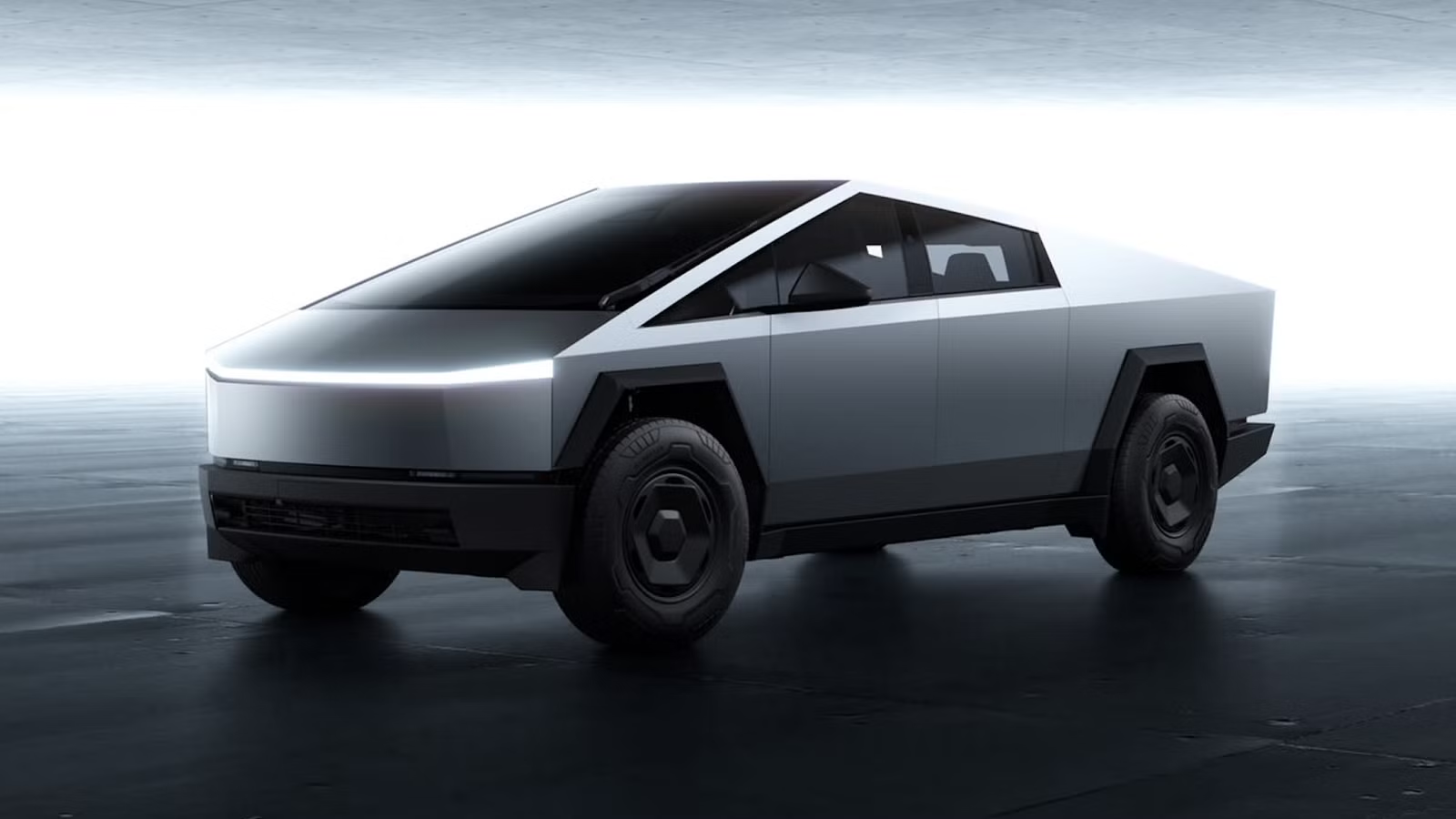
You have to think quite hard to come up with a vehicle that is more polarizing than the Tesla Cybertruck. After all, it’s got a face that only a mother could love, a boring stainless-steel body, and a bit of an on-again, off-again story that, combined, have given critics plenty of ammunition.
There’s no doubt that Tesla and Elon Musk wanted to make a significant statement when they launched the Cybertruck, making it as controversial as possible on purpose. But still, one of the most important and useful Cybertruck ideas is hiding well below that stainless steel body in the form of its innovative 48-volt electrical architecture. The truck uses this architecture as a fundamental part of the vehicle’s very function, and recent developments across the industry seem to prove that in this particular area, the Cybertruck is on the right road after all.
The Cybertruck’s Loudest Feature Was Never Its Cleverest One

|
2026 Tesla Cybertruck Cyberbeast Specifications |
|
|---|---|
|
Motor |
Liquid-cooled AC permanent magnet synchronous and induction motors |
|
Transmission |
Single-speed electric drive reduction gearing |
|
Drivetrain |
All-wheel drive |
|
Power |
est. 845 hp |
|
Torque |
est. 864 lb.-ft |
Tesla launched the Cybertruck at the end of November 2023, with a starting price of $60,900, which was a long way above the roughly $40,000 entry price Tesla first proposed. The public didn’t know what to make of it, and many thought the pickup looked ridiculous, with some wondering whether it was practical from a purely truck-focused perspective and others simply questioning the price.
But while those arguments may matter commercially, savvy engineers were more interested in what lay beneath. And here, they discovered that Tesla had made a very good systems decision when it decided to deploy that 48-volt architecture. Usually, the low-voltage side of a vehicle is ordinary background infrastructure, and in a gas car, it powers familiar accessories. But in a modern EV, it must increasingly support the car or truck’s nervous system as well, and here Tesla made a groundbreaking decision.
Tesla made 48V central to how the Cybertruck’s low-voltage electronics would operate, and that may be the cleverest part of the entire project.
The Simple Reason 48V Matters More Than The Bodywork

In modern, power-hungry cars, the old 12-volt standard can be seriously mismatched to the electrical load, making the case for 48V architecture even stronger. And it all comes down to how you generate electrical power, multiplying voltage by current.
If a component receives the same power with less current, raising the voltage allows for smaller terminals and wiring. For example, if you increase the voltage by a factor of four (as in the difference between 12V and 48V), you can reduce the current by the same factor. Resistive power loss also rises with the square of the current, so losses in the power delivery system may fall by a factor of 16 in a 48V architecture, depending on the optimization of the system.
So, a 48V system doesn’t just become more exciting because 48 is a bigger number than 12. It becomes more exciting because newer vehicles ask the low-voltage network to do a lot more than it was originally designed to do. If more current flows through any system, that typically means more heat, thicker wires, larger switches, higher losses, and more packaging problems. But if you use a higher-voltage approach alongside proper engineering, you can move much more useful power around the vehicle far more efficiently.

Modern vehicles have an enormous number of newfangled systems, such as driver-assistance features, infotainment, larger displays, and comfort features. And these systems are constantly maturing, so they’re likely to push average low-voltage vehicle power demand nearer to 5 or 6 kW by the end of the decade. But if you can raise the low-voltage level, that should help reduce the weight of the wiring harness and cut down on complexity, as well as semiconductor switch costs, making it easier and cheaper to design these modern-day electrical behemoths.
You can also do far more than just save a few pounds of copper by introducing a proper 48V system. You can give the next generation of software-defined, accessory-heavy vehicles ample electrical headroom to operate far more efficiently.
The Cybertruck Shows Why EVs Need A Stronger Low-Voltage Backbone

Tesla’s Cybertruck is certainly not the same as a stripped-down commuter EV, so it’s a good vehicle within which to demonstrate any 48V capability. After all, the beefy Cyberbeast version has all-wheel drive, 11,000 pounds of towing capacity, a 6,863-pound curb weight, and can reach 60 mph in 2.6 seconds, with a 130-mph top speed.
Onboard, there’s an 18.5-inch center touchscreen and a 9.4-inch rear touchscreen. When you look at everything together, you’re dealing with a heavy, high-demand electric truck that has a large amount of powered equipment on board. The Cybertruck’s 48V battery powers the windows, doors, touchscreens, and other low-voltage systems when the high-voltage battery is not available. And that battery also provides redundant power to critical systems, such as power steering.
This Cybertruck Model Flopped, And A Recall Reveals Just How Badly
This particularly unloved version of the Tesla Cybertruck didn’t even reach 1,000 sales before being discontinued.
The 48V System Is An Integral Part Of Cybertruck’s Wider Philosophy

There’s no doubt that any contemporary low-voltage network system will come under even more pressure as technology develops and vehicles become more complex. The Cybertruck already uses electrical control for functions that some older vehicles would treat mechanically or hydraulically. And tomorrow’s vehicles may feature steer-by-wire, brake-by-wire, active chassis systems, higher-output cabin electronics, powered closures, centralized computing, and even more advanced driver assistance systems.
So today, Tesla is already answering some important technical questions about how to feed more power to more systems without letting heat, wiring, weight, and cost get out of control. This shows why Cybertruck’s 48V architecture is likely to age far better than the host vehicle’s polarizing design.
The Rest Of The Industry Was Already Circling The Same Conclusion

Many luxury and performance brands have been using 48V technology in their mild-hybrid applications for some time, while full-size trucks may feature it for efficiency and torque-assist functions. Take Audi’s newer MHEV+ system as an example. It uses a 48V mild-hybrid setup with a powertrain generator, belt alternator starter, while a lithium-ion phosphate battery supports the combustion engine. This approach helps reduce emissions and increase performance and comfort, according to Audi. Then there’s Ram with the e-Torque system on its 2026 1500 HEMI V8. This uses a motor generator working alongside a 48V battery pack for start/stop operation, brake energy regeneration, and torque addition.
2025 Electric Pickup Truck Comparison: Tesla Cybertruck Vs. Ford F-150 Lightning
Now that both electric pickups have been on sale for a while, which one comes out on top?
Many of those earlier systems were there primarily to support combustion engines. They were able to recover braking energy, power electrical compressors, smooth out start/stop operations, or supply short bursts of torque. And while Tesla didn’t invent 48V vehicle systems, the Cybertruck did push the conversation closer to a broader low-voltage architecture that serves the entire vehicle. Its general approach also appears to be catching on.
In February 2026, Ford announced its Universal EV program, centered on its upcoming midsize electric pickup and its first 48-volt low-voltage system. This approach moves Ford away from the old 12V default for low-voltage components and toward a 48V rail.
Ford will retain 12V power for some accessories via a step-down arrangement, indicating a transitional architecture that may become a feature of these innovations. But you could argue that Ford’s move is far closer to the Cybertruck approach than just a conventional mid-hybrid add-on. It represents a cleaner electrical backbone with less current, less copper, less heat, and fewer packaging compromises for Ford’s software-defined vehicles of tomorrow.
The Cybertruck Can Be Both Flawed And Right About This

While the Cybertruck can be polarizing, compromised, and expensive, it’s nevertheless carrying an engineering idea that the rest of the industry needs. But as sensible as its 48V approach seems, nothing is likely to change overnight in the industry, since an entire ecosystem has already been built specifically for the old 12V approach. Any wholesale 48V transition would mean redesigning motors, modules, connectors, diagnostics, safety procedures, and repair practices, and that’s not a drop-in replacement approach for every 12V habit.
But with a longer-term view, 48V architecture certainly makes more sense as the industry moves toward software-defined vehicles. In this case, 48V feels less like a novelty and more like infrastructure that’s simply catching up with the vehicle itself. Certainly, 12V is beyond its original comfort zone in the modern era, and something has to give. And while the Cybertruck itself may never represent the actual future of pickup trucks, it’s making a strong argument that 48V should be the electrical standard across the board.