
Key Points
-
SpaceX’s valuation recently hit $1.5 trillion in private market trading.
-
At the high end of its IPO range, SpaceX could be trading at well over 100x sales.
-
SpaceX is a proven player in the space exploration and low-orbit satellite markets, but the company is marketing artificial intelligence (AI) as its hidden tailwind.
- These 10 stocks could mint the next wave of millionaires ›
With whispers of a valuation approaching $2 trillion, SpaceX stands on the precipice of potentially the largest initial public offering in history. Yet forecasting the company’s stock price at 2030 feels more like an astrology project than astute financial analysis. SpaceX must overcome regulatory hurdles and make significant technological leaps over the next few years to meet investors’ sky-high expectations.
Let’s explore where SpaceX stands today, detail the company’s vast opportunities, and examine some sobering lessons from recent high-profile IPOs.
Will AI create the world’s first trillionaire? Our team just released a report on the one little-known company, called an “Indispensable Monopoly” providing the critical technology Nvidia and Intel both need. Continue »
Image source: Getty Images.
Putting SpaceX’s valuation into perspective
Let’s take a look at SpaceX’s valuation trajectory over the last couple of years:
- In late 2024, SpaceX bought back shares from employees for $185 each. This secondary share deal valued the company at $350 billion.
- About one year later, a tender offer pushed the company’s worth to $800 billion by December 2025.
- Earlier this year, SpaceX merged with xAI in a $1.25 trillion transaction.
- Most recently, shares of SpaceX hit a valuation of $1.5 trillion on Forge Global’s private market trading platform.
The company is reportedly eying an IPO valuation between $1.75 trillion and $2 trillion. For context, the company would be valued higher than Walmart, Samsung, Meta Platforms, and Tesla at the high end of this range.
Given SpaceX’s S-1 filing remains confidential, investors have only estimates of the company’s revenue and profitability. Some analysts estimate that SpaceX generated between $15 and $16 billion in revenue last year, while others put the company’s top line closer to $18 billion. Regardless of the precise sales figure, SpaceX’s IPO valuation implies a price-to-sales (P/S) multiple exceeding 100.
Separating SpaceX’s actual business from its lofty goals
SpaceX currently operates two proven segments with a third, transformative one taking shape. The company’s reusable rockets reduce launch costs by orders of magnitude, helping SpaceX capture lucrative contracts across commercial and government sectors. Meanwhile, Starlink has evolved from a niche connectivity provider into a global broadband network.
The real multiplier for SpaceX is artificial intelligence (AI). The company is increasingly marketing itself as an orbital AI infrastructure provider — leveraging Starlink’s network and Starship’s launch capacity to deploy data centers in space.
The pitch looks compelling on the surface: Orbital compute can sidestep Earth’s power grid and cooling bottlenecks, offering greater scale for training and inference workloads. Reports claim that SpaceX estimates its total addressable market to be around $28 trillion, with the vast majority tied to enterprise AI.
These technology IPOs might be a good proxy for SpaceX’s fate
After a direct listing in 2020, Palantir Technologies (NASDAQ: PLTR) faced loads of skepticism over its lumpy, government-heavy revenue and recurring operating losses. A strategic pivot toward commercial AI applications fueled top-line growth and helped widen profit margins. Since bottoming at around $6 per share in 2022, Palantir stock has gained more than 2,100%.
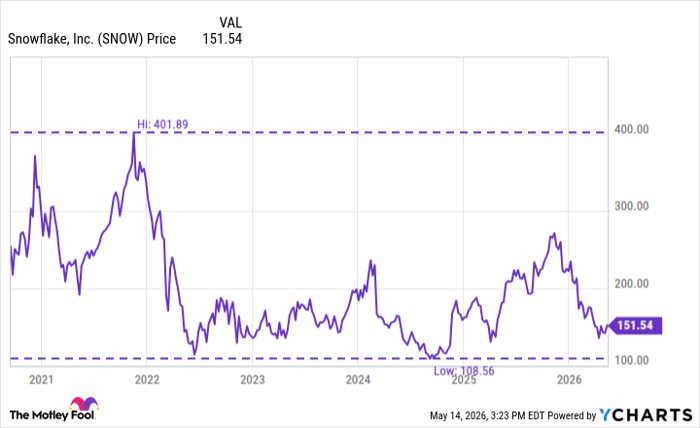
Snowflake (NYSE: SNOW) followed a completely different arc. Its 2020 IPO popped dramatically on the first day of trading. Ultimately, it surrendered these gains due to a high-interest-rate environment and normalized growth rates. Investors who bought near the peak remain in the red years later.
Most recently, Figma (NYSE: FIG) and Cerebras Systems (NASDAQ: CBRS) delivered outsize first-day surges driven by enthusiasm across high-growth software and next-generation chip architectures. Figma’s momentum eventually settled into a more measured trajectory, with shares now hovering well below their level in early trading days. For now, it’s too early to tell if Cerebras stock will maintain its premium as the company works to convert backlog from OpenAI and Amazon Web Services into durable revenue against larger chip rivals.
History shows that high-profile IPOs generally come with immediate hype and valuation premiums that are driven by narrative. These frothy valuations can persist if business fundamentals compound rapidly and execution matches the growth story — as with Palantir.
More often, however, IPO stocks erode in the first year after lockups expire, as actual quarterly performance replaces inspiring rhetoric. SpaceX enters the public markets under immense scrutiny. Its IPO will almost certainly price shares at a premium, reflecting the assumed synergies between AI and the final frontier. But the company’s valuation in 2030 remains anyone’s guess.
Maintaining a trillion-dollar profile will require Starlink to scale to serve tens of millions of users, Starship to achieve routine launches, and orbital AI to evolve from an interesting concept into a revenue-generating business. Execution delays, geopolitical tensions over orbital routes, dependence on Elon Musk, and the possibility that AI compute economics favor ground-based solutions are all genuine risks for SpaceX.
Buying SpaceX at its IPO price requires accepting extreme valuation and volatility risk. A single missed milestone or change in perception could easily trigger a steep correction that lasts several years. Meanwhile, flawless execution from Musk and his team could mint generational wealth. While the stars are within reach, the journey will undoubtedly test even the most patient investors.
Don’t miss this second chance at a potentially lucrative opportunity
Ever feel like you missed the boat in buying the most successful stocks? Then you’ll want to hear this.
On rare occasions, our expert team of analysts issues a “Double Down” stock recommendation for companies that they think are about to pop. If you’re worried you’ve already missed your chance to invest, now is the best time to buy before it’s too late. And the numbers speak for themselves:
- Nvidia: if you invested $1,000 when we doubled down in 2009, you’d have $584,450!*
- Apple: if you invested $1,000 when we doubled down in 2008, you’d have $57,222!*
- Netflix: if you invested $1,000 when we doubled down in 2004, you’d have $469,293!*
Right now, we’re issuing “Double Down” alerts for three incredible companies, available when you join Stock Advisor, and there may not be another chance like this anytime soon.
*Stock Advisor returns as of May 17, 2026.
Adam Spatacco has positions in Amazon, Meta Platforms, Palantir Technologies, and Tesla. The Motley Fool has positions in and recommends Amazon, Figma, Meta Platforms, Palantir Technologies, Snowflake, Tesla, and Walmart. The Motley Fool has a disclosure policy.
The views and opinions expressed herein are the views and opinions of the author and do not necessarily reflect those of Nasdaq, Inc.