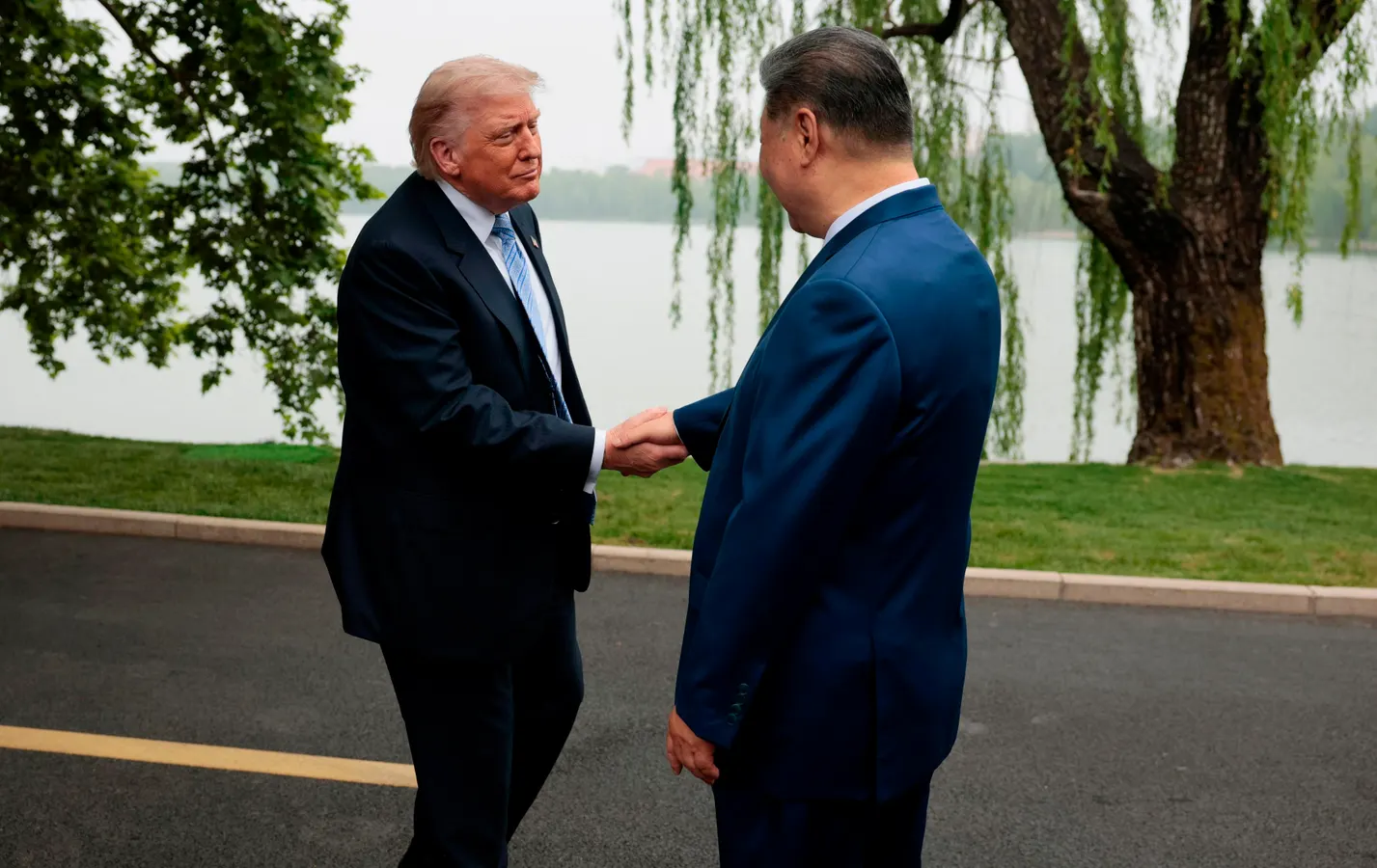

U.S. President Donald Trump, left, shakes hands with Chinese President Xi Jinping at Zhongnanhai Garden in Beijing on May 15, 2026. (Evan Vucci/Pool Photo via AP)
REUTERS
Following their high-profile summit in Beijing this week, U.S. President Donald Trump and Chinese President Xi Jinping will need to work hard to prove a popular Chinese adage about power-sharing among rivals is wrong, one of the top international business scholars working in the country believes.
“There’s a Chinese saying: ‘No mountain is big enough for two tigers,’” said John Quelch, executive vice chancellor at Duke Kunshan University in a written exchange. “Global peace and prosperity depend on the two leaders working hard to prove that adage wrong.”
The rivalry between the two sides was highlighted at the start of the gatherings this week by Xi who, per state media, posed the question: “Can China and the United States overcome the Thucydides Trap and create a new paradigm of major-country relations?” The “trap” refers to conflict between an established, powerful nation and an up-and-comer. State-run Xinhua news organization yesterday described it as one of “the defining questions of the 21st century.”
Comments by business groups after Trump’s visit have widely praised the gathering’s emphasis on stability. “The US-China Business Council applauds President Donald Trump and President Xi Jinping for their meetings in Beijing,” the organization said in a statement yesterday. “The renewed commitment to stability is a welcome step,” said its president, Sean Stein.
Stein, however, also pointed to underlying strains in the economic ties between the two that need to be addressed. Discussions involving trade and investment are “the only way to make progress on longstanding structural issues in China’s economy and begin discussing non-tariff barriers, which undermine American companies’ ability to compete in China’s dynamic and competitive market,” he added.
“It’s critical that we keep championing fair and equitable trade”
“For two economies that are so fundamentally interconnected, it’s critical that we keep championing fair and equitable trade at the highest levels of government,” Stein said. “The inclusion of more than a dozen American CEOs in the visit is a recognition of that reality.” Founded in 1973, the U.S.-China Business Council’s more than 270 American companies that do business in China including FedEx, Medtronic, Qualcomm, Steptoe LLP, UL Solutions, and Visa.
Trump’s flowery descriptions of Xi ahead and during the trip have raised eyebrows globally; his conservative supporters at home have expressed wariness about concessions that he might make to Xi as well as underlying conflict between the economic systems of the two nations and geopolitical differences.
The two leaders will meet again in September at the White House, according to announcements during this week’s summit visit. “Managed competition requires frequent leader-to-leader dialogs which reaffirm and update the guardrails governing the two countries’ strategic rivalry,” said Quelch, the author, co-author or editor of 25 books including All Business Is Local (2012) and an emeritus professor of business administration at Harvard Business School.
“We’re encouraged by news of a reciprocal visit by President Xi in the fall,” Stein also noted.
U.S. President Donald Trump, left, shakes hands with Chinese President Xi Jinping at Zhongnanhai Garden in Beijing on May 15, 2026. (Evan Vucci/Pool Photo via AP)
REUTERS