Warren Buffett stock market warning is sending a ripple through Wall Street just as Tesla, traditional automakers, and EV battery companies are facing mounting pressure from slowing EV demand, aggressive Chinese competition, and investor concerns over profitability. While Buffett did not directly target the automotive sector, his cautious market outlook is fueling new questions about whether Tesla is the most exposed major automaker in a potential downturn and whether EV battery companies could face a painful double squeeze from falling prices and weaker consumer demand.
To be more clear, Warren Buffett’s broader stock market warning is already being interpreted through the lens of autos, EVs, batteries, and especially the growing China-vs-Detroit battle.
The key takeaway from Buffett’s recent comments is this: he believes the market is still overvalued, the current pullback is “nothing,” and he is waiting for a much bigger downturn before deploying Berkshire Hathaway’s massive cash pile.
That matters to the automotive industry for several reasons.
Why Buffett’s Warning Matters to Automakers
The auto industry is one of the most economically sensitive industries in the world. When Buffett signals caution, Wall Street usually starts reassessing cyclical sectors like:
- Automakers
- EV startups
- Battery suppliers
- Semiconductor makers
- Auto lenders
- Charging infrastructure companies
If investors become more defensive, capital-intensive industries like EVs often get hit first.
And that is especially relevant right now because the EV industry is already under pressure from:
- Slowing EV demand growth in some markets
- High interest rates
- Tariff uncertainty
- Aggressive Chinese competition
- Falling used EV prices
- Battery oversupply concerns
Buffett’s warning adds another layer of caution.
The Biggest Automotive Angle: China and BYD
Ironically, one of Buffett’s most important automotive connections is his long history with BYD.
Buffett famously invested in BYD back in 2008 through Berkshire Hathaway, and that investment became legendary as BYD transformed from a battery maker into one of the world’s biggest EV companies.
Now the automotive conversation around Buffett has shifted from “Buffett was smart to buy BYD” to:
“What happens as Chinese EV makers pressure the entire global auto industry?”
BYD’s rise from battery supplier to global EV powerhouse is already reshaping how investors view Tesla and the broader EV market.
That discussion exploded again recently because analysts and industry watchers increasingly believe Chinese EV makers could trigger a brutal pricing and margin war worldwide.
This directly affects:
- Tesla
- Ford
- General Motors
- Volkswagen
- Korean and Japanese automakers trying to stay competitive in EVs
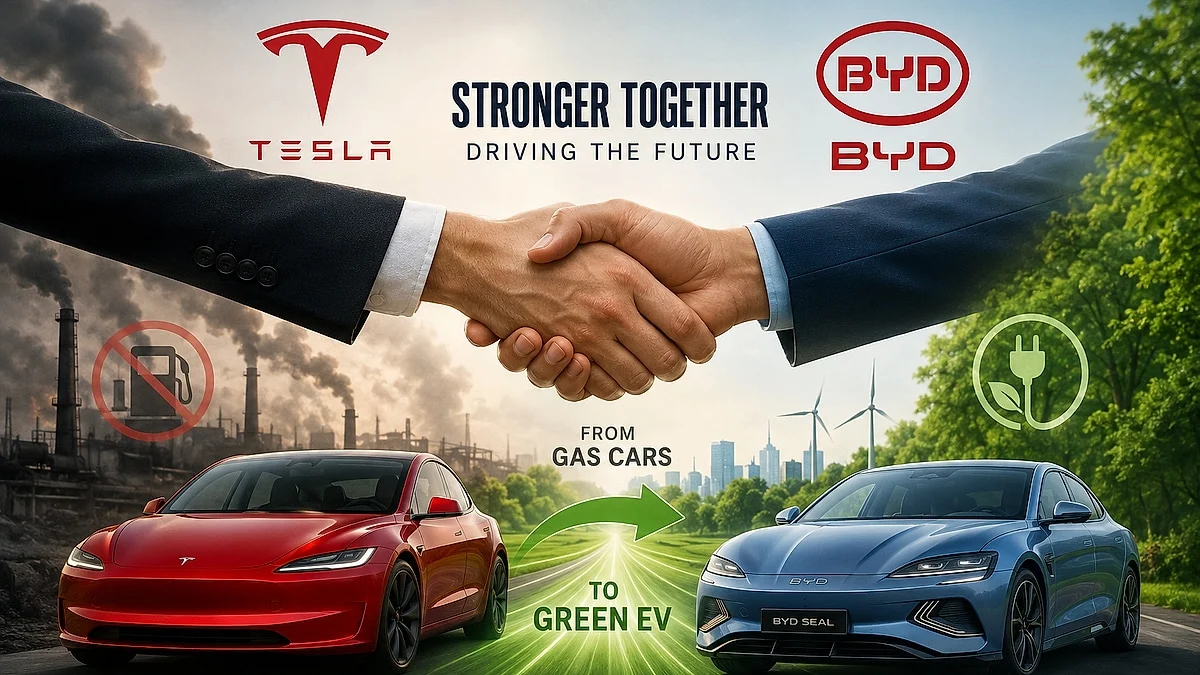
Despite intense competition, Tesla and BYD are also accelerating the broader transition away from gasoline vehicles.

Buffett’s caution about markets indirectly reinforces fears that weaker automakers or EV startups may struggle if the economy softens while Chinese competition intensifies.
Chinese EV makers are no longer just disrupting the market. They are rapidly changing the global automotive power structure.
Tesla Is Probably the Most Exposed
One thing being discussed heavily in financial circles is whether a risk-off environment could disproportionately hurt Tesla.
Why?
Because Tesla is still valued more like a tech company than a traditional automaker. That means if investors become more conservative, high-multiple stocks usually face the sharpest corrections.
At the same time:
- Tesla is dealing with shrinking margins
- More EV competition
- Slower global demand growth
- Political controversies around Elon Musk
- Stronger Chinese rivals like BYD
Even Musk himself warned that Chinese automakers could “demolish” competitors without trade barriers.
That is one reason Buffett’s cautious tone resonates in automotive discussions right now. Investors are asking:
“What happens if the market weakens while EV competition intensifies?”
EV Battery Companies Could Face a Double Squeeze
Battery makers are another major area of concern.
Many battery companies expanded aggressively expecting:
- explosive EV growth,
- sustained government subsidies,
- and premium pricing.
But the market now faces the opposite risks:
- price compression,
- overcapacity,
- and slowing consumer demand in some regions.
A Buffett-style warning about elevated valuations makes investors more skeptical of speculative battery companies that are still burning cash.
Battery technology, reliability, and long-term durability are becoming major investor concerns as EV competition intensifies.
Companies tied heavily to lithium, nickel, and battery raw materials could also see volatility if:
- EV demand cools,
- or automakers reduce production targets.
That does not necessarily mean EVs are failing. Far from it.
But it may mean the industry is transitioning from a “growth at any cost” phase into a “survival and profitability” phase.
That is a huge difference.
Legacy Automakers May Actually Benefit in One Way
Here’s the interesting twist.
If markets become more defensive, some investors may rotate away from speculative EV names and back toward traditional automakers with:
- strong cash flow,
- truck/SUV profits,
- manufacturing scale,
- and dividend stability.
That could temporarily help companies like:
- Toyota
- Ford
- General Motors
especially if they slow EV spending and focus on profitability.
In fact, Wall Street has recently rewarded automakers that demonstrate “capital discipline” instead of aggressive EV expansion.
That mindset aligns surprisingly well with Buffett’s investing philosophy.
Could Certain Car Models Be Affected?
Indirectly, yes.
If automakers become more cautious because of economic fears or tighter financing conditions, you could see:
- delayed EV launches,
- reduced production,
- fewer trim options,
- more incentives on slow-selling EVs,
- and increased focus on profitable hybrids.
That is why hybrids are suddenly becoming incredibly important again.
Vehicles like:
- Toyota RAV4 Hybrid
- Toyota Prius
- Ford Maverick Hybrid
fit perfectly into a cautious economic environment because they:
- lower fuel costs,
- avoid charging anxiety,
- and are usually profitable for automakers.
Meanwhile, expensive premium EVs could become harder sells if consumers become financially defensive.
One Quiet But Important Signal: Buffett Has Been Selling Stocks
Another reason the auto industry is paying attention is because Buffett has been accumulating cash instead of aggressively buying stocks.
When one of the most respected investors in history becomes cautious:
- lenders become cautious,
- suppliers become cautious,
- investors become cautious,
- and automakers often reduce risk.
The automotive industry depends heavily on financing and consumer confidence. If either weakens, vehicle demand can slow quickly.
The Real Automotive Story Behind Buffett’s Warning
The deeper story may not be “Buffett predicts a crash.”
It may be this:
The global automotive industry is entering a brutal new phase where:
- Chinese EV makers are forcing prices down,
- traditional automakers are fighting margin pressure,
- EV startups face survival challenges,
- and investors are no longer rewarding growth without profits.
That environment strongly favors companies with:
- manufacturing scale,
- cash reserves,
- battery control,
- and operational efficiency.
Ironically, that sounds a lot like the kind of businesses Buffett has historically admired.
The EV industry may also be entering a phase where falling battery costs help car buyer, but squeeze supplier profitability.
Do you think Tesla is more vulnerable than traditional automakers if the stock market enters a deeper downturn, or will its technology advantage help it stay ahead of rivals?
If EV battery prices continue falling while competition from Chinese automakers intensifies, which car brands do you think are best positioned to survive the next phase of the EV market?
About The Author
Armen Hareyan is the founder and Editor-in-Chief of Torque News and an automotive journalist with over 15 years of experience writing car reviews and industry news. Now based in the Charlotte region (Indian Land, SC, he founded Torque News in 2010, which since then has been publishing expert news and analysis about the automotive industry. He can be reached at Torque News on X, Linkedin, Facebook, and Youtube. Armen holds three Masters Degrees, including an MBA, and has become one of the known voices in the industry, specializing in the landscape of electric vehicles and real-world stories of actual car owners. Armen focuses on providing readers with transparent, data-backed analysis bridging the gap of complex engineering and car buyer practicality. Armen frequently participates in automotive events throughout the United States, national and local car reveals and personally test-drives new vehicles every week. Armen has also been published as an automotive expert in publications like the Transit Tomorrow, discussing how will autonomous vehicles reshape the supply chain, and emerging technologies in vehicle maintenance.
Follow us today…