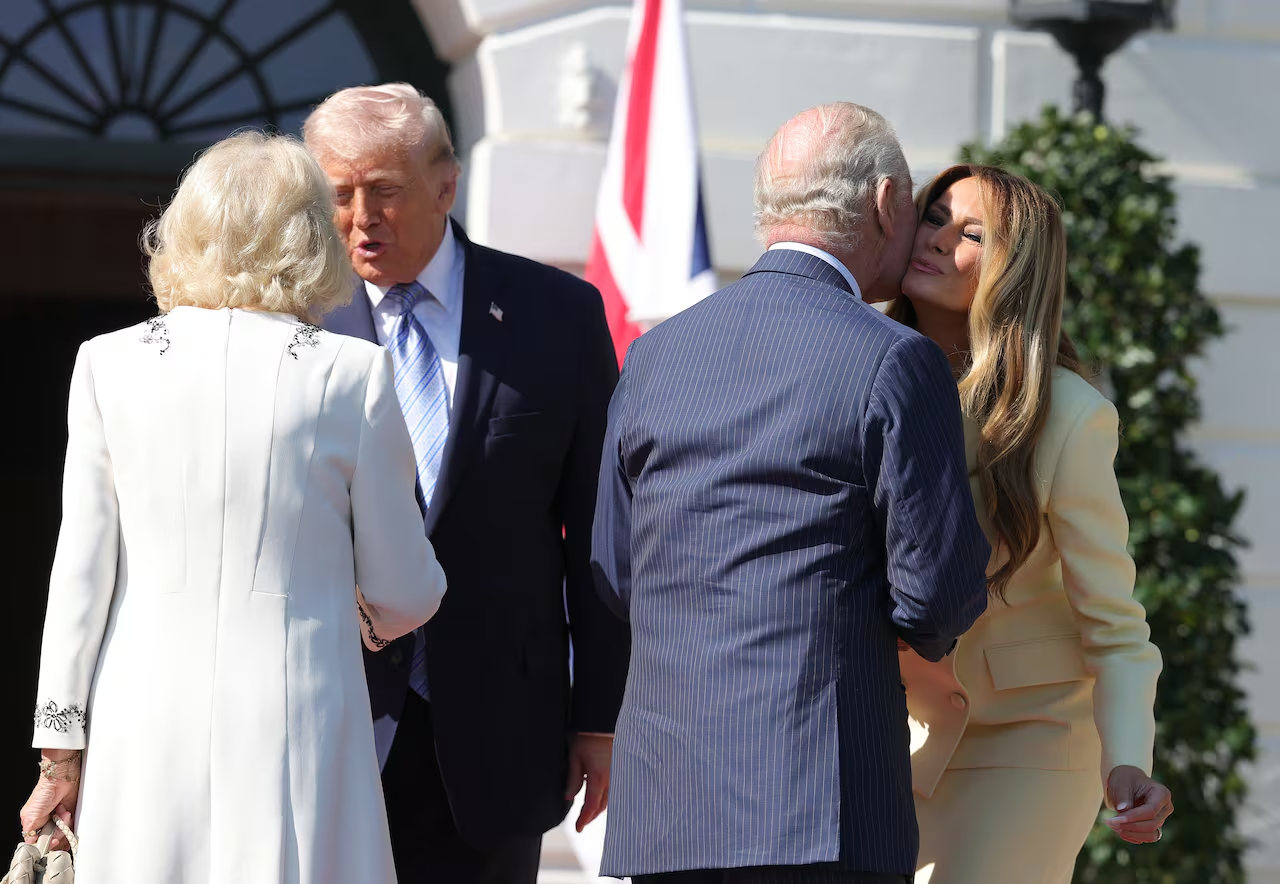
There were wide smiles and hearty handshakes, warm welcomes and much talk of all the strengths that lie in a shared past.
And the two highly anticipated speeches King Charles made during his state visit to the U.S. were warmly received by their audiences in Washington as he settled into a trip that was haunted by the question of what it could do to mend the fraught relations between the United States and the United Kingdom.
As the four-day visit winds down Thursday, new questions loom: What did the visit accomplish — and what is the ultimate litmus test of the impact it will have?
“The question is how long does the good feeling last?” Garret Martin, a professor at American University’s school of international service in Washington, D.C., said in an interview.
“The concern is that can we expect next week some kind of new incident, some new jab on social media that will again direct the bandwidth or the attention towards what’s going wrong in the relationship?”

Jabs and incidents have been a hallmark of the relationship between the U.S. and the U.K. for a while now, particularly from U.S. President Donald Trump, who has made repeated criticisms, denigrations and dismissive outbursts against both Britain and its Prime Minister Keir Starmer, especially over the war in Iran.
“They may seem like small episodes, but I think they really shape the way people think about the relationship,” said Martin.
“The concern is the slow but steady erosion of good feeling amongst the respective publics on both sides. And I think that’s very hard to repair.”
Ahead of the visit, which was billed as an effort to mark the 250th anniversary of American independence, much anticipation centred on just what the King would — and would not — say during his address to Congress.
The 20-minute speech was warmly received on both sides of the aisle and left some observers surprised by how Charles alluded to so many charged areas within the Anglo-American relationship.
“It was far more forward and forthright than we’re used to seeing in the sovereign,” royal historian Justin Vovk said in an interview.

King Charles acknowledged an ‘unbreakable’ U.S.-U.K. bond and called for unity during his speech to Congress Tuesday. Royal commentator Ed Wang says the speech aimed to satisfy the entire American political spectrum.
Charles’s reference to his “immense pride” in serving in the Royal Navy was widely seen as a rebuttal to Trump’s jibes against the service — he once dismissed the U.K.’s warships as “toys.”
And the King’s admiration for the idea that executive power is subject to checks and balances seemed like a veiled reference to the current state of political affairs in the U.S., where Trump often seems intent on acting outside the guardrails of the courts or lawmakers.
“That was particularly pointed, because it’s quite unusual for a head of state to go to another country and talk about their affairs,” Craig Prescott, a constitutional expert and lecturer in law at Royal Holloway, University of London, said in an interview.
“For the British monarch to do that is, I think, really quite remarkable in some ways because you can’t imagine [Queen Elizabeth] going to another head of state and … pointing out some of their problems.”

Pointing them out, however, is one thing. The type of response they might elicit is another thing entirely.
Or, in other words, to what extent will the points Charles made resonate with Trump?
“That’s the big question,” said Prescott.
“We might think of this as all being a game of chess in some ways, whereas Trump really listens to games of checkers.”
Trump, Prescott suggested, “operates in much more black and white terms,” while the points as Charles presented them were much more in shades of grey.
The president, with his well-known admiration for the monarchy, clearly revelled in his role playing host to Charles, praising the King repeatedly.

U.S. President Donald Trump is known to have a soft spot for King Charles, publicly describing the British monarch as a friend and ‘elegant gentleman.’ For The National, CBC’s Eli Glasner breaks down the surprising bromance and how it might have helped Canada dodge more 51st state threats.
Getting a good sense of how or whether that has any impact on Anglo-American relations in the longer term is more difficult.
“We won’t, in my opinion, have the full effect of [the visit] until it’s over, because right now there is still the excitement and the pomp and ceremony of it all,” said Vovk.
“But when the King and Queen leave and we see how the American public, the American media commentators, start to react to the visit, [that] will give us a much clearer indication of its level of success or failure as far as American public opinion is concerned.”
On the British side, there is also the question of just what, exactly, the government was hoping to accomplish with the visit that had — unusually for such affairs — proved controversial and sparked considerable public debate.
“We will have to wait and see how President Trump reacts to the United Kingdom in the days going forward to determine if this really has been the geopolitical success that Keir Starmer may have been hoping for,” said Vovk.
In the immediate term, Trump did say Thursday afternoon, after bidding farewell to Charles and Camilla at the White House, that he would be “removing the Tariffs and Restrictions on Whiskey having to do with Scotland’s ability to work with the Commonwealth of Kentucky on Whiskey and Bourbon.”
In his social media post, Trump added: “The King and Queen got me to do something that nobody else was able to do, without hardly even asking! A wonderful Honor to have them both in the U.S.A.”
Prescott said whisky is a major export for Scotland, and that in the U.K., whenever tariffs are mentioned, specific tariffs on whisky are always an issue.
“If the tariffs are removed, that would be a big win for the U.K.”
The Current10:28Does King Charles have enough soft power to flex?
King Charles III is in the U.S. this week, more by force. On the surface, the state visit is to commemorate the 250 year anniversary of U.S.’ independence, but it’s no secret that he’s been tasked to ease tensions with the U.S. He has to walk a fine line in dealing with the U.S. President Donald Trump, as explained by historian and royal commentator, Carolyn Harris.
Prescott said the visit was never going to trigger an apology from Trump, but could have other impacts.
“It was never going to accomplish … President Trump saying, ‘Oh, I’m so sorry about all those nasty things I’ve said,’ type thing, but what it probably has done is just reset the mood, the underlying approach perhaps, and may, in the private meetings, have allowed the British to explain where they’re coming from, and that the U.K. has had a hearing in Washington.”
Martin sees a range of accomplishments in the visit, including the principle of “first do no harm.”
“It may seem like a low ambition, but that matters in the current context,” he said.
“Sometimes we’ve seen other dignitaries come to Washington and the story has become the public dispute. That has not happened, seemingly, so I think that’s important.”

Martin also sees the visit offering, “at least for this week … a counterpoint to the narrative of exchanging barbs and insults via social media.”
But can relations be mended because of this visit?
“No,” said Martin. “That’s too much of an ask. But again, I think if the goal is also about speaking to the rest of America and … trying to at least remind them of the importance of this relationship, that in itself is important.”
Even with the visit, the Anglo-American relationship is still one that is “walking on eggshells,” Martin said.
“The fact that we … are reduced to a situation where we’re trying as much as possible to avoid further conflict, as opposed to think constructively, or to focus more constructively on future areas of growth — I think it’s telling of where we are.”
And maybe other world leaders could take the same approach that played out this week in Washington, Martin suggested.
He said that if, for example, Prime Minister Mark Carney were to visit Washington, “there might be a little bit of the same dynamic where ‘let’s avoid making things dramatically worse.’ “
Highlighting a bond with Canada
While Charles’s speech at the state dinner on Tuesday had a playful reference to his role as Canada’s head of state, one action he took after bidding farewell to the Trumps at the White House on Thursday was a more serious nod to the country — and a show of support for co-operation between countries.
Prime Minister Mark Carney posted on X that Charles visited the Canadian Cross of Sacrifice at Arlington National Cemetery in Virginia.
“This monument honours the Americans who, moved by a sense of duty to fight for freedom, joined the Canadian Armed Forces in the years before the United States officially entered the First World War,” Carney said.
“It was later rededicated to all Americans who joined Canadian forces in the Second World War and the Korean War.”
Charles’s act of remembrance “is a powerful reminder of the bonds between our countries,” Carney said.
Today, His Majesty the King visited the Canadian Cross of Sacrifice at Arlington National Cemetery in Virginia, USA.
This monument honours the Americans who, moved by a sense of duty to fight for freedom, joined the Canadian Armed Forces in the years before the United States… pic.twitter.com/kGSFANU074
Vovk said Carney’s post seems like a non-partisan effort to show that the prime minister is very much aware that the King is undertaking this visit to the United States.
It also reinforces Charles’s comments, “particularly those made before Congress, about the importance of remembrance and commemoration of those who gave their lives in preserving not just the freedom of a single country, but rather, the freedom of international co-operation against oppression,” Vovk added.
Last May, Charles, as Canada’s head of state, was in Ottawa to read the speech from the throne. Those listening broke into applause as he drew that speech to a close by saying, “As the anthem reminds us: The true north is indeed strong and free.”
That whirlwind trip unfolded in a highly charged political climate for the country after repeated annexation taunts from Trump.
On to New York and Virginia
While the speeches King Charles made to the U.S. Congress and at the state dinner did much of the diplomatic and political heavy lifting of the state visit, other events on the agenda returned the King and Queen to their interests and causes.
Still, amid those events there was a bit of a boost to the diplomacy on display over the four-day visit.
In New York on Wednesday, Charles and Camilla visited Ground Zero, where they commemorated those who lost their lives on 9/11 and met with first responders and families of victims, just ahead of the 25th anniversary of the Sept. 11 attacks.

“Choosing to go to pay tribute to the victims of 9/11, I think there’s the obvious paying respect to a deep, important moment of U.S. history,” Martin said.
“But you could also think there’s a subtext here, which is referenced in the speech [to Congress], which is in the aftermath of 9/11, British soldiers, along with other NATO allies, fought in Afghanistan.”
That’s important, Martin said, “but … is it [an] implicit rebuke to what President Trump said about the sacrifice of U.K. soldiers back in January, which really, really infuriated a lot of the British public?”
That is speculation, Martin said, but “diplomacy is about symbols and diplomacy is also about the message you send back home.”
On Wednesday, Camilla attended an event to promote literacy, a cause she has long supported. Charles, who has a longstanding interest in sustainability and agriculture, visited a local community organization and after-school initiative that focuses on health, education and well-being challenges for children and families that transforms abandoned urban lots into sustainable farms.

On Thursday, Charles and Camilla will be in Virginia, where they’ll attend a block party to mark the anniversary of American independence. Charles will visit a national park, where he will meet members of an Indigenous community — both engagements that reflect longstanding interests.
“The fact that the Queen is going to the New York Library to promote literacy, the King is meeting with Indigenous leaders isn’t just a statement for Americans,” said Vovk.
“It is also a statement for the rest of the Commonwealth that these are the values that your head of state holds dear and cherishes whether he is in a country that has him as sovereign or is in a country that broke away.”
Winnie-the-Pooh diplomacy
While King Charles made a nod to being Canada’s head of state during the state dinner in Washington on Tuesday night, Queen Camilla offered up another Canadian connection during the couple’s visit to the U.S.
The event focusing on literacy that Camilla attended Wednesday in New York celebrated British author A.A. Milne’s stories about Winnie-the-Pooh, which mark their 100th anniversary this year.

The beloved character was based on a real-life bear found in White River, Ont., and ultimately donated to the London Zoo by Canadian Army veterinarian Harry Colebourn during the First World War. Colbourn had named the bear Winnie after his hometown of Winnipeg.
“Winnie-the-Pooh is a character that binds Canada, Britain and the United States together,” Vovk said.
“He transcends politics. He transcends nationalism and his messages are very much in line with the monarchy’s values about kindness … the simplicity of caring for others — simplicity in a positive way.”
During the event Wednesday at the New York Public Library, Camilla had a look at its permanent Treasures collection, which includes teddy bears that belonged to Milne’s son.
She also gave the library a replacement doll for another Winnie-the-Pooh character — Roo — that was made by British manufacturer Merrythought, which produced the original toys more than 100 years ago.

Royally quotable
“You recently commented, Mr. President, that if it were not for the United States, European countries would be speaking German. Dare I say that, if it wasn’t for us, you’d be speaking French! Of course, we both love our French cousins dearly, and we three states are not only bound by our shared values, but by a profound belief that, together, we are more than the sum of our parts.”
— King Charles, during a speech at the state dinner in Washington, D.C., on Tuesday.
Royal reads
Fashion, billionaires and jokes: Here’s a look inside the White House state dinner for the King and Queen. [BBC]
The Princess of Wales attended a Westminster Abbey service to commemorate the war dead of Australia and New Zealand. [Sky News]
The Prince of Wales has spoken of “fond memories” of his former air base as he returned to mark its 85th anniversary. [BBC]
The Prince and Princess of Wales have shared a holiday snapshot of their family, lying together in the grass in the sunshine, to celebrate their 15th wedding anniversary. [ITV]