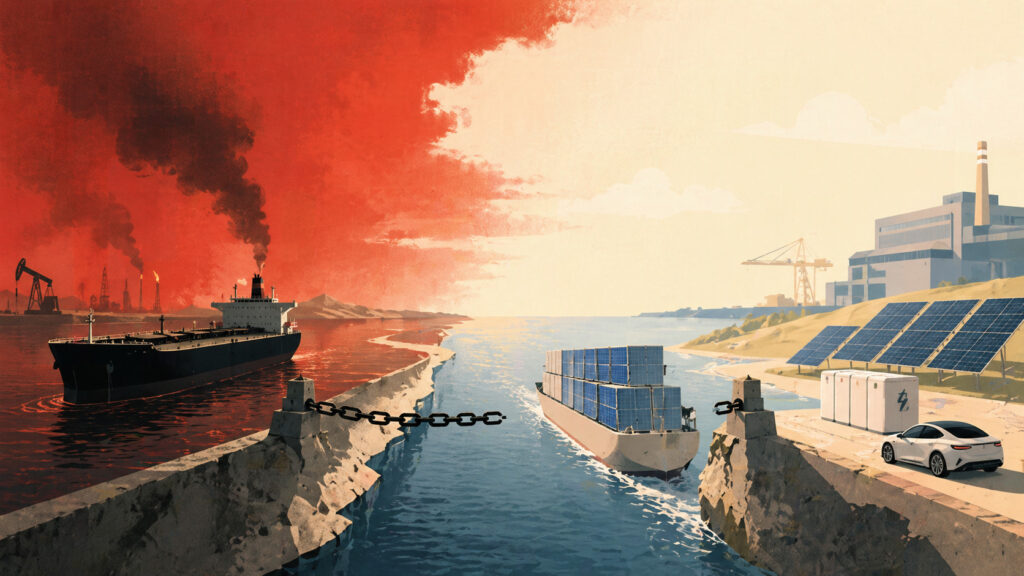

After the war in Iran repeatedly choked ship traffic through the Strait of Hormuz, one of the planet’s most important energy corridors, governments did what governments usually do in a crisis. They searched for more fuel elsewhere, something which has particularly benefited the United States, whose energy exports just hit all-time highs.
But they also did something else. They ordered record amounts of Chinese clean technology, seeking to hedge against other oil shocks in the future.
In March, China exported 68 gigawatts of solar panels, cells and wafers, according to data from Chinese customs officials compiled by Ember. That is roughly the solar capacity of Spain. It was also about double the previous month’s level. Reuters reported that China’s wider clean technology exports — batteries, solar systems, electric vehicles and other components — reached $26 billion in March, the highest monthly total yet recorded.
If there’s anything good to come out of the Iran debacle, it’s that the oil shock appears to have accelerated the renewable energy transition.
A Fossil Fuel Crisis with a Solar Response
The Strait of Hormuz is not just any shipping lane. Roughly a fifth of the world’s oil passes through it. When war began in Iran in February and the country repeatedly halted ship traffic through the strait, the shock travelled fast through energy markets.
Fatih Birol, head of the International Energy Agency, called the disruption “the biggest energy security threat in history.”
This was certainly a wake-up call. Energy security no longer means only drilling more wells, storing more barrels, or signing new gas contracts. It now also means building power systems that do not depend on a single narrow waterway, a foreign supplier, or a tanker route that can close overnight.
That is why the response has looked so different from the oil shocks of the 1970s. Then, industrial nations scrambled for alternatives, but that meant simply finding other sources of crude. Today, there are alternatives that did not exist back then, chief among them being solar energy.
China’s Mega Factories Meet the Moment
China dominates clean technology manufacturing. It produces about 80% of global solar manufacturing capacity, 70% of wind equipment, 80% of battery cells and systems, 70% of electric vehicles, and 58% of hydrogen electrolysers. In newer markets such as heavy electric trucks, its share rises above 90%.
The scale of China’s dominance in clean tech is clear. It has also created a problem for China itself: overcapacity. Chinese firms can make far more solar panels than the world has recently been buying, so prices have fallen. But then came this opportunity.
Solar exports surged to 68 GW. Fifty countries set records for imports of Chinese solar panels, according to Ember data cited by The Conversation. Africa’s imports rose 176% in one month to 10 GW. Asia imported 39 GW. India alone bought 11.3 GW, while Indonesia imported 6.2 GW. Exports to India, Laos and Malaysia more than doubled from the previous month, while exports to Kenya, Ethiopia and Nigeria more than tripled.
Some of the surge has been driven by China’s change to export tax rebates in April, which effectively raised the cost of solar panels by about 9%, encouraging buyers to place orders early. But that cannot explain the whole pattern. The largest gains appeared in countries exposed to high fuel prices and fragile energy supply.
The message was simple. When oil becomes less reliable, solar looks like the more strategic energy asset.
Batteries Join the Surge
Solar panels grabbed much of the attention, but let’s not forget batteries.
Chinese battery exports topped $10 billion in March for the first time. That was well above the monthly average of about $7 billion since the start of 2025. Europe took 43% of those exports, worth $4.3 billion. Asia followed with 29%.
Germany was the largest single buyer of Chinese batteries in March, with $1.26 billion in imports. The United States followed with $823 million. The Netherlands, Vietnam and Australia were also among the biggest markets.
Batteries change the politics of solar. Without storage, solar power is abundant by day and absent by night. With storage, it becomes a tool for stabilising grids, reducing gas-fired peaking power, and making electricity useful when people actually need it.
That matters most in countries where grids are unreliable or fuel imports are expensive. Pakistan offers a preview. In recent years, households and businesses there installed huge amounts of solar because the grid was costly and unreliable. As a result, the solar boom reduced demand for gas.
This is how energy transitions often happen. Not as a moral awakening, but because a cheaper, more reliable technology solves a practical problem.
The Return of Energy Independence
The March export surge also shows how the meaning of “home-grown energy” has changed.
A country without oil wells cannot make its own crude, nor can a nation without gas fields make its own methane. But a country with sunlight can make electricity, once it imports the equipment. That equipment may come from China, which raises its own strategic questions. Yet once installed, solar panels do not need daily fuel shipments.
This is why developing countries have moved fast. Africa and Asia were hit hard by the oil and gas shock. They also have some of the world’s strongest solar resources and many of the world’s fastest-growing electricity needs.
New solar generation already met most of the world’s new power demand last year, according to Ember data. For the first time, renewables supplied more electricity than coal worldwide. The March surge therefore did not come from nowhere. It built on a trend already moving at historic speed.
Cheap panels also obey a long-known industrial rule. Wright’s Law holds that each doubling of cumulative production tends to reduce costs by a predictable amount. China’s enormous manufacturing scale has pushed solar and battery costs downward.
What About Electric Vehicles?

Solar panels displace coal and gas in power grids. Electric vehicles displace oil derivatives like gasoline and diesel.
Here, too, China’s exports remain strong, though more uneven. Reuters reported that Chinese EV exports in the first quarter of 2026 reached just over $21 billion, a record for the January-to-March period and far above the $12 billion exported in the same months of 2025.
Europe was the largest destination for Chinese EVs in March, taking 45% of exports. Asia accounted for 25%. Belgium, Brazil, the United Kingdom, Germany and Australia ranked among the top country markets.
But the Iran war also disrupted trade in historically lucrative regions. Chinese EV sales to the Middle East fell sharply in March as air raids and blocked shipping routes slowed the movement of goods. The region accounted for just 4% of China’s EV exports that month, compared with 11% in 2025.
That fall does not necessarily signal weak demand. It may just be pent-up demand once trade routes reopen.
The broader direction remains clear. Batteries and electric vehicles are now as valuable if not more to China’s clean technology export machine as solar panels.
The Next Frontier is Industry
Electricity is only the beginning.
Solar and batteries can also unlock parts of the economy once considered hard to clean up. Steelmakers can use electric arc furnaces instead of coal-fired blast furnaces. Food and chemical plants can use electric boilers and high-temperature heat pumps instead of gas. Mines can shift toward battery-electric haul trucks and renewable-powered operations.
These technologies still cost more upfront in many cases. They need cheap electricity to make economic sense. That is why the solar-and-storage boom can come into play. It does not only cut emissions from power plants. It creates the conditions for electrifying factories, mines, vehicles and heat.
Australia imported nearly 1 GW of solar from China in March, a monthly record. It already has the world’s highest rooftop solar uptake per person. Battery storage is rising fast. Its main power grid now gets about half of its electricity from renewables. EV uptake, after a slow start, is growing.
The same pattern may spread. First homes and businesses add panels. Then grids add batteries. Then vehicles, mines and factories start to follow the energy source and adapt their hardware as a result.
A Stopgap and a Turning Point
None of this means oil and gas disappear overnight.
In fact, U.S. oil and gas exports also reached a record of nearly 12.9 million barrels a day during the crisis. Countries are buying fossil fuels and clean technologies at the same time.
For now, ships still carry crude through dangerous waters. Gas still sets electricity prices in many markets. Coal still powers much of Asia and will continue to do so for years to come. But each new solar panel, battery and electric vehicle changes the arithmetic slightly.
The Iran war has exposed the old vulnerability of the global energy system: too much depends on combustible fuels moving through fragile routes.