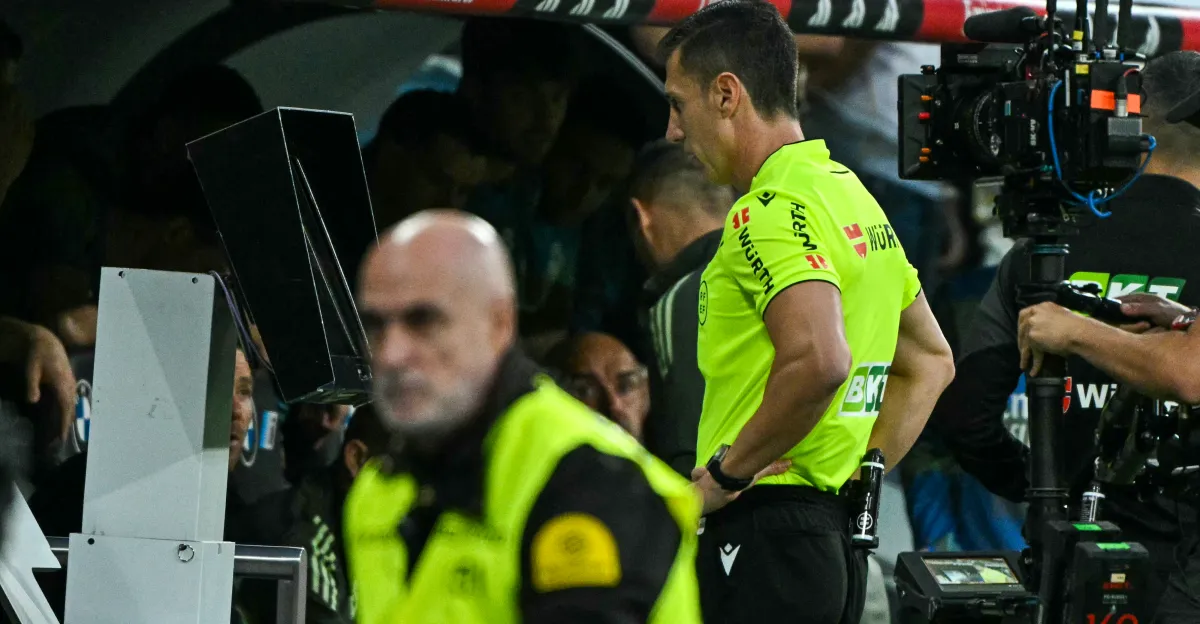
Spanish football has reached a boiling point where even the technology meant to fix mistakes is being labeled a failure. Following a chaotic 3-3 draw between Rayo Vallecano and Real Sociedad that left everyone from the stands to the dugouts fuming, a major overhaul of the VAR system is now on the horizon for next season.
Part of the problem is the wait itself. The promise of VAR was that it would correct mistakes made by the ref in a timely fashion. Both the “correct” and “timely” components were important. As such, VAR was supposed to intervene when the mistake was “clear and obvious,” meaning borderline calls were left as-is. This hasn’t always been the case in practice.
Rayo manager Iñigo Pérez didn’t hold back after Sunday’s drama, arguing that “if a play needs several minutes to be decided, it can hardly be considered an obvious error.” He floated the idea of a one-minute time limit to keep the game moving, a sentiment echoed by Elche’s Eder Sarabia. Sarabia noted that while the tool itself is “wonderful,” the current habit of spending four or five minutes staring at a screen is a clear misuse of the technology.
Yesterday, La Liga President Javier Tebas admitted that “something is not working” and suggested it’s time to “take the bull by the horns.” His vision for the future includes shifting toward a Football Video Support (FVS) model. Under this system, which is currently being tested in lower divisions, coaches would have “challenges” allowing them to request up to two reviews per game if they believe a clear error was made. This is similar to the system used in top level tennis and basketball.
That’s further in the future, because the FVS system is still in an experimental phase, and FIFA would need to give the green light before it hits professional leagues like La Liga.
So, in the meantime, the focus will shift to more immediate technological and personnel upgrades.
One of the biggest changes reportedly coming next season is the introduction of fully automatic offside technology. Tebas has been vocal about his disdain for the current semi-automatic version. By using a chip inside the ball, the league hopes to eliminate the manual human error that still plagues the current system.
The RFEF is also looking to professionalize the VAR room to ensure it doesn’t become a retirement home for declining referees. AI is set to play a role here too. According to reports, artificial intelligence will be used to evaluate referee performance and help handle match designations based on merit.