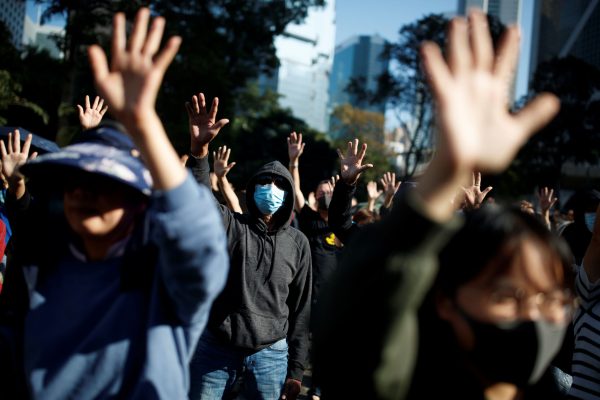
Hong Kong’s government has confirmed it is running a so-called “rehabilitation program” that sends people who were arrested during the 2019 anti-extradition protests, but never charged, on organized trips into mainland China. Roughly 7,000 people are eligible. Hong Kong’s secretary for security Chris Tang calls it the “Special Project.”
The program is being rejected by everyone outside the regime who has spoken about it. Hong Kong lawyers, exiled politicians, and former protesters who served prison terms for their role in the 2019 anti-extradition movement say the project is a brainwashing operation built on legal coercion, and that the trips into mainland China carry physical danger up to and including the risk of forced organ harvesting. Vision Times spoke with two of the most outspoken voices: Hong Kong Muay Thai champion Kui Teng, who is also a former senior legal assistant in Hong Kong’s criminal courts, and Keith Keung Ka-wai, the speaker of the Hong Kong Parliament. Both men served prison sentences for their participation in the 2019 anti-extradition movement and now live in exile in Canada.

Why 7,000 Hong Kong protesters have spent seven years in legal limbo
Hong Kong police arrested more than 10,000 people during the 2019 anti-extradition protests. Only about 3,000 of them have faced formal criminal charges. The remaining 7,000 have spent years suspended in legal limbo, neither cleared nor prosecuted, carrying an arrest record that has damaged their employment and personal lives.
Speaking to Cable TV, Hong Kong’s secretary for security Chris Tang, a hardline Beijing loyalist who has repeatedly defended the city’s national security crackdown, broke the government’s silence on the program. He confirmed that the “Special Project” was launched a year or two ago to offer “rehabilitation” outside the courts. The core component is organized travel to mainland China, where participants are taken to see “national development” and learn about “national security.” Asked about safety concerns, Tang said government personnel would personally accompany participants so they need not worry about being detained on the mainland. He also dangled rewards: participants who performed well, he said, could be offered government internships and might eventually qualify to apply for civil service jobs.
Human rights lawyers say the entire structure rests on legal coercion. Wu Shaoping, director of the Overseas Chinese Human Rights Lawyers Concern Group, said the Hong Kong government is using the threat of pending prosecution as leverage, converting it into an administrative tool to force former detainees into political reeducation.
Success
You are now signed up for our newsletter
Success
Check your email to complete sign up
Hong Kong Muay Thai champion warns Special Project participants risk forced organ harvesting in China
Kui Teng, the Hong Kong Muay Thai champion now living in exile in Toronto, brings unusual credentials to the analysis of the Special Project. Beyond his career as an athlete, he spent thirteen years as a senior legal assistant inside Hong Kong’s criminal justice system. He says the Special Project is a brainwashing program.
Kui Teng laid out the legal mechanics in his interview with Vision Times. “I just call it the brainwashing program, because Hong Kong’s prison capacity is limited. From 2019 onward, the Hong Kong national security police have been keeping a list of everyone involved in the 2019 social movement, whether they appeared at protest sites or simply expressed opinions online. The most serious political cases get sent to court first. The less serious ones are kept in what I call progressive prosecution: they’re released on bail, but they aren’t cleared. They’re queued up, waiting for prosecution.”
He said no one should be reassured by the absence of formal charges. “I have never heard of a single political defendant in Hong Kong being completely cleared of charges. Even when defendants have been acquitted, the Department of Justice can invoke a case-stated procedure years later to send the case back to the Court of Appeal for retrial.” Hong Kong’s Department of Justice, once a recognizably professional prosecutorial body, now functions as an arm of the regime’s national security apparatus. Practicing lawyers in Hong Kong now stay silent out of fear of arrest, Kui Teng said, and he feels he has a duty to speak as someone who understands the system from the inside.
Asked what could happen to participants on the mainland, Kui Teng said: “Before I do anything, I analyze it from a legal standpoint. What is the best possible outcome? What is the worst? The best outcome of this brainwashing program is that prosecution gets delayed. The worst outcome is something dangerous happening on the mainland.”
He went on to describe what he believes that danger looks like. “I absolutely suspect they could be subjected to forced organ harvesting. After I escaped to Canada, I learned about many Falun Gong practitioners whose family members and friends were arrested in China and may have been killed for their organs. These are real, documented cases. There are also many cases of women being sexually assaulted and gang-raped in detention.” Kui Teng said the Chinese Communist Party is engaged in genocide against Hong Kong’s protest movement, and that sending 7,000 young people into the mainland is “delivering them to Satan’s headquarters to be slaughtered.” He added: “Dead people are the safest. They eliminate the future problem.”

Hong Kong Parliament speaker Keith Keung calls the Special Project naked totalitarian control
Keith Keung Ka-wai, the speaker of the Hong Kong Parliament, also spoke to Vision Times, and his anger was unmistakable. The Hong Kong Parliament is the overseas legislative body established by exiled Hong Kong democrats to keep the city’s pro-democracy political tradition alive after Beijing dismantled meaningful representation in the city’s actual Legislative Council. Keung said the Special Project represents something larger than a single bad policy.
“I can no longer use moderate language to describe something that is not moderate at its core,” Keung said. “When a totalitarian regime can hold thousands of people who were arrested in a social movement but never prosecuted in legal limbo for years; when ‘not being prosecuted’ becomes a transaction that requires obedience, cooperation, and even a transformation of one’s thinking to obtain; what we are facing is no longer a question of legal procedure. It is naked totalitarian control.”
Keung said that under conditions of fear and coercion, no one’s participation in these “exchange trips” can be called voluntary. “This is not rehabilitation. It is not opportunity. It is packaged training in obedience to the Chinese Communist Party. Under the regime’s pressure and the shadow of uncertainty it creates, real choice no longer exists. This Communist Party model of brainwashing through coercion and inducement is expanding across Hong Kong. It is no longer aimed only at people’s actions. It is aimed at their thoughts.”
He posed a direct challenge to anyone who would defend the program. “If order is built on suppression, can it still be called justice? A system that has confidence in itself does not need to remake the minds of its people. Only power that is not trusted fears the free will of the people of Hong Kong.” Keung urged Hong Kongers to hold to their conscience in the city’s darkest period. “The fight is not against any one person. It is to reject and destroy the Chinese Communist Party model itself.”
Why Hong Kong singer Hins Cheung’s pro-democracy reversal triggered the backlash
The Special Project has gained a high-profile public face in Hong Kong singer Hins Cheung. Cheung recently issued a public apology, expressing regret for past statements critical of the government, and announced that he would personally lead groups of 2019 detainees on exchange trips to mainland China. The reversal triggered an emotional reaction across Hong Kong social media, with longtime fans calling it heartbreaking and bewildering.
Kui Teng has done extensive background research into Cheung’s family and political history, and what follows is his analysis, not findings of any independent investigation. He says Cheung’s father served as Communist Party secretary of the Dongshan district subdistrict office in Guangzhou, a position of significant local power. Cheung’s mother, Luo Xiaodan, has extensive government connections and resources of her own.
“Hins Cheung absolutely won the starting line in life. He has deep networks and resources in Guangzhou,” Kui Teng said. According to his research, Cheung joined the Young Pioneers as a child and pledged to “contribute his strength to the cause of communism.” His song “My Way” was awarded a prize by the Communist Youth League and reportedly considered for inclusion in school teaching materials. In 2009 Cheung became a member of the Guangzhou Municipal Youth Federation, and in 2010 he was named one of the “Top Ten Outstanding Youth of Guangzhou.”
Kui Teng believes Cheung’s pro-democracy “yellow ribbon” image during the 2012 anti-national-education protests and the 2014 Umbrella Movement was strategic. “I believe it was a commercial decision to expand his fan base.” His conclusion is harsher. “I am completely convinced that his role all along has been to operate as a Communist Party undercover agent, doing quiet work in Hong Kong. Now that he has apologized and become an instructor in the brainwashing program, many of his yellow-ribbon fans will say he is being persecuted. And some young protesters whose minds are not yet formed will be misled by their idol, follow him into China to take the brainwashing program, and offer up their organs and their precious lives for nothing.”
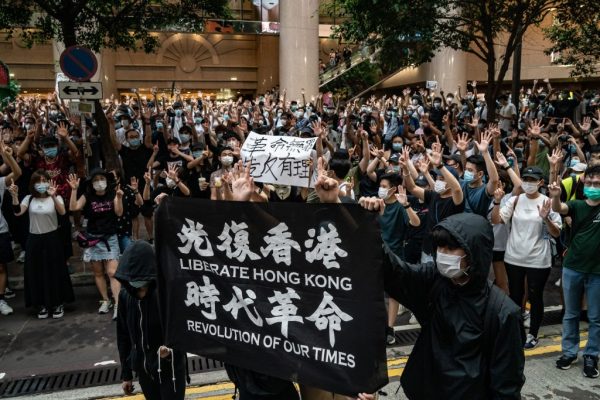
How Hong Kong has replaced courts with administrative coercion
Lai Jianping, a Beijing-trained human rights lawyer now active in international human rights law, said the Special Project amounts to political punishment of people who have never been convicted of anything. He said the Hong Kong government is “using politics to replace law, punishing the inner thoughts of these so-called suspects, with the goal of making them submit to the Chinese Communist Party’s authoritarian rule.”
The structure of the Special Project traps the 7,000 in a position from which they cannot escape through normal legal means. With no trial scheduled and nothing adjudicated, they cannot prove their innocence in court and have nothing to appeal. Instead, they are placed under prolonged administrative surveillance and must participate in patriotic activities to buy temporary peace.
What 7,000 Hong Kong lives now hang on
The aftershocks of the 2019 anti-extradition movement are still rolling through Hong Kong as the city moves deeper into 2026. The fates of 7,000 young people now hang on what the Hong Kong government calls the Special Project. Officials describe it as rehabilitation and reintegration. The voices outside the regime describe it as something closer to a slow-motion disappearance.
Kui Teng put it this way at the close of his interview. “As a devoted Christian, I will only speak honestly. The strength of any one of us may be small. But we can refuse to encourage other people to walk into Satan’s territory and be slaughtered.”
Keung made a similar appeal. “History tells us that this kind of logic is always overthrown in the end by the people it oppresses. In the darkest of times, be the best version of yourself. In extraordinary times, extraordinary measures are required.”
By Meng Hao