UAE Central Bank Governor Khaled Mohamed Balama raised the idea of a currency-swap line with Treasury Secretary Scott Bessent and Treasury and Federal Reserve officials in meetings in Washington last week, the officials said, as quoted by WSJ.
Also read: Pakistan to repay USD 1.5 billion outstanding UAE debt by April 23
The Emiratis emphasized that they had so far avoided the worst economic effects of the conflict but might still need a financial lifeline, the officials told the publication.
The seven-week-long conflict that began with joint US-Israeli strikes on Iran has raised the risks of global inflation, already impacting oil prices and causing an energy crisis in many corners of the world. Several aspects, including disturbances in the Strait of Hormuz and airspace closure, have disrupted the economies worldwide.

The US-UAE talks highlighted the Gulf nation’s concern fearing that the war could inflict major damage on its economy and its position as a global financial hub. The ask for a financial backstop reflects that the government is also concerned about its depleting foreign reserves and scaring away investors who once saw the country as a stable and secure place for their money.
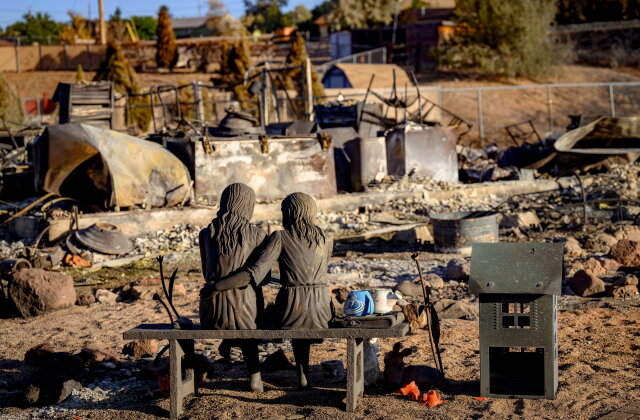
The prolonged conflict involving the US, Israel and Iran has damaged the UAE’s oil and gas infrastructure and disrupted tanker traffic through the Strait of Hormuz, effectively cutting off a crucial source of its dollar revenues.
As per the WSJ report, Emirati officials have not made a formal request for a financial swap line, which would give the UAE central bank inexpensive access to dollars to support its currency or shore up its foreign reserves in case of a liquidity crisis. In talks with the US government in the recent days, the officials have portrayed the proposal as preliminary and precautionary, the US officials said.
But they have also argued that it was US President Donald Trump’s decision to attack Iran that entangled their country in a destructive conflict whose effects may not be over, some of the officials told WSJ.
Also read: 11 nations call for coordinated IMF-World Bank support amid Middle East war risks
On the negotiating table, Emirati officials told the American counterparts that if the UAE runs short of dollars, it may be forced to use Chinese yuan or currencies from other countries for oil sales and other transactions, some of the officials said. If that comes into effect, it would mark an implicit threat to the US dollar, which reigns on top among global currencies, partially because of its near-exclusive use in oil transactions.
Some officials aware of the matter also told the publication that the swap lines are typically administered by the Fed, but its 12-person policy committee, the Federal Open Market Committee, is unlikely to approve one for the UAE. The central bank usually reserves them for relieving severe funding-market pressures that could spill back into America’s economy.
The Fed has standing arrangements with central banks in the United Kingdom, Canada, Japan, Switzerland and the European Union. During periods of acute stress, most recently in 2020 COVID pandemic, the authority extended swap lines to nine other central banks, including in Mexico, South Korea and Brazil. The UAE has milder ties with US markets than traditional swap recipients.
The UAE Central Bank didn’t respond to WSJ’s requests for comment, and a Fed spokesperson declined to comment.
As per the report, the US Treasury Department has recently provided alternative swap arrangements without the Fed’s approval. The department signed off on a $20 billion swap for Argentina through the Exchange Stabilization Fund in 2025.
With the onset of the war against Israel, Iran has targeted the UAE and several other Gulf nations, firing over 2,800 drones and missiles, according to the U.A.E.’s Ministry of Defense, although most were shot down.
The Emirati dirham is pegged to the dollar and backed by foreign-currency reserves of $270 billion, but the war has put it under pressures from capital-flight risks, stock-market volatility and other disruptions, analysts told WSJ.
In a report dated March 6, the credit-rating firm S&P Global mentioned that the UAE’s “substantial fiscal, economic, external, and policy flexibility will act as an effective buffer” against the economic effects of the Middle East war. However, the report also warned that “the potential for prolonged disruption” to its oil exports and damage to infrastructure “add clear risk to our expectations.”
The war has also driven the Emiratis closer to the US and, at least for now, to abandon the notion that forging diplomatic and financial ties to Iran would help insulate it from the region’s conflicts.
US Treasury officials invited Gulf countries on the sidelines of the International Monetary Fund and World Bank meetings in Washington last week to outline their needs for repairing infrastructure and rebuilding their economies, as the country promised to put them at the front of the line if assistance is needed.
Finance ministers and central bankers met in the US for the IMF and World Bank meetings, where they didn’t expect an easy or swift recovery for the region.
Gulf countries have also raised billions of dollars in debt from investors over the past week, highlighting their push to have cash on hand as they face what the International Energy Agency has called “the most severe oil-supply shock in history.”
Abu Dhabi, the UAE’s capital and the richest of the seven emirates that make up the country, raised around $4 billion from investors in private-placement transactions arranged by banks, including Goldman Sachs, earlier this month, people familiar with the matter told WSJ. The emirate borrowed at a premium to avoid a drawn-out fundraising process, they said.
Bahrain has also set up a roughly $5 billion swap line with the UAE earlier this month to help improve financial stability, the countries’ central banks said.
“The basic logistics of scheduling tankers and bringing them back after the chaos we have seen, that will take possibly to the end of June,” said Mohammed Al-Jadaan, Saudi Arabia’s finance minister, during a panel earlier on Thursday. “Anyone who’s counting for a quick recovery, even if there is a total end of hostilities, will need to recalculate that.”
(With inputs from the Wall Street Journal)