Iran’s powerful parliament speaker said there has been “progress” in talks with Washington but that “fundamental” differences remain, while US President Donald Trump rejected what he called “blackmail” by Tehran after it again closed the Strait of Hormuz.
“We are still far from the final discussion,” Mohammad Baqer Qalibaf, who is also Iran’s lead negotiator, said in a televised address early on April 19.
“We made progress in the negotiations, but there are many gaps and some fundamental points remain,” he added, referring to the first round of face-to-face talks in Islamabad on April 11-12.
“There are some issues on which we insist…They also have red lines. But these issues could be just one or two,” he added, while also expressing hard-line sentiments, claiming that Iran has been “victorious in the field” during the war.
The fate of renewed face-to-face meetings between Washington, Tehran, and Pakistani mediators appeared unclear. Trump on April 17 cited progress and said negotiations would continue over the weekend.
However, amid speculation that the sides could reassemble on April 20 in Islamabad, no new date has been announced.
Trump suggested that an announcement regarding negotiations could come soon. “We’ll be talking about Iran later. We have very good conversations going on.”
Cease-Fire Expiration
The remarks come days ahead of the expiration of a two-week cease-fire between US and Israel forces and Iran nears on April 22.
Iran’s top national security body on April 18 said Tehran is reviewing “new proposals” from the United States delivered through Pakistani army chief Asim Munir, but it has not yet responded.
The Supreme National Security Council stressed that Iran’s negotiating team “will not make even the slightest compromise, retreat or leniency,” and would defend national interests “with all its strength.”
Civilian Ships Attacked
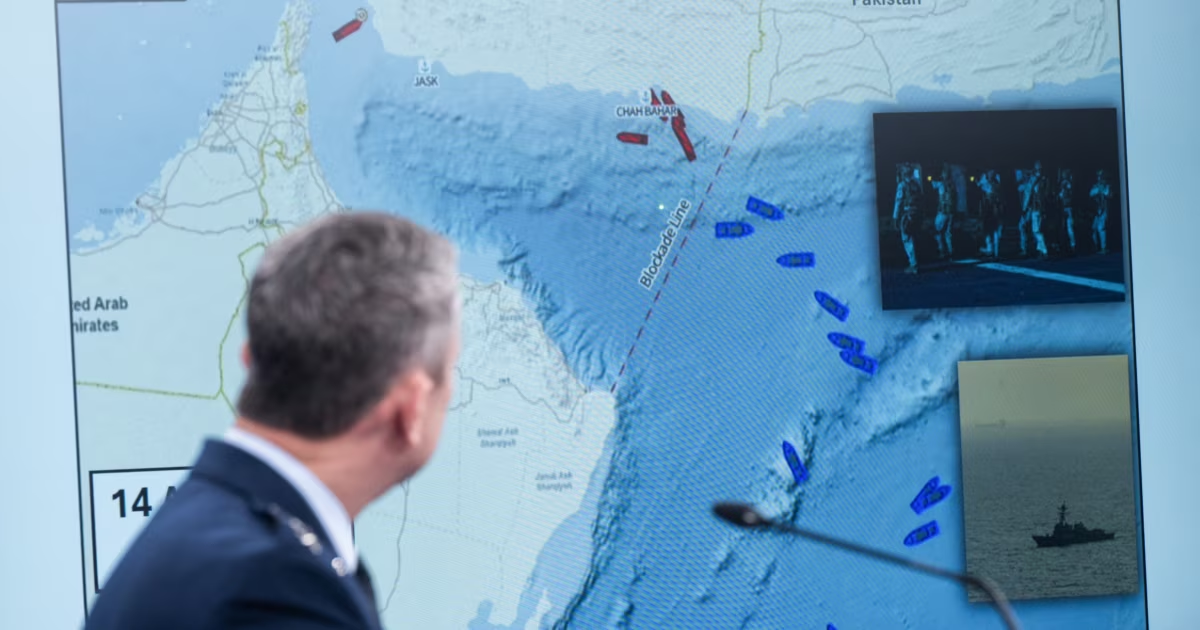
Hopes that shipping would resume through the strait proved short-lived on April 18, as Iranian forces attacked at least three civilian ships after Tehran announced it was reversing its decision to reopen the route.
Speaking in Washington, Trump said: “They got a little cute…They wanted to close up the strait again, you know, as they’ve been doing for years. And they can’t blackmail us.”
A shipping security monitor detailed three attacks — the first such incidents since a two-week cease-fire began on April 8.
In the first incident, two Islamic Revolutionary Guards Corps (IRGC) gunboats fired on a tanker without warning, the monitor said.
Later, it said a container ship was “hit by a projectile,” while there was a near miss with an attack on a third vessel.
Two of the ships were Indian-flagged, prompting India to summon the Iranian ambassador in protest.
After the latest incidents, IRGC naval forces late on April 18 warned that any vessel approaching the Strait of Hormuz would be treated as a target.
“We warn that no ship, of any kind, should leave its anchorage in the Persian Gulf and the Sea of Oman. Any attempt to approach the Strait of Hormuz will be considered cooperation with the enemy, and the offending vessel will be targeted,” it said on its official news website.
Qalibaf — who many observers say is the power behind the Iranian regime — on April 17 had issued a blistering social media post, accusing Trump of telling “lies” and said that as long as the US blockade of Iranian ports was in place, “the Strait of Hormuz will not remain open.”