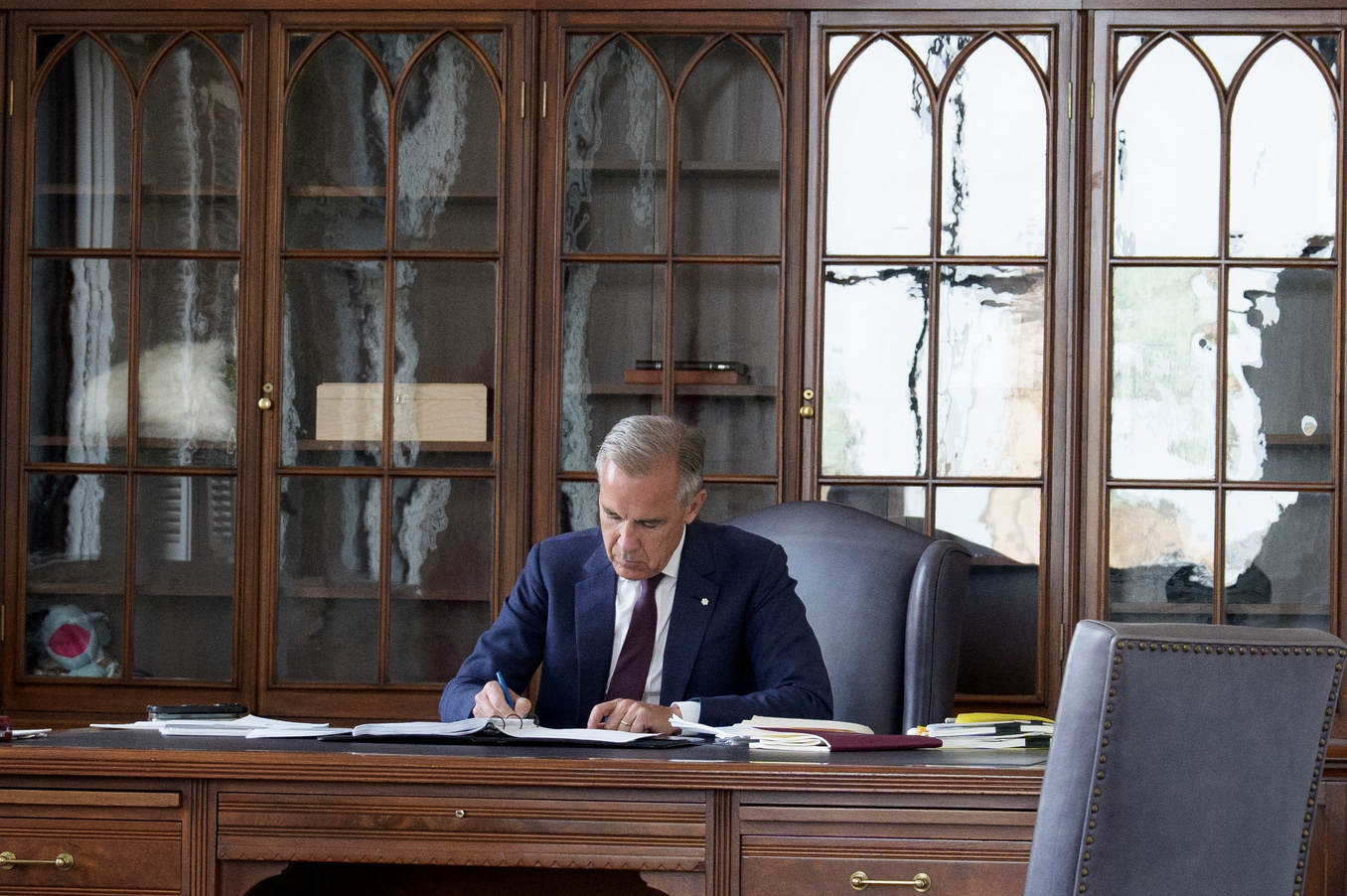

Prime Minister Mark Carney/PMO
By Kevin Lynch and Paul Deegan
April 18, 2026
On April 28, 2025, Canadians elected a rookie politician, Mark Carney, as an MP and prime minister.
Quite a journey from a distinguished career in business and central banking to leader of a moribund Liberal Party of Canada and the highest office in the land.
A fellow traveller on the last part of that journey, Donald Trump, provided a major boost to Mr. Carney’s political prospects. With his tariff attacks and assaults on global institutions, NATO, international trade rules, and Canadian sovereignty — not to mention democracy, dignity and decency — Trump made himself, and who was best qualified to deal with him, the ballot question in the election.
Canadians’ answer was Mark Carney. A year on, the Carney government has a sizable lead in the public opinion polls coupled with a new parliamentary majority after several floor crossings and three by-election victories, but the global tumult generated by President Trump has only grown.
So, what is the Carney report card in five crucial areas?
Trump and Tariffs
When asked how he has navigated the relationship with Trump, Carney responds, “Respect but not obsequiousness.” While Trump has dialed back some of the belittling commentary toward Canada, and the leader-to-leader relationship is better than it was under Justin Trudeau, there has been little progress on the tariff front over the past year.
Time will tell if Carney’s strategy of selective accommodation, whereby he scrapped the digital services tax and removed most Canadian counter-tariffs, will help us conclude a new free-trade agreement with the unpredictable Trump.
And what might that agreement look like? Will it be trilateral, or will Trump — as hinted by USTR Jamieson Greer — seek separate agreements with Mexico and Canada? Will it be comprehensive or a series of sectoral agreements focused on specific industries like steel, aluminum, or autos. Will Trump demand that Canada match American policies towards China, eliminate supply management for dairy, or drop any perceived restrictions on U.S. tech companies?
On the CUSMA review, Carney has added significant bench strength on the Canadian side, bringing in former Clerk of the Privy Council Janice Charette as chief trade negotiator to the United States, former finance and investment executive Mark Wiseman as ambassador to the United States, and Glenn Purves as deputy minister of international trade. Their blend of talent and experience should serve Canada well.
With a little more than six months away from the U.S. midterm elections, where it appears the Republicans will get thumped, time may well be on Carney’s side, which bodes well for his pledge to keep Canada’s economy strong, sustainable, and sovereign.
But Trump has done a masterful job of spewing misinformation and disinformation about the mutual benefits of trade with Canada, and corporate America has been hesitant or afraid to speak up, as former U.S. Treasury Secretary Bob Rubin pointed out in the Wall Street Journal.
Boosting Growth and Productivity
Carney inherited an economy that was struggling with weak growth and propped up by high immigration of low-skilled workers. His policy pivot to prioritize investment over redistribution, to diversify markets for Canadian exports, and to expand exports of energy and other natural resources, deserves high marks. And the Iran conflict and long-term uncertainty about the Strait of Hormuz have created new leverage for Canadian LNG and oil in Asia, and LNG in Europe.
Carney is creating trade and investment optionality, using our resource strengths in oil, LNG and critical minerals as well as new defence spending and security partnerships. He has travelled extensively, building relationships among countries and leaders who share Canadian concerns about Trump’s policies and the fractures in the rules-based international order.
But others are doing the same — the EU has just concluded trade agreements with India, Mercosur and Australia — and Carney now has to quickly turn those shared values into concrete trade and security agreements.
An example was allowing a limited number (49,000) of Chinese electric vehicles into the Canadian market at the most-favoured-nation tariff rate. It is a smart move, as it got China to reduce punitive tariffs on canola. But going forward it should be tied to the manufacturing of Chinese EVs in Canada.
Another form of trade diversification, and one totally in Canadian hands to deliver, is eliminating interprovincial trade barriers and allowing more trade within Canada. The IMF says this could increase Canadian GDP by 7%. But, despite eliminating the fairly minor federal barriers to internal trade, progress by the provinces has been more rhetorical than real, and the Carney government has not been willing to use political capital to drive movement.
Getting more natural resources out of the ground is essential to boosting growth. Locating the Major Projects Office (MPO) in Calgary sent an important signal to Westerners, as did the energy MOU with Alberta. Equally important, it sent a signal to investors that Canada will finally ‘lighten’ our regulatory approval processes, which have been slow, complex, and highly unpredictable. Dawn Farrell, MPO’s CEO, hails from the energy sector and has the kind of experience the job demands. Now it is time to get shovels in the ground on some of the listed major projects.
High Deficits and Rising Debt
Next to dealing with Donald Trump, this is perhaps Carney’s greatest challenge. While Trump will eventually exit, Carney has been left with a mountain of debt and structural deficits by his predecessor – which he has added to with gusto. Yet, in a world of rupture and volatility, you want to have the best balance sheet in the neighbourhood.
In Carney’s first budget, the deficit is forecast at $78.3 billion in 2025-26, falling only slightly to $65.4 billion in 2026-27. However, the debt-to-GDP ratio actually rises to 43.1% next year and the debt mountain will hit $1.4 trillion. More troubling still is that none of these fiscal forecasts will be realized given the numerous unfunded policy initiatives the Prime Minister has announced since the October budget and the worsened global economic outlook as a result of Trump’s war in Iran.
While Canada has the lowest net debt-to-GDP ratio in the G7, our gross debt is now middle of the G7 pack at 113% of GDP. It is time for the Carney government to commit to an effective fiscal anchor — grounded on a declining debt-to-GDP ratio and credible fiscal forecast backstopped by a reinstated contingency reserve. The challenge will be one of balancing targeted investments to boost economic growth and productivity, while implementing surgical cuts. For this, former prime minister Jean Chrétien’s example of a comprehensive program review, not across-the-board cuts, is worth emulating
Doubling Down on Defence
Canada was a defence deadbeat for far too long — hurting our credibility with our allies. Carney deserves credit for hitting the 2% of GDP NATO target in his first year.
But now we must meet the new NATO yardstick of 5% — 3.5% on core defence spending and an additional 1.5% on security-related critical infrastructure investments — by 2035. That will put massive pressure on the fiscal framework as well as require a new national security plan on how to spend these monies wisely.
Arctic security should be a key pillar of new defence planning and spending since it could become a new front line in the geopolitical tensions between China, Russia, and the United States. The Northwest Passage is becoming ice-free for longer each year, and the Arctic contains vast reserves of critical minerals. With Trump’s America a less reliable partner in defence and not overly respectful of others’ sovereignty, we need to invest heavily to detect, deter and defend against increased Russian, Chinese, and now possibly American activity in our Arctic.
International Disorder
The most globally significant event of Prime Minister Carney’s first year was his eloquent speech to the World Economic Forum at Davos. Carney said the quiet part out loud: the rules-based international order is over. It was characterized across capitals as the most important foreign policy speech in years. David Kusnet, who served as chief speechwriter to Bill Clinton, wrote in The National Post, “Carney gave a master class in how to give a speech that matters” and “punched above his weight, setting standards other orators can follow.”
As Carney enters his second year in office, with a parliamentary majority at home and a world that looks even more uncertain and volatile, timely and effective implementation of his ambitious agenda is critical. A plan beats no plan, and speed wins.
Kevin Lynch was Clerk of the Privy Council and vice-chair of BMO Financial Group.
Paul Deegan, CEO of Deegan Public Strategies, was an executive at BMO and CN.