

How do teachers captivate their students? Here, in a feature we call How I Teach, we ask great educators how they approach their jobs.
Sign up for Chalkbeat’s free monthly newsletter How I Teach to get inspiration, news, and advice for — and from — educators.
“I don’t eat that,” are the famous last words teacher Shirley Brezzell hears from her fifth graders when she introduces food the kids think they won’t like, such as pickled beets, pickled onions, eggplant, and oatmeal burgers.
Brezzell teaches science and social studies at Detroit’s Mackenzie Elementary-Middle School in the Detroit Public Schools Community District. But she’s particularly passionate about exposing students to fruits and vegetables through an outdoor school garden she created and manages, and teaching them about healthy eating. She incorporates the work in the garden into her lessons, showing students during a lesson on matter how food changes while being cooked. Consequently, she’s able to turn those “I don’t eat that” comments into appreciation.
“When they see the process from seed to a piece of fruit that they can actually eat, it is mind-blowing. They are in awe,” Brezzell said. “Oh, and then when you taste it, and when it comes off of the vine, and it is all organic, it’s a whole other experience.”
If you walk into the outdoor garden, you’ll see plenty of garden beds where fruits and vegetables grow. You’ll also see Walmart recyclable bags that students use to grow everything from greens and cabbage to tomatoes and potatoes. Parents will create their own bags during an event this month.
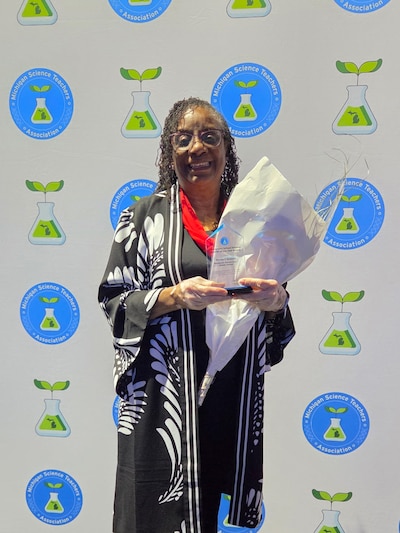
Brezzell was recently named the 2026 Elementary School Science Teacher of the year by the Michigan Science Teachers Association. The Detroit native, who graduated from Cass Technical High School in 1975, spent much of her career in the banking industry during a 22-year stretch that took her from working as a teller to an operations manager for a bank. When that bank closed, she began homeschooling her children. Soon after, she began substitute teaching in the Detroit district and by 2011, she had become a certified teacher. Brezzell hasn’t for one moment regretted her decision to become a teacher.
“My regret is that I didn’t do it 100 years ago. Absolutely, this is my calling,” Brezzell said.
Her career will likely end soon, as Brezzell considers retirement. But that won’t happen until after this summer, because her garden supplies plants for her students’ families to grow and provides fresh fruits and vegetables to the wider school community during the summer,
“I have to bring the harvest,” Brezzell said.
This interview has been lightly edited for length and clarity.
What’s your favorite lesson to teach and why?
My favorite unit to teach is on matter, as it utilizes food as the medium to show the various stages of matter. I love taking the students out to our school’s garden to pick fresh fruits and veggies and then bringing them back inside to cook them together. It’s a perfect hands-on way to show how matter changes — how food transforms with cooking — and it also gives me the opportunity to introduce them to new flavors they might not have tried before. Altogether, it’s a really engaging and memorable way to connect science to everyday life.
What’s something happening in the community that affects what goes on inside your classroom (or your school)?
Mackenzie is in a neighborhood of Detroit that’s considered a food desert. While I officially teach fifth grade science and social studies, I also manage our school garden. Alongside 10 stationary garden beds, I created the “Garden in a Bag” project where students plant and maintain portable gardens, in a Walmart recyclable bag. This way, they can potentially have fresh produce all summer, even if they move. Plus, the veggies from our on-site beds go straight to Mackenzie families, helping everyone enjoy fresh veggies and a healthier lifestyle.
How do you get your students engaged with science?
In my classroom, I set high expectations and we dive into science from every angle. We follow the curriculum, do hands-on projects, work in the garden, and even use those vegetables in cooking as a way to show how matter changes. And through that, I introduce them to fresh fruits and vegetables they might not usually try. That’s truly my passion — giving them a glimpse of a healthier lifestyle while they learn. At the heart of my teaching, I’m passionate about connecting what we learn in class to real-life choices. I want my students to feel empowered not only to understand science concepts, but also to see how these lessons influence a healthier lifestyle. It’s all about giving them the tools to make good decisions about what they eat and how they care for themselves.
Tell us how you came to create an outdoor oasis for your students.
Four years ago, I joined a group of researchers from Michigan State University in a project called Teaching Science Outdoors: The Urban Project, or TSOUP. With encouragement from them and through American Forests, we planted a total of 65 trees over two plantings. Then, a grant from the Whole Kids Foundation helped us refurbish the garden with garden beds and a hoop house, and with a series of mini-grants from TSOUP, we were able to expand even more.
In the past year, the district has added a new shelter and this spring, will finish the cement work under it. They’re also adding eight picnic tables to create a third outdoor classroom on the patio near the middle school side of the building, and the original outdoor classroom is being moved elsewhere on the property for its own cement work.
And finally, we received another grant from the Whole Kids Foundation that allowed us to build an irrigation station, solving our watering problem with a 450-gallon water capacity. This station will also have cement work and create a comfortable place for students and teachers to sit, cool off, and relax.
How do you approach news events in your classroom? Please provide an example.
I tell them the truth. For instance, we really dove into the pause in governmental food benefits. That was a genuine challenge many families faced, and having those real, honest conversations allowed us to lay a foundation where we can have meaningful discussions about the news and how it impacts their daily lives. This pause also gave me another opportunity to talk about eating healthfully even on a budget, whether that was making oatmeal burgers or finding creative ways to put together a whole meal from basic kitchen staples.
Tell us about your own experience with school and how it affects your work today.
I’m a product of Detroit Public Schools, graduating from Cass Tech in January of 1975. My parents and teachers instilled in me the importance of education and how it could afford me many opportunities. To that end, I work tirelessly to help my students see the importance of their education and their potential to become whatever they want to be. To that end, I am a demanding teacher. I have high expectations for my kids and most rise to the occasion. My goal is to make sure that when my students, after a year with me, move to the next grade, they are better than when I first met them. They will be tired, but they will KNOW the material.
How do you take care of yourself when you’re not at work?
Lol! What a notion! Like all of us, I wear many hats. Wife, mom, sister, aunt, church member, and the list goes on. This year I am learning to at least try to put Shirley first. What does this look like? I have a bedtime. I am taking my vitamins regularly. I am promising myself to exercise daily. I am drinking WATER and have mostly eliminated sugar from my diet. But above all, I am learning to take time for just me.
Lori Higgins is the bureau chief for Chalkbeat Detroit. You can reach her at lhiggins@chalkbeat.org.