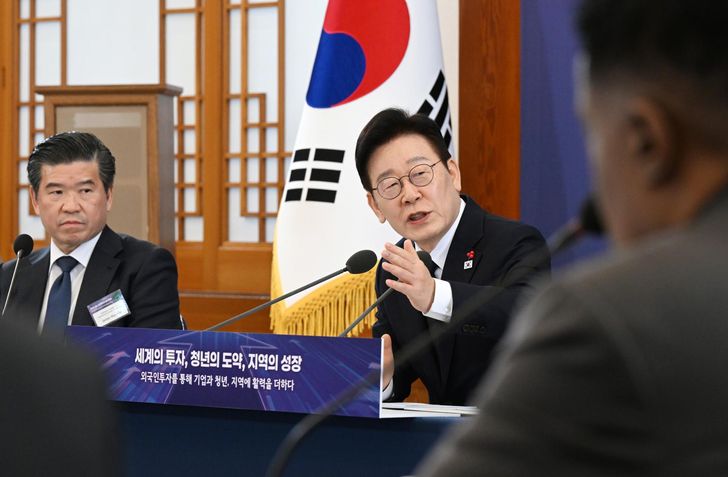

American Chamber of Commerce in Korea Chairman James Kim, left, listens to President Lee Jae Myung during the president’s meeting with foreign business leaders in Korea at Cheong Wa Dae in Seoul, Jan. 28. Korea Times photo by Wang Tae-seok
Korea is becoming less attractive as a base for Asia-Pacific headquarters for U.S. companies, with Hong Kong overtaking it, the American Chamber of Commerce (AMCHAM) in Korea said Wednesday.
AMCHAM attributed the result partly to Korea’s inflexible labor market and regulations that are not aligned with global standards.
According to a survey of AMCHAM members, only 11.8 percent of respondents said Korea is the preferred destination for their Asia-Pacific headquarters, while 58.8 percent chose Singapore and 17.6 percent picked Hong Kong.
This marks the first time since 2022 that Korea has fallen to third place.
After strict lockdown measures in Hong Kong and mainland China during the COVID-19 pandemic, Korea had maintained its ranking in the second spot, surpassing Japan, Hong Kong and China.
Until last year, Korea had also hosted the second-largest number of Asia-Pacific headquarters of AMCHAM members, following Singapore.
However, Korea has lost that status to Hong Kong this year as well.
AMCHAM said it continues to analyze exactly which factors led to the shift, though it views Korea’s regulatory conditions as a key aspect behind the country’s declining attractiveness as a regional headquarters location.
When multiple answers were allowed, 68.8 percent of respondents described Korea’s regulatory environment as “restrictive” or “very restrictive,” while 61 percent cited Korea-specific or globally misaligned regulations.
Additionally, 71 percent of respondents identified Korea’s labor policy and labor market flexibility as the most significant barriers to becoming an attractive regional headquarters pick for U.S. firms.
Legal risks for management and regulatory uncertainty were also cited as obstacles.
Since the Serious Accidents Punishment Act took effect in 2022, foreign business officials in Korea have expressed concerns about the law, which they fear can lead to the imprisonment of CEOs over fatal worksite accidents when the companies are found to have insufficient safety precautions.
The implementation this year of the revised Trade Union and Labor Relations Adjustment Act, also known as the “yellow envelope law,” has also raised concerns because it compels companies to negotiate directly with subcontracted workers.
“Korea’s drop to third place as a regional headquarters destination is a disappointing outcome, but it is also a clear signal that more needs to be done to strengthen its competitiveness,” AMCHAM Chairman James Kim said.
“Korea remains a stable and resilient market with strong growth potential, and with improvements in regulatory predictability and labor market flexibility, it is well-positioned to regain its standing.”
The chamber plans to share its analysis and present policy recommendations during its upcoming “Doing Business in Korea” policy seminar on April 21.