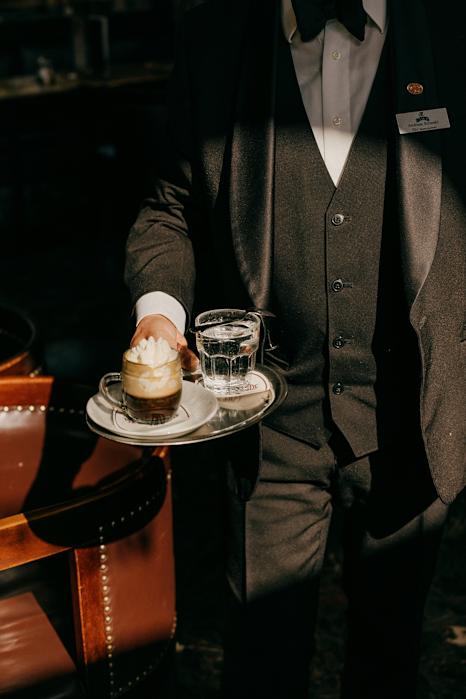

Vienna’s historic coffee houses, such as Cafe Schwarzenberger, are part of a cafe culture that’s been recognised by Unesco Julius Hirtzenberger, Wien Tourismus
This article was produced by National Geographic Traveller (UK).
Ethiopia is said to be the birthplace of coffee, but Europe is certainly the place where it grew up. From Africa, coffee was believed to have made its way to Yemen in the Middle Ages, arriving in Turkey by the 16th century. During the 17th century, Ottoman ambassadors gifted coffee to royals in Paris and merchants brought it to Venice. Coffee houses flourished across the continent — fertile, caffeine-fuelled hubs for some of the 20th-century’s leading artists, philosophers and flaneurs. And the rest is, happily, history. Relaxing over a coffee is an enduring ritual that underpins pan-European tradition. We celebrate seven cities where coffee-lovers can explore a cornucopia of cafes, from the traditional mirrored salons of the 1900s to minimalist third-wave contemporary coffee hotspots.
1. Vienna
Vienna is the grande dame of Europe’s original coffee scene, and its opulent, neo-Renaissance and neo-baroque 19th-century coffeehouses were the cradle of cafe culture now inscribed on Unesco’s Intangible Cultural Heritage list. Start with a wiener melange (a cream-enriched take on a cappuccino) at Cafe Frauenhuber, Vienna’s oldest coffeehouse, then take in the vaulted ceilings and marble columns of Cafe Central, while you sip a frothy einspänner (espresso topped with whipped cream).
For something stronger, Demel’s cakes and kaiserschmarrn (scrambled pancakes) are complemented by its liqueur coffees, and Cafe Landtmann — said to have been a favourite of Sigmund Freud — makes an apple strudel that pairs perfectly with a brauner (espresso with milk on the side). GOTA Coffee Experts, a vanguard of Vienna’s specialty coffee scene, offers barista workshop, and serves cold brews and flat whites alongside coffee cocktails.

Demel’s is one of Vienna’s favoured destinations for coffee accompanied with kaiserschmarrn pancakes served with rum-soaked raisins. Peter Rigaud, Wien Tourismus
2. Copenhagen
The Nordic light roast defines most coffee consumed in Denmark, where beans are roasted at lower temperatures for less time, preserving natural acidity and bright fruity notes. Workshops at the Nordic Roasting Co in Copenhagen are the place to learn more about the art, and taste beans with different degrees of roasting. Danish capital cafes such as Coffee Collective, Darcy’s Kaffe and Prolog Coffee have a variety of beans and brews for the discerning coffeeholic; while at coffeeshop and roastery-bakery Andersen & Maillard, pastries are as a big a draw as the drinks. Go for the almond croissant or try the spandauer (classic Danish custard-filled pastry) to accompany everything from espresso tonics to nitro cold brews.
3. Paris
What would Paris be without cafes? It’s an inconvincible concept. So, pull up a chair at Left Bank literary landmarks like Les Deux Magots and Cafe de Flore, once popular with writers including Simone de Beauvoir and Ernest Hemingway, and order a cafe au lait, the smooth French classic is made with brewed coffee instead of the latte’s espresso base. The glossy red walls, gilded portraits and chandeliers of Le Procope — the city’s oldest cafe founded in 1686 — evokes an era of Voltaire and Rousseau and is said to be the first place in Paris to offer table service with porcelain cups. Modern cafes such as Tanat and Substance Cafe will satisfy specialty coffee-lovers with their range of high-end, single-origin beans, lovingly roasted locally or on site.

Le Procope has been in business for over 340 years with much of the same decor. Le Procope

Turkish coffee is traditionally brewed over hot coals. Ayse Kapusuz
4. Istanbul
When coffee arrived in Istanbul in the 16th century, Sultan Suleiman liked it so much he appointed a kahvecibaşı (chief coffee maker). And so began a grand coffee tradition that was recognised by Unesco’s Intangible Cultural Heritage list in 2013. “In Turkish coffee, beans are ground to an almost powder-like consistency and cooked slowly in a small pot, known as a cezve,” says Ayse Kapusuz, a Turkish coffee educator who organises workshops in London. “It’s served unstrained, which creates a full-bodied, velvety texture.” And it’s the residue of this dense coffee that gave rise to the fortune-telling custom of kahve fali, which interprets the patterns formed by the coffee grounds.
For classic Turkish coffee in Istanbul, Ayse recommends Hafiz Mustafa 1864, where drinks can be paired with lokum (Turkish delight). And Kurukahveci Mehmet Efendi, a family-run roastery, operating since 1871, whose website offers a kahve fali guide to consult once your coffee is consumed. Bring tradition up to date at Montag Coffee and Petra Roasting Co, where speciality coffees include the likes of cold brews and dirty chai latte.
(How Istanbul’s ancient coffee culture is holding its own in the modern world.)
5. Madrid
Cafe con leche, Spain’s defining drink, is made with equal parts espresso and scalded milk. Try it at Cafe Comercial, in the chic, central Chamberí district, which has been keeping people fed and caffeinated since 1887. Madrid does cafes that could double as film sets — try Cafe Manuela, a boho art nouveau spot, or Ajenjo Cafe, which feels like an 1800s time capsule. A lot of Spanish coffee is made by the torrefacto method of roasting coffee beans with sugar, which burns to give beans their dark glaze. “Torrefacto dates back to the post-Civil War period, when coffee was scarce and expensive,” explains Lauren Aloise, co-founder of Madrid-launched European food tours company, Devour. “The glossy coating extended the beans’ shelf life while intensifying the flavour — a caramelised, slightly smoky bitterness.” Not a fan? For torrefacto-free coffee, try speciality roaster cafes such as Toma Cafe, La Bicicleta or Hola Coffee.

Johan & Nyström is a mecca for coffee lovers heading to Stockholm with their own, in-house coffee roastery. Johan & Nyström

Image caption override Johan & Nyström
6. Stockholm
Coffee arrived on Scandinavian shores in the 18th century, and Swedes quickly made it their own. Fika, a social ritual of catching up over coffee and cake, punctuates the Swedish day, with kanelbullar cinnamon buns a popular accompaniment. Other regulars on this sweet-treat menu include kardemummabullar (cardamom buns) and princess cakes, dome-shaped sponges containing raspberry jam and vanilla cream. In Stockholm, the rise of speciality coffee has brought the fika into sharp contemporary focus. The likes of Drop Coffee and Cafe Pascal source beans from independent producers across Africa and South America, and roast them in small batches. At Johan & Nyström, you can find detailed brew guides for various coffees, while Stora Bageriet has a selection of breads that make a great breakfast.
(Where to find the best meatballs, fika and fine dining in Stockholm.)
7. Trieste
The first espresso might have been brewed in Turin in 1884, but it’s in the northeastern city of Trieste, the hometown of Illy Caffè, that Italian coffee culture flourished. Trieste was a key seaport in the Austro-Hungarian empire, and its 18th-century abolition of tax on coffee led to a cafe explosion across the city. Its coffee spots are museum-piece marvels. Intricately decked ceilings carved with cherubs have been watching over cafe-goers at Antico Tommaseo since 1830, while the boiserie panelling and Venetian masks of Caffe San Marco are a maximalist’s dream. Soak up the library-like atmosphere of former James Joyce-favourite Caffe Pirona, or indulge in people-watching at ornate Caffe degli Specchi, a veritable hall of mirrors where all coffees are accompanied by a tiny glass of chocolate — hot in winter, chilled in summer.
And note that here in Trieste, they do it differently — from coffee lingo to favoured cups and glasses, along with what goes in them. Capo in B is perhaps the most ubiquitous order — an espresso with foamed milk served in a small glass (‘b’ for bicchiere, which means glass) — while an espresso is simply known as a nero. Temper the inevitable caffeine overload with a strucolo (strudel) or presnitz (spiral, nut-filled pastry).
(An espresso-fueled tour of Trieste, Italy’s longstanding coffee capital.)
To subscribe to National Geographic Traveller (UK) magazine click here. (Available in select countries only).