
By Abel Tewodros
Ethiopia has long drawn travelers with its ancient history, dramatic landscapes, and rich cultural traditions. But right now, in April 2026, the United States, Canada, and the United Kingdom are all saying the same thing in different words: most of the country is too dangerous to visit, and in some regions, lethally so.
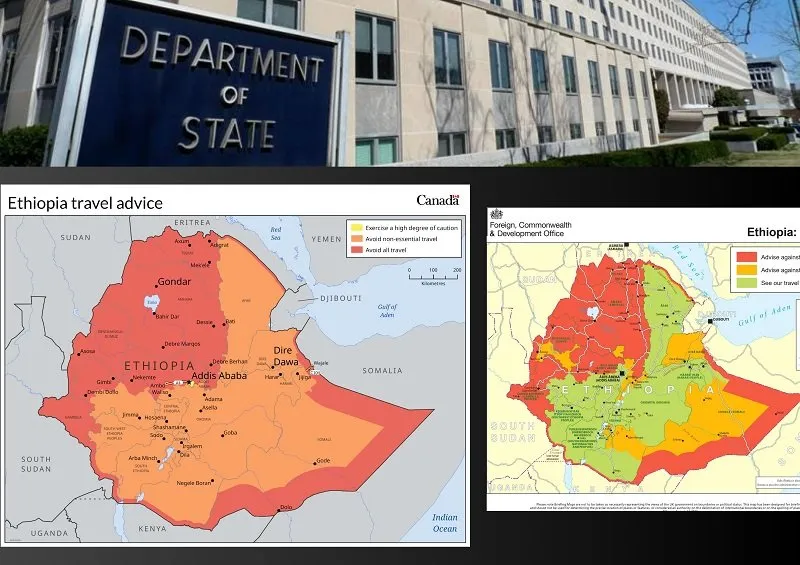
Three major Western governments have collectively identified at least seven Ethiopian regions as dangerous, effectively placing approximately 90% of the country’s territory off-limits to foreign nationals. When you map every restricted zone and measure what’s left, the only patch of relative safety is the capital, Addis Ababa, a city representing less than 1% of Ethiopia’s land mass. Everything beyond it is a patchwork of war zones, kidnapping corridors, and ethnic flashpoints.
A Country at War With Itself
The Amhara region, home to over 35 million people and some of Ethiopia’s most visited historical sites, has been under a state of emergency since August 2023. Armed groups and government security forces have been fighting in and around cities, towns, and airports. Roadblocks appear without notice. Curfews are imposed overnight. In Tigray, sporadic clashes erupted again in January 2026, and the 2022 ceasefire the world briefly celebrated was never fully implemented. The war there didn’t end, it paused.
In Oromia, Ethiopia’s largest region, armed conflict and ethnic violence have become almost routine. Roadside attacks, kidnappings, and intercommunal clashes occur regularly. Terrorist groups, including Al-Shabaab incursions from the Somali border, have explicitly targeted foreigners. The Gambella and Benishangul-Gumuz regions carry active kidnapping threats, and landmines near border zones remain unmarked and deadly. These are not isolated incidents. They are patterns.
The Unpredictability Problem
What makes Ethiopia particularly dangerous and what no advisory fully captures is the randomness of it. The security situation can deteriorate without warning. A road that was safe yesterday can be blocked by armed men today. Internet and cell service are deliberately shut down during periods of unrest, leaving travelers without navigation, communication, or the ability to call for help. Even in Addis Ababa, demonstrations can turn violent without notice, and conflict from surrounding regions has previously spilled into the capital.
What Three Governments Are Saying
The U.S. State Department’s Level 3 advisory, updated April 1, 2026, urges Americans to reconsider all travel to Ethiopia, with outright “Do Not Travel” orders for Tigray, Afar, Amhara, Gambella, and Benishangul-Gumuz. U.S. government employees require special authorization to enter those areas, and the Embassy explicitly notes it cannot assist citizens needing emergency medical evacuation in restricted regions. Canada advises avoiding all non-essential travel to Ethiopia entirely, warning that the security situation can deteriorate without notice, a position last updated on March 30, 2026. The UK Foreign Office advises against all travel to multiple regions and has barred its own embassy staff from leaving Addis Ababa without special authorization, as of its January 31, 2026 update.
If You’re Already There
For travelers currently in Ethiopia, authorities recommend registering with your embassy through programs like the U.S. Smart Traveler Enrollment Program, avoiding travel beyond Addis Ababa, monitoring local media constantly, and maintaining evacuation plans that do not rely on government assistance. Medical facilities across the country remain severely limited. Those still considering a visit should obtain comprehensive travel insurance, prepare for possible sudden communication blackouts, and seriously evaluate whether the trip is essential.
Ethiopia’s history, culture, and people remain extraordinary. But the convergence of civil war, terrorism, kidnapping, and administrative collapse has made it one of Africa’s most precarious destinations. Three governments, independently, reached the same conclusion in the same month. That alignment is not a coincidence; it is a warning.
Sources: 1. U.S. Embassy Ethiopia Travel Advisory (April 1, 2026),
2. Government of Canada Travel Advice for Ethiopia (March 30, 2026),
3. UK FCDO Ethiopia Travel Advice.
Editor’s Note : Views in the article do not necessarily reflect the views of borkena.com
__
Support Borkena : https://borkena.com/subscribe-borkena/
Join our Telegram Channel : t.me/borkena
Like borkena on Facebook
To submit Press Release, send submission to info@borkena.com
Add your business to Ethiopian Business Listing / Ethiopian Business Directory
Join the conversation. Follow us on X (Formerly Twitter) @zborkena to get the latest Ethiopian News updates regularly.