Key Points
-
The AI boom has made several trillion-dollar semiconductor companies.
-
Micron stock has pulled back following a blistering run over the last six months.
-
Investor expectations for the memory sector remain volatile.
- 10 stocks we like better than Micron Technology ›
The AI boom has created plenty of winners, and one of the biggest ones has been Micron (NASDAQ: MU).
Despite a recent pullback, shares of the memory-chip leader have soared over the last six months as the company is benefiting from an epic supply crunch that has driven up prices for memory components used to run AI models like high-bandwidth memory (HBM). It’s the same dynamic that has helped make Nvidia the most valuable company in the world. Demand for AI chips is outstripping supply, and that imbalance is unlikely to change soon.
Will AI create the world’s first trillionaire? Our team just released a report on the one little-known company, called an “Indispensable Monopoly” providing the critical technology Nvidia and Intel both need. Continue »
Micron and its memory chip peers have pulled back over the last couple of weeks on the threat from Google’s compression algorithm, TurboQuant, and fears that Micron stock had run too far too fast as shares fell even after it delivered blowout second-quarter results in March.
Now, Micron has a market cap of more than $400 billion, and the business certainly has the momentum to go higher. It trades at a forward P/E of less than 7, and profits are expected to surge in 2027 as well.
At a market cap of $410 billion, Micron is already one of the most valuable companies in the world, but it’s only natural to speculate on whether it will hit $1 trillion and when, joining semiconductor peers like Nvidia, Taiwan Semiconductor Manufacturing, and Broadcom.
Let’s take a look at what it would take Micron to get there.
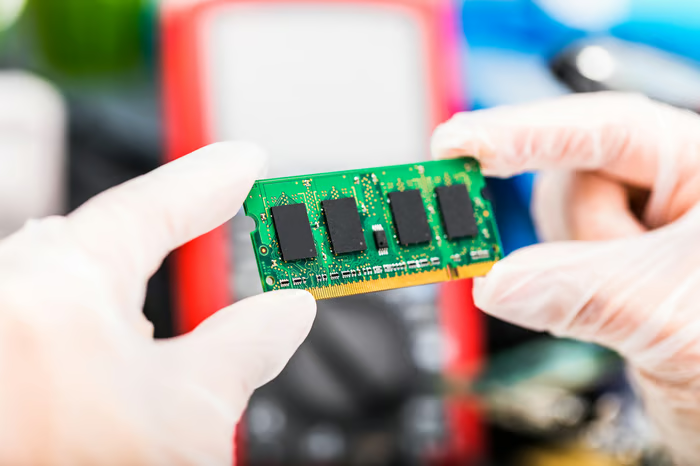
Image source: Getty Images.
An expectations-driven stock
The semiconductor sector is cyclical, which explains the modest valuations in stocks like Nvidia and TSMC, but the cyclicality of the memory sector is extreme, and Micron has been historically prone to booms and busts.
That seems to explain why investors sold the stock after its latest earnings report. While it’s clear the company isn’t done growing, investors are afraid of what’s on the other side of that cycle when pricing dynamics cool off. As recently as 2022, Micron was reporting significant losses due to an inventory glut in the sector, and Micron and its peers are expanding capacity to meet skyrocketing demand from AI.
Additionally, the threat from TurboQuant poses another challenge for Micron. At this point, it’s unclear how significant, if any, the impact of Google’s compression algorithm will be, but investors have overreacted to similar developments in the past, including DeepSeek, and at least one Wall Street analyst posited that Jevons paradox could mean that improvements in efficiency increase demand for memory chips, accelerating AI growth.
Still, in order for the stock to reach a $1 trillion market cap, Micron will have to win the expectations game, meaning it has to convince investors that this cycle is different, that it can still grow revenue for years to come, and that AI has raised the floor on the bottom of the cycle.
Micron’s also in a position to buy back significant amounts of its stock, and doing that could lift the share price as well, as that would give investors lasting benefits, even beyond the peak of the AI cycle.
Can Micron reach $1 trillion?
Based on the current trajectory of the business, Micron should be able to reach a $1 trillion market cap.
The company said it expected supply demand conditions to remain tight at least into calendar 2027, supporting higher prices, and its guidance for the fiscal third quarter called for strong sequential growth, forecasting revenue around $33.5 billion, up 40% from the second quarter, and even stronger growth on the bottom line.
After a recent meeting with management, Cantor Fitzgerald said it expected “very aggressive” share buybacks starting in December after restrictions related to the CHIPS Act expire, and it’s in an advantageous position as a U.S.-based chip manufacturer, especially at a time when its South Korean rivals are seeing energy costs surge from the war in Iran.
If the AI boom plays out as insiders like Nvidia CEO Jensen Huang expect it to, Micron still has a strong growth path ahead of it. Even at its low valuation, the stock should be able to reach the trillion-dollar mark by 2030, if not sooner.
Should you buy stock in Micron Technology right now?
Before you buy stock in Micron Technology, consider this:
The Motley Fool Stock Advisor analyst team just identified what they believe are the 10 best stocks for investors to buy now… and Micron Technology wasn’t one of them. The 10 stocks that made the cut could produce monster returns in the coming years.
Consider when Netflix made this list on December 17, 2004… if you invested $1,000 at the time of our recommendation, you’d have $532,066!* Or when Nvidia made this list on April 15, 2005… if you invested $1,000 at the time of our recommendation, you’d have $1,087,496!*
Now, it’s worth noting Stock Advisor’s total average return is 926% — a market-crushing outperformance compared to 185% for the S&P 500. Don’t miss the latest top 10 list, available with Stock Advisor, and join an investing community built by individual investors for individual investors.
*Stock Advisor returns as of April 3, 2026.
Jeremy Bowman has positions in Broadcom, Micron Technology, Nvidia, and Taiwan Semiconductor Manufacturing. The Motley Fool has positions in and recommends Micron Technology, Nvidia, and Taiwan Semiconductor Manufacturing. The Motley Fool recommends Broadcom. The Motley Fool has a disclosure policy.
The views and opinions expressed herein are the views and opinions of the author and do not necessarily reflect those of Nasdaq, Inc.