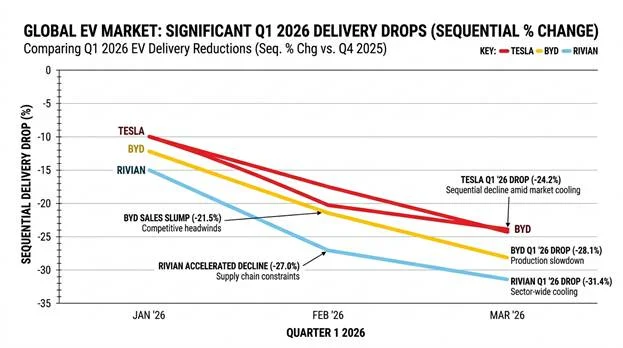
The first quarter of 2026 has sent a shiver through the electric vehicle sector, and the epicenter is Austin, Texas. Tesla’s stock plummeted over 5% following the release of its Q1 delivery figures, which revealed 358,023 vehicles handed over to customers. While any other startup would dream of such volume, for Tesla, it represents a sobering 14% sequential drop from the record-breaking highs of Q4 2025.
For those of us living in EV-dense hubs, the data feels contradictory to our daily surroundings. In my neighborhood in Bend, Oregon, Teslas are as common as pine trees. I actually live within walking distance of a large Tesla sales and service center, and the lot is rarely empty. Yet, the disconnect between local visibility and global delivery charts is becoming impossible to ignore. Tesla isn’t just fighting a “law of large numbers” problem anymore; it is fighting a fundamental shift in market sentiment.

Contextualizing the Slump: Is Tesla Alone?
To understand if Tesla’s 14% sequential drop is an anomaly or a trend, we must look at the broader “EV-only” landscape. Pure-play EV manufacturers like Rivian and Lucid are facing similar headwinds, though for different reasons. Rivian has struggled with scaling its R2 platform, while Lucid remains a niche luxury play focused on ultra-high efficiency. However, the most telling comparison comes from the East.
BYD, Tesla’s primary global rival, also saw a sequential dip following the Lunar New Year, yet they continue to eat into Tesla’s market share in Europe and Southeast Asia. According to Electric Cars Report, while some growth has returned compared to the dismal start of 2025, the momentum is lagging significantly behind the exponential curves Musk promised years ago.
Traditional OEMs like Hyundai and Kia, which offer a mix of powertrains, are actually showing more resilience. Their ability to pivot to hybrids while EV demand softens in the U.S. has protected their balance sheets. Tesla, being EV-exclusive, has no such safety net. When the pure-EV market sneezes, Tesla catches a cold.
The Root Causes: Why the Miss?
Several factors converged to create this Q1 “perfect storm.”
- Saturating the Early Adopter Market: In regions like mine, the “early adopter” phase is over. Almost everyone who wanted a Model 3 or Model Y and could afford one already has one. To grow further, Tesla must convert the skeptical “late majority” who are currently deterred by high interest rates and charging anxiety.
- Product Stagnation: The Model 3 Highland refresh was a step forward, but the Model Y—Tesla’s bread and butter—is aging. In a market where consumers are used to frequent “new” looks, the familiar silhouette of the Y is starting to blend into the background.
- The “Musk Risk” Factor: Consumer sentiment surveys continue to suggest that Elon Musk’s increasingly polarized public persona is impacting brand equity. In liberal-leaning EV strongholds like the West Coast, some potential buyers are looking toward brands like Polestar or Volvo—specifically the new Volvo EX60—to avoid the political “baggage” currently associated with Tesla.
- The Rise of Incentives: Tesla’s pricing war has reached a point of diminishing returns. Constant price cuts have decimated the resale value of existing owners’ cars, creating a “wait and see” attitude among new buyers who fear their purchase will be worth thousands less next month.

The Roadmap to Recovery: What Musk Must Do
To stabilize the stock and regain the 20% annual growth target, Tesla needs to move beyond tweets and Full Self-Driving (FSD) hype.
Prioritize the “Model 2” (Next-Gen Platform): The world does not need another $100,000 Cyberbeast; it needs a $25,000 mass-market vehicle. Tesla must accelerate the timeline for its smaller, cheaper platform to compete with the influx of affordable Chinese EVs.
Refresh the Model Y Immediately: As the best-selling vehicle in the world in 2023, the Model Y is the company’s lifeblood. A “Juniper” refresh that offers more range and a more premium interior is essential to spark a Q3/Q4 recovery.
Separate the Brand from the Man: Tesla needs a Chief Operating Officer (COO) with the public-facing gravitas of a traditional automotive executive. Musk’s brilliance in engineering and first-principles thinking is undisputed, but the company needs a “steady hand” to manage customer service and PR—areas where Tesla notoriously lags.

Can Tesla Recover?
Betting against Tesla has historically been a losing game. The company still possesses the world’s most efficient manufacturing process and an unparalleled Supercharger network that remains a “moat” even as it opens to other brands.
However, the “recovery” might not look like the vertical “to the moon” trajectory of 2020. We are likely entering a period of “normalization” where Tesla becomes a mature automaker. The recovery will depend on whether Tesla can successfully transition from being a “tech company that makes cars” to a “car company that dominates energy and AI.” If the Robotaxi reveal later this year fails to provide a concrete revenue roadmap, the stock may find a new, lower floor.
Wrapping Up
Tesla’s Q1 delivery miss of 358,023 units is a wake-up call. The 14% sequential drop highlights a saturation point in key markets and a desperate need for product diversification. While the company is still the volume leader among EV-exclusive vendors, the gap is closing. To recover, Musk must deliver on the promised affordable platform and refresh the aging lineup. Tesla isn’t going away—the density of cars in my own neighborhood is proof of their cultural footprint—but the era of easy, uncontested growth is officially over. The next year will determine if Tesla remains the industry leader or becomes just another player in a crowded field.
Disclosure: Images rendered by Artlist.io
Rob Enderle is a technology analyst at Torque News who covers automotive technology and battery developments. You can learn more about Rob on Wikipedia and follow his articles on TechNewsWord, TGDaily, and TechSpective.
Follow us today…