8h05 ▪
4
min read ▪ by
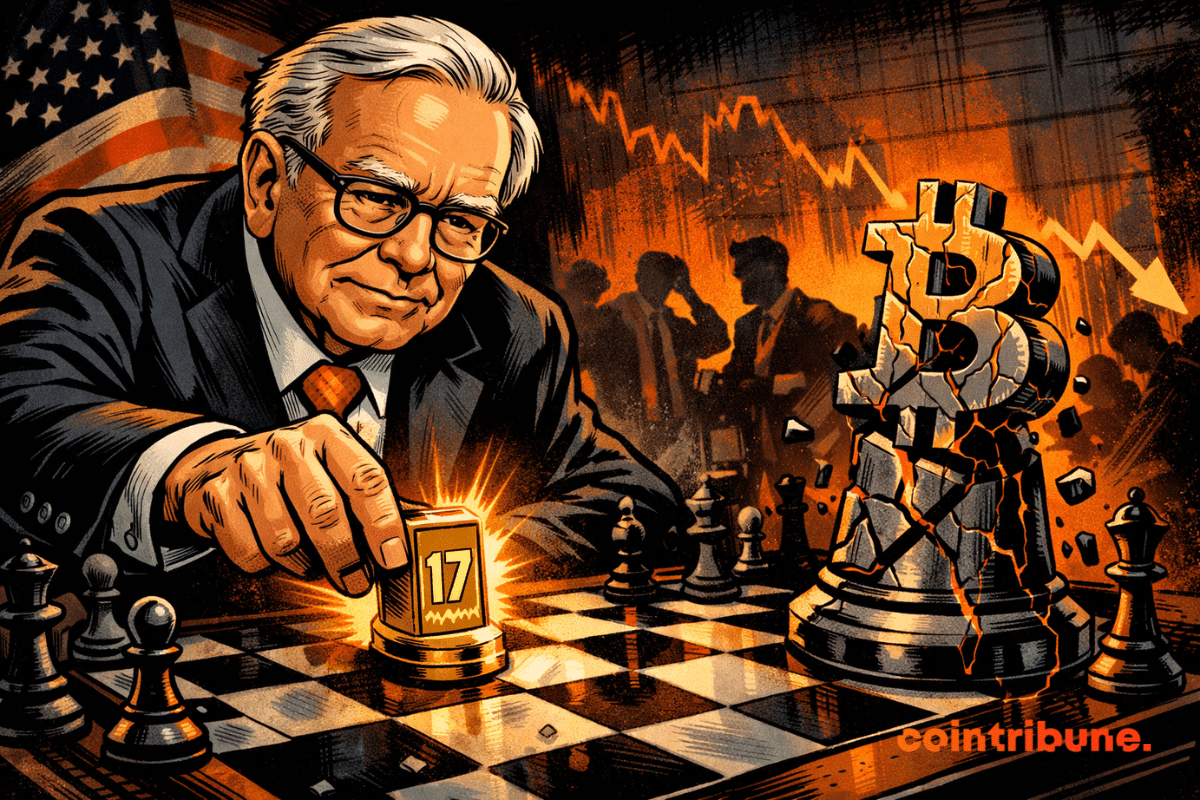
Warren Buffett just announced it on CNBC. Berkshire Hathaway bought about 17 billion dollars of U.S. Treasury bills at the latest auction. A seemingly mundane move. But for those who follow bitcoin price, this signal deserves close attention.
In Brief
- Berkshire Hathaway bought about $17B in T-bills in the latest auction.
- Berkshire Cash: $373B at end 2025 – an all-time record, more than double the end of 2023.
- Buffett: the S&P 500 drop (–5.75%) is nothing compared to crashes of –50%+.
- Bitcoin/Nasdaq correlation = +0.47 over 20 weeks, a bearish signal if markets fall further.
- Berkshire liquidated Nu Holdings (crypto fintech) in Q1 2025 for $250M+ profit.
- Some analysts predict Bitcoin at $30,000 in 2026 in a bearish scenario.
Why Does Buffett’s Cash Strategy Constitute a Bearish Signal for Bitcoin?
According to data, Berkshire Hathaway ended 2025 with 373 billion dollars in cash and equivalents. That’s more than double the levels at the end of 2023. An all-time record! It doesn’t directly impact bitcoin’s value, but it has some importance.
When asked about the recent S&P 500 decline (–5.75% since its January 2026 peak) during his interview, Buffett compared this correction to major crashes of the past. According to him, stocks aren’t yet substantially cheaper. This explains why Berkshire is not buying.
History gives weight to this interpretation. In 1998, Buffett had begun building up his reserves. This brought Berkshire’s cash to 13.1 billion. That represented 23% of assets. In 2000, this ratio rose to 25%. That was precisely when the dot-com bubble burst. Berkshire then deployed its capital on the ruins. The leading indicator had worked.
This context explains Berkshire’s recent behavior regarding crypto fintech. In Q1 2025, the group sold its entire position in Nu Holdings. This is a crypto-friendly digital bank acquired in 2021.
- Result: $250 million profit realized.
- Implicit message: even adjacent cryptocurrency is no longer in the sights.
How Does the Correlation Between BTC and the Stock Market Amplify This Risk?
Data confirms it: bitcoin is no longer seen as an asset uncorrelated with traditional markets. Indeed, the 20-week rolling correlation between BTC/USD and the Nasdaq Composite stands at +0.47.
Explanation: when the Nasdaq drops, the BTC price tends to fall as well.
This is not a new phenomenon. Since 2020, bitcoin has gradually aligned with risk assets (alongside tech stocks, not gold). When global liquidity contracts, investors sell the most volatile assets first. And BTC remains at the top of the list for many.
For their part, crypto analysts are not reassuring. In a prolonged bear market scenario, several project a bitcoin price at $30,000 in 2026. And why?
- Recession risks in the United States estimated at about 50%;
- Geopolitical tensions fueling inflation;
- Questions about the quantum security of the Bitcoin network.
Several years ago, Buffett called bitcoin “rat poison”. And to this day, he hasn’t changed his mind. But it’s not his opinion that matters here. It’s mainly his reading of the overall market. When the most followed investor in the world prefers Treasury bills to any other asset, the signal is universal. Whether we like it or not, bitcoin is no exception.
Certainly, Buffett’s decision doesn’t directly concern bitcoin. Nevertheless, it says something about the state of the markets. And in 2026, BTC cannot ignore this macro signal.
Maximize your Cointribune experience with our “Read to Earn” program! For every article you read, earn points and access exclusive rewards. Sign up now and start earning benefits.

My name is Ariela, and I am 31 years old. I have been working in the field of web writing for 7 years now. I only discovered trading and cryptocurrency a few years ago, but it is a universe that greatly interests me. The topics covered on the platform allow me to learn more. A singer in my spare time, I also cultivate a great passion for music and reading (and animals!)
DISCLAIMER
The views, thoughts, and opinions expressed in this article belong solely to the author, and should not be taken as investment advice. Do your own research before taking any investment decisions.