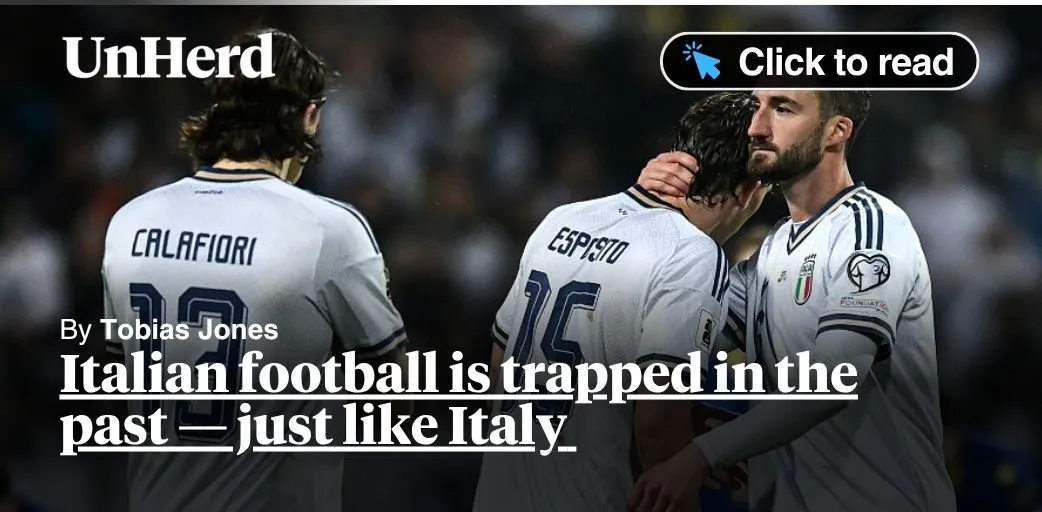
For the third time running, Italy — a former superpower of world football — won’t be going to the World Cup. On Tuesday evening, the four-time world champions were dumped out on penalties by Bosnia-Herzegovina in their crucial qualifier.
In many ways, this elimination was hardly even surprising: last year, in the group qualifying stages, Italy was tonked home and away by Norway, losing 7-1 on aggregate over two matches. That pasting came in the aftermath of Inter Milan being battered 5-0 by Paris Saint-Germain in the 2025 Champions League final.
For those of us who remember Italy’s World Cup triumphs of 1982 and 2006 (the latter final was the last time Italy won a knockout match in the tournament), this is a grim implosion. In the past, one just knew Italy would find a way to win; now, one just knows the team will find a new way to lose.
This footballing crisis mirrors wider problems. Italy is a gerontocratic country, empowering the elderly at the cost of youth, and it’s now facing a “demographic winter”. Its football reflects that: in a country often devoid of meritocracy, the sport is bossed by elderly men with no vision. Gabriele Gravina, the septuagenarian head of the Italian FA, has now overseen two failed World Cup qualifying campaigns, yet last year he was re-elected to his role with the North Korean percentage of 98.68%.
Italy doesn’t just distrust youth but also, oddly, Italian talent. Serie A used to have a limit on the number of foreign-born players a team could field, whereas now 68.5% of players in the league are non-Italian. For comparison, the figure in La Liga, Spain’s top division, is 43.7%. And so the country’s football, like its economy, is reliant on immigrants.
But Italian football remains extremely provincial because it isn’t exporting players: the country lies 24th in the league table of exported footballers between 2020-25. The top six exporters are, roughly, the current favourites for the World Cup: Brazil, followed by France, Argentina, England, Spain and Germany.
Serie A games also seem two gears slower than Premier League ones, which is partly why broadcasting conglomerates have little interest in them. In the 2021-24 cycle, the foreign rights to Serie A were sold for a paltry $658 million compared with (in the 2022-25 period) the Premier League’s $6.55 billion.
All sports evolve, and it may just be that 21st-century football doesn’t suit the traditional ways Italians have always played it. For decades, the Azzurri relied on the beautiful paradox of defensive closure (catenaccio) and attacking flair (fantasia). Its football was, perhaps like Italy itself, at once risk-averse and hypnotically creative. Modern football is now the opposite: defences are far more open, playing out from the back, but attackers are less inventive, slotted into rigid formations. The game has moved on and Italy, it seems, is yet to catch up.