The extraordinary news that the result of the 2025 Africa Cup of Nations final had been reversed, almost two months after it was played, sent shockwaves through sport.
Senegal won the match, 1-0 after extra time, on January 18 but temporarily left the pitch during it in protest at opponents and host nation Morocco being awarded a penalty late in normal time — which was then missed following the nerve-shredding wait caused by the walk-off.
The Royal Moroccan Football Federation (FRMF) appealed, claiming that Senegal should forfeit the match and the title as a result of their behaviour. The Confederation of African Football (CAF) agreed with them, and thus Morocco were controversially declared champions. Senegal have, in turn, appealed CAF’s ruling.
All this got The Athletic thinking: which other famous moments, games and events in sporting history could have seen the results reversed? Or should have been replayed? Which injustices were so egregious that the outcome on the day should have been expunged?
From last-lap, last-race drama in Formula One, Stanley Cup controversy, deliberate cheating in football and much more, this is what our writers have come up with.
The final race of the 2021 Formula One Drivers’ World Championship
The 2021 Abu Dhabi Grand Prix will forever be written into the pantheon of questionable sporting results.
Lewis Hamilton of Mercedes led title rival Max Verstappen of Red Bull for most of the race, the last of the season, and was poised to win his record-breaking eighth World Championship title.
Instead, race director Michael Masi — under intense lobbying from Verstappen’s team principal Christian Horner — made a highly questionable and controversial decision.
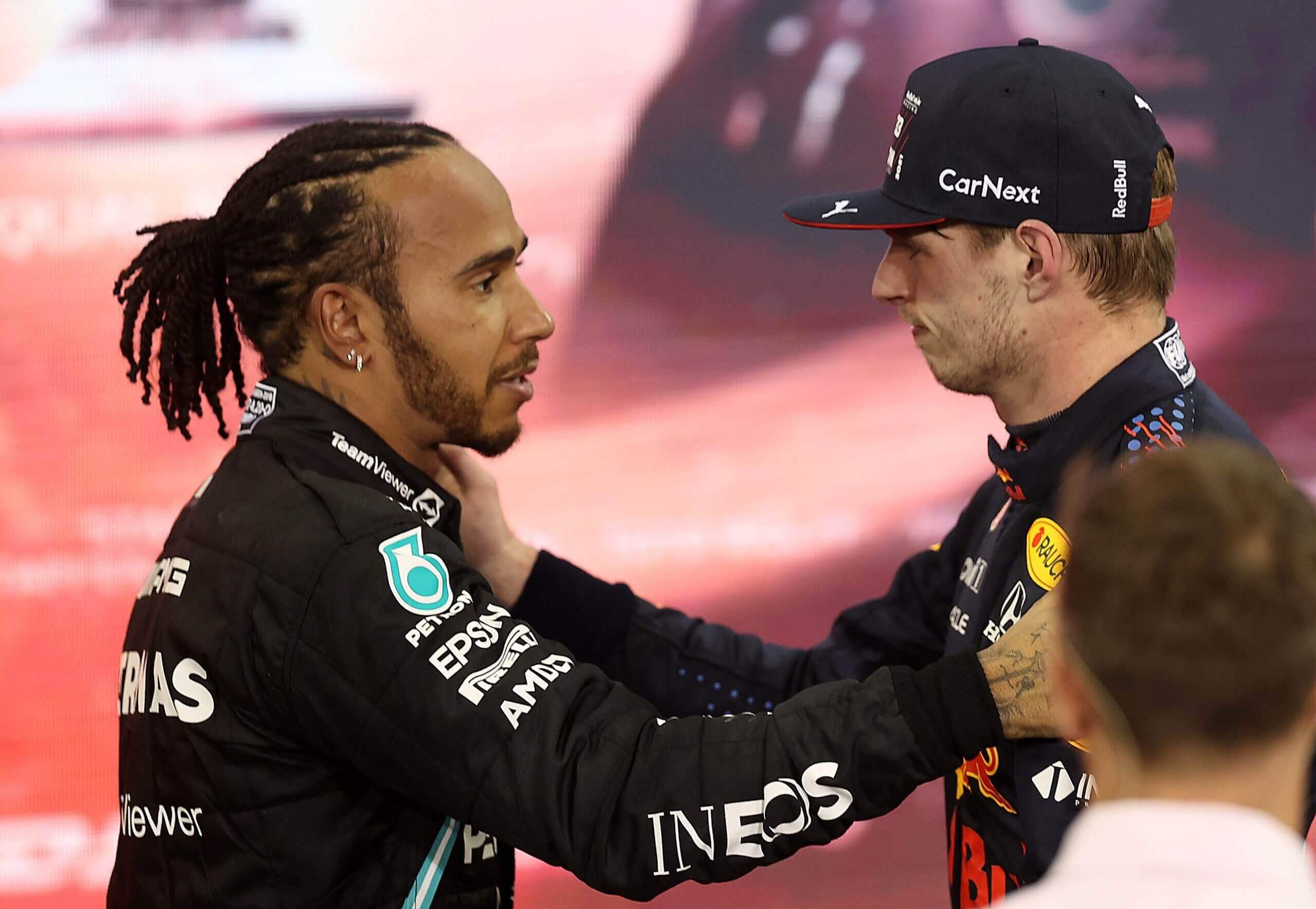
Hamilton (left) and Verstappen after the race (Lars Baron/Getty Images)
Only the cars between the chasing Verstappen and Hamilton were allowed to un-lap themselves and the speed-limiting safety car period was ended prematurely.
That made Hamilton a sitting duck for Verstappen, who was on fresher tyres, and the Dutchman duly overtook the Brit and snatched the title away from him on the final lap.
Masi was eventually replaced as a result but Hamilton’s sense of injustice, understandably, endures.
Max Mathews
France vs Republic of Ireland in the play-offs for the 2010 World Cup
Mention this Thierry Henry handball to an Irish football fan and watch their face contort in rage and pain. However, the real shame is that the furious fallout masked just how good an away performance this was from the Republic of Ireland.
After losing the first leg of the 2010 World Cup play-off 1-0 in Dublin, Ireland took France to extra time in Paris in the second courtesy of a Robbie Keane goal.
Deep down, Irish fans know the controversy should never have been allowed to happen in the first place, with Keane and Damien Duff missing golden one-on-one chances to settle the tie in normal time.
But, in the 103rd minute, happen it did. The officials missing one handball is egregious enough but Henry handled twice in the same movement — first with his forearm, then with his hand — before prodding the ball across for William Gallas to score the winner.

Republic of Ireland’s furious players surround Swedish referee Martin Hansson and his assistant (Franck Fife/AFP via Getty Images)
Goalkeeper Shay Given rushing to the assistant referee in the immediate aftermath and Richard Dunne slumped on the floor at the end of the game are images seared forever into the Irish football psyche.
It was a gross injustice but realistically, a replay was never an option. The Football Association of Ireland’s attempts to overturn the result were slightly unedifying, including a bizarre request to be allowed to enter the 2010 World Cup as a 33rd nation.
Outlandish as this suggestion was, then-FIFA president Sepp Blatter’s giggling response did not exactly go down well in Ireland.
Conor O’Neill
The 1999 Stanley Cup final
In 1991, the NHL introduced a controversial rule: goals would be disallowed if the puck entered the net while an attacking player is standing on the goal crease line, is in the goal crease or has his stick in the goal crease.
Eight years later, Game 6 of the Stanley Cup Final between the Dallas Stars and the Buffalo Sabres had gone to triple overtime, the second-longest game in the history of the final round of the play-offs. Both teams were looking to win their franchise’s first Stanley Cup.
With just over five minutes remaining in the third overtime, the Stars fired the puck at all-world Sabres goalie Dominik Hasek. Hasek fell to his stomach to corral the puck, but it snuck free.
The rebound came to Stars forward Brett Hull, one of game’s most lethal goalscorers. Hull kicked the puck to his stick. His left skate entered the crease as he fired home the Cup-winning goal. The Sabres were livid and demanded an explanation from NHL Commissioner Gary Bettman.

Hull playing for the Dallas Stars in 1999 (Harry How/Getty Images)
Bettman said that Hull had maintained possession of the puck throughout the play, which meant the goal would count. The Stars would win their first and only Stanley Cup, while the Sabres are still yet to win an NHL championship.
And in Buffalo, you only need to enter any sports bar and mutter the words “No Goal” to have a Sabres fan lower their heads in frustration.
Joshua Kloke
Ghana vs Uruguay at the 2010 World Cup
Ghana’s Golden Generation were an illegal goal-line clearance away from making history at the 2010 World Cup in South Africa.
The Black Stars were in the quarter-finals, playing Uruguay, and the game was tied at 1-1 nearing the end of extra time.
Victory for Ghana would have made them the first African nation to reach the World Cup semi-finals — and at the first tournament on their continent.
Then it happened. A free kick for Ghana comes into the box, a legal goal-line clearance from Luis Suarez to block Stephen Appiah’s shot with his knee, and then… an instinctive swing of his hands towards the ball to keep out Dominic Adiyiah’s headed follow-up.

Luis Suarez’s notorious handball (Michael Steele/Getty Images)
Suarez was sent off and Ghana were awarded a penalty. Asamoah Gyan had a chance to make history for Ghana but his penalty hit the crossbar and went over. Ghana lost 4-2 in the penalty shootout.
Suarez’s punishment was correct according to the rulebook but that did little to ease the devastation.
The incident ignited a minor football rivalry between the nations. The 2022 World Cup group stage gave Ghana a chance for revenge and when the Black Stars won a penalty in the 22nd minute, it felt like the football gods were offering up an apology for what happened 12 years earlier.
It wasn’t to be: Andre Ayew took one of the worst penalties the World Cup has seen and Uruguay ran out 2-0 victors. Ultimately though, both sides were eliminated in that first round in Qatar.
Carl Anka
Super Bowl XLIV
The New Orleans Saints won Super Bowl XLIV in February 2010, but two years later, an NFL inquiry ruled that they had run a bounty program from 2009 to 2011, handing out bonuses for hard hits and injuring opponents. This leaves a big asterisk on their victory.
They were never stripped of the championship but those involved received severe punishments. Sean Payton, now the Denver Broncos head coach, was suspended for the 2012 season, while the defensive coordinator (DC), Gregg Williams, was indefinitely suspended before this sanction was later reversed. He’s now the Tennessee Titans’ DC.

New Orleans Saints on their way to winning the Super Bowl (Jed Jacobsohn/Getty Images)
The Saints paid a $500,000 (£372,000; €430,000) fine and were docked draft picks.
In their NFC Championship game against the Minnesota Vikings, opposition quarterback Brett Favre’s ankle swelled to the size of a tennis ball following an illegal hit to the back of his legs. After the NFL investigation, which reviewed 180,000 documents, the league sent its findings in a memo to all teams, with one such example that Saints linebacker Jonathan Vilma offered $10,000 to any team-mate who took Favre out of the game.
Eduardo Tansley
South Korea’s run to the 2002 World Cup semi-finals
The 2002 World Cup in Japan and South Korea was the first edition of the famous competition to be hosted by more than one country, with Brazil eventually lifting the trophy for an unprecedented fifth time.
But it was one of the most controversial World Cups in the modern era thanks to South Korea’s run to the semi-finals. The co-hosts eliminated Italy (in the round of 16) and Spain (in the quarter-finals) following highly questionable decisions from the match officials.
Firstly, against Italy, the Ecuadorian referee Byron Moreno awarded South Korea a soft penalty in the first half. Gianluigi Buffon saved the spot kick but that was far from the end of the controversy\, with Alessandro Del Piero elbowed in the face later in the match.
Extra time then saw Italy midfielder Francesco Totti sent off after picking up a second yellow card when Moreno adjudged him to have dived.

Totti receives his second yellow card (Kim Jae-hwan/AFP via Getty Images)
Then, Damiano Tommasi thought he had scored what would have been the winning Golden Goal but was flagged for a questionable offside. Ahn Jung-hwan scored the winner for South Korea with three minutes to go.
Moreno was later investigated for allegations of match-fixing in Ecuador and served time in prison after being convicted of drug trafficking in 2010.
In the last eight, Spain’s Joaquin set up what would have been the winning goal with a deft cross but the ball was ruled to have been off the field, despite footage showing it was clearly still in play. Then in the penalty shootout, South Korea goalkeeper Lee Woon-jae was clearly off his line when he saved the decisive spot-kick from Joaquin. Their good fortune ran out against Germany in the semi-finals.
Felipe Cardenas
The 2019 Cricket World Cup final
The scene was Lord’s; the tension excruciating. Ben Stokes had just swung a six into the stand over deep midwicket to leave England needing nine from Trent Boult’s last three balls to beat New Zealand and claim their first 50-over World Cup.
Then came what former umpire Simon Taufel, one of the game’s most respected officials, would later describe as “a clear mistake” which changed the course of the match.
Stokes heaved a full toss from Boult out to cow corner and set off knowing he had to run two to be back on strike. The ball was gathered near the fence by Martin Guptill, who threw to the wicketkeeper’s end. Stokes, sensing he would be short, dived to make his ground with the ball inadvertently deflecting from the back of his bat and scuttling off to the unguarded boundary in front of the pavilion.

Stokes dives to make his ground (Dibyangshu Sarkar/AFP via Getty Images)
Amid the bedlam inside the stadium, the umpires Marais Erasmus and Kumar Dharmasena awarded six runs — the two that had been completed, plus four overthrows. England eventually tied the game and won on a Super Over.
Except, as Taufel pointed out soon after the match had concluded, the umpires had erred. Under the Laws of the game, Law 19.8 relating to overthrows states that “if a boundary results from an overthrow” the runs scored shall be “the allowance for the boundary and the runs completed by the batsmen, together with the run in progress if they had already crossed at the instant of the throw”.
Television replays showed clearly that Stokes and his batting partner, Adil Rashid, had not crossed for the second run when Guptill released the ball, so England should technically have been awarded only a single in addition to the four overthrows. Similarly, had the law been enforced, then Rashid would have been on strike for the game’s penultimate delivery rather than Stokes.
All of which seems a bit unfair on New Zealand. And particularly when you throw in the fact that the Super Over was also tied, with each side making 15, meaning the final was ultimately decided on the little-used boundary count-back rule. England had struck 26 over the course of the day to New Zealand’s 17. Which, when you think about, was an equally ridiculous way to conclude a seven-week tournament.
Dominic Fifield
France vs West Germany at the 1982 World Cup
After settling on the magic triangle of Michel Platini, Jean Tigana and Alain Giresse — Luis Fernandez would complete the square at the following major tournament — France reached their second World Cup semi-final in sweltering Spain in 1982.
Sporting a magnifique Adidas kit, they met West Germany in Seville. At 1-1 the game was sizzling along nicely when Patrick Battiston replaced the booked Bernard Genghini at the base of the midfield diamond in the 50th minute.
He was on the pitch for less than 10 minutes; two and a half of them spent lying unconscious.
As Platini caressed a pass forward to his surging Saint-Etienne team-mate Battiston, West Germany goalkeeper Harald ‘Toni’ Schumacher raced off his line towards the edge of the penalty area. Battiston got there first and the camera operator followed his shot as it trickled wide, before clocking that the main event had been missed.
This is because, despite having ample time to reconsider, Schumacher charged airborne into Battiston’s head. The shot from behind the goal is particularly graphic as a concussed Battiston collapsed in a heap.
Dutch referee Charles Corver didn’t even book Schumacher, let alone award a penalty.
Battiston required oxygen and lost three teeth, and as he left the field on a stretcher, a harrowed Platini held his right hand. He was discharged from hospital the following day.

Platini comforting a stricken Battiston (AFP via Getty Images)
Sporting a thousand-yard stare, Schumacher put his hands on his hips and chewed gum as he waited to take the resulting goal kick. “I regret not having looked after Patrick when he was on the ground,” he said in 2016.
After taking a 3-1 lead in extra time, France began to showboat. West Germany got it back to 3-3 and won the penalty shootout, the World Cup’s first. Of course, Schumacher saved twice.
Peter Carline