THE INDEPENDENT RUSSIAN MEDIA, nearly all of them in exile, have for the past week been abuzz with the astonishing saga of Ilya Remeslo, the pro-war blogger and Kremlin stooge who suddenly turned furiously on Vladimir Putin, denouncing him as a war criminal and a crook in a series of increasingly audacious Telegram posts and videos. Remeslo is now in a psychiatric hospital amid frenzied speculation: Is this Soviet-style punitive psychiatry or is he hiding out in the hospital to avoid arrest? Is his sudden rebellion an opportunistic attempt at rebranding, an ingenious government provocation—or a move by a Kremlin faction seeking to topple Putin?
The issue isn’t Remeslo, until now a fairly obscure figure except among the dissidents he helped hound; it’s whether his mutiny is one of the signs of a coming crackup of the Putin regime. The Russian offensive in Ukraine flails and founders; other war hawks and Kremlin loyalists besides Remeslo are saying heretical things; internet shutdowns and massive cattle culls to combat reported epidemics of infectious disease are causing a wave of discontent to spill out into usually docile public spaces. Meanwhile, Putin is keeping a low profile, staying completely out of sight for ten days and then reappearing with a boilerplate speech. As political scientist Ekaterina Schulmann put it in an interview, “Something is bubbling up.”
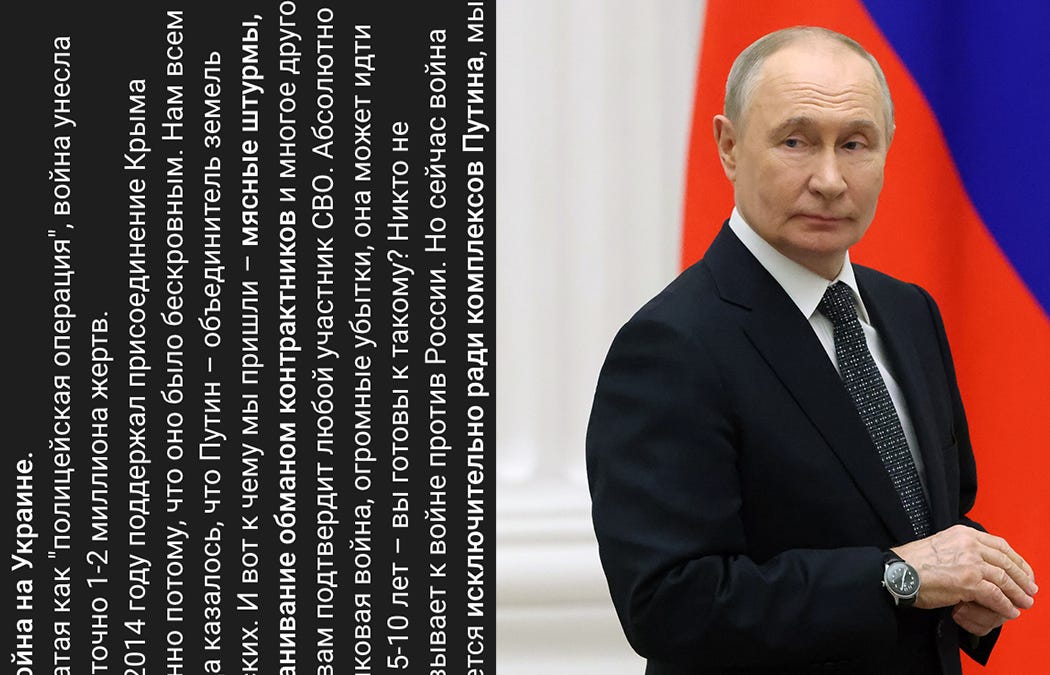
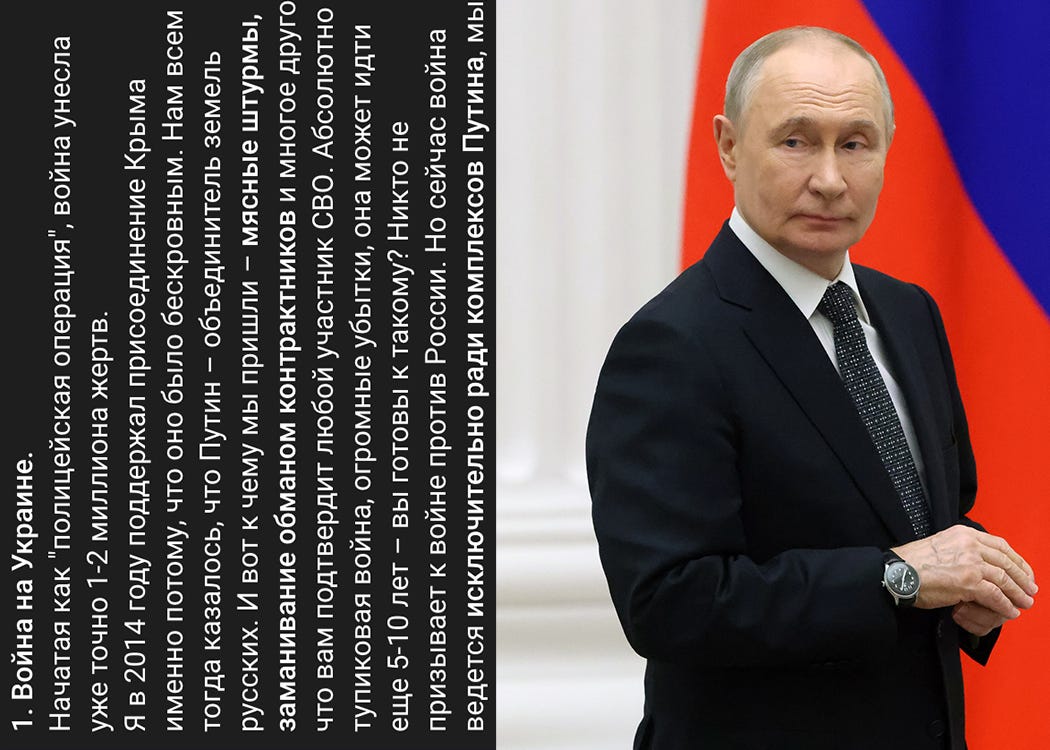
REMESLO’S MARCH 17 TELEGRAM POST, titled “Five Reasons I’ve Stopped Supporting Vladimir Putin,” was nothing if not audacious. He bluntly stated that the war in Ukraine was a “dead-end” disaster carried out solely on account of Putin’s “complexes” (i.e., psychological issues) and that Russia’s economy and its citizens’ well-being were suffering “massive damage.” He continued his indictment with the suppression of the media and, more recently, “the choking of the internet.” He raised the issue of Putin’s fitness at 73, argued that his 27 years in power have been a textbook example of how “absolute power corrupts absolutely,” and finally accused Putin of contempt for Russian voters and of insulating himself from all criticism or debate—not to mention political opposition. He concluded by asserting that “ Vladimir Putin is not a legitimate president” and calling not only for his resignation but for his prosecution “as a war criminal and thief.” An addendum mentioned Putin’s pathological love of luxury and self-enrichment.
Remeslo’s j’accuse sparked a flurry of explanations. His Telegram account must have been hacked! (Nope; he promptly recorded videos confirming that he had written the post.) The post must have been greenlit by the Kremlin as part of some clever plan—perhaps as bait to draw closeted subversives out into the open, or maybe to groom a fake opposition figure in time for September’s fake elections for the Duma! (Nope; YouTube journalist Michael Nacke and others have pointed out that Remeslo’s broadside against Putin had smashed all sorts of taboos whose breaking the regime never would have sanctioned.)
The one hypothesis virtually all commentators rejected out of hand was Remeslo had had a genuine crisis of conscience, since that would presuppose the possession of such a faculty. Remeslo, a 42-year-old lawyer whom Nacke described as a “loathsome character,” is not just a professional propagandist but also a professional rat who had spent years actively assisting in the persecution of opposition activists—including the late Alexei Navalny—with denunciations and criminal complaints. (In a stranger-than-fiction wrinkle, remeslo means “skilled trade” in Russian, generating a lot of jokes about the nature of his skills.) Believing in the authenticity of Remeslo’s Saul-to-Paul conversion was all the more difficult since, by his own account, he had only stopped supporting Putin at some point in the last three years, even though much of his indictment had been true long before that.
Other theories mentioned by Nacke include the possibility that the government-adjacent Remeslo was about to face embezzlement charges as part of ongoing corruption probes and purges in the Russian Ministry of Defense and decided to rebrand himself as a dissident in the hope of leaving Russia and receiving political asylum abroad. Nacke’s own view is much more straightforward: that Remeslo actually did have a psychotic break as a result of the cognitive dissonance that comes with being a Kremlin propagandist. But Remeslo certainly didn’t seem to be having any psychiatric problems in his media appearances, including a forty-five-minute interview with the Breakfast Show, a YouTube media project run by Russian émigré journalists. That interview was also remarkably candid: Remeslo matter-of-factly admitted that he had been in the Kremlin’s pay and that the pay had dried up, a thing that could make the scales fall from anybody’s eyes. Interestingly, Remeslo also asserted in that interview that he had actually seen the light after the mutiny and subsequent murder of former Putin henchman and mercenary warlord Yevgeny Prigozhin three years ago—and was finally emboldened to speak out because he believes the regime is on its last legs and that Putin will be out of power by the end of the year.
Political analyst Stanislav Belkovsky (himself a Kremlin-adjacent political strategist in the early 2000s) told the Breakfast Show that talk of Putin’s imminent political demise was “wishful thinking.” But Belkovsky also noted that Remeslo’s still-mysterious demarche, whatever the real reason for it, points to one simple truth: plenty of people at the Kremlin’s feeding trough think the same things, they just don’t have the guts or the incentives to say it publicly.
PUTIN MAY NOT BE NEARING his downfall and delivering Hitler rants in his various bunkers, but there are a lot indications that he’s nervous—among them, three weeks of severe disruptions to mobile internet service in Moscow, apparently ordered by the FSB and not by the communications oversight agency Roskomnadzor, which normally has online censorship in its purview. One possible reason is that Putin was reportedly freaked out by the assassination of Iranian leader Ali Khamenei and feared that he could be located via mobile signals. However, mobile internet outages have also been reported all over Russia, most recently in St. Petersburg. So could it be fear of Ukrainian smart drones, whose strikes within Russia now happen on a regular basis? Or fear of popular access to news the Kremlin doesn’t want ordinary Russians to see—for instance, about failures and heavy casualties in Russia’s spring offensive in Ukraine, which military expert Yuri Fedorov says has “choked” before it even started properly? Maybe both?
Whatever the motive, there is no question that the inconveniences caused by the loss of mobile internet have been a major irritant. People in Moscow and many other Russian cities have come to rely on smartphones for everything from car service to food delivery; what’s more, the outages have severely curtailed their ability to use credit cards for various goods and services, including even paid public toilets. Yes, you can moralize about people who shrug off a horrific war their government is waging but get indignant when they suddenly can’t buy a snack or find a place to pee, but such self-centeredness is hardly exclusive to Russia—though Russian political apathy in the Putin era has reached shocking levels of learned helplessness. Taking away the internet in 2026 is the kind of thing that may finally break through that apathy.
Add to this the moves to throttle Telegram, Russia’s most popular blogging and messaging platform; according to the latest reports, its availability in Russia has now been reduced to about 25 percent of normal access. This decision may have helped impede Russian military operations in Ukraine, especially in conjunction with loss of access to Starlink satellite communications: Many units relied on Telegram for messaging. But it has also angered scores of pro-Kremlin propagandists and war-hawk bloggers who relied on Telegram for revenue. If, as Remeslo asserts, Kremlin pay is also drying up, we could see more rebellions. Telegram blogger Ivan Filippov, a longtime watcher of the “Z community”—i.e., Russia’s active war-hawk faction, identified by the “Z” symbol used by the Russian armed forces during the Ukraine invasion—says that discontent in that group has been at unprecedented levels lately and is increasingly directed at Putin himself. Even a frequent guest of top propagandist Vladimir Solovyos’s Solovyov Live webcast, retired intelligence officer Andrei Bezrukov, suddenly gave a podcast interview denouncing the internet and Telegram restrictions as “ridiculous” and harmful to ordinary Russians. “It’s as if, at a difficult moment for our country, we were deliberately trying to irritate a large segment of our people,” said Bezrukov.
A few days ago, even the governor of the Belgorod province, a border region that has been a frequent target for Ukrainian drone and missile strikes against military-related targets, joined the chorus of critics, saying that the Roskomnadzor should be “put on trial.” The communications oversight agency is a relatively safe target, unlike Putin—but, coming from a high-level Russian official, this is still an act of defiance.
Meanwhile, the cattle cull, which is affecting a relatively small number of people—some 150 farming households in Siberia—has become another unlikely irritant. Videos made by desperate farmers and reports of healthy cows and sheep being killed with no testing and no real explanations of what epidemic is being targeted have unexpectedly triggered a strong public response across Russia. (Reports of shocking cruelty, including cows being incinerated while injected with a paralyzing agent but still alive, added to the outrage.) Model and entertainment TV hostess Viktoria Bonya, who lives abroad but still has a following in Russia—and who, until recently, criticized anti-Russian attitudes in the West—went viral with a clip denouncing “this fuckery with the cows”; for good measure, she also railed against the internet shutdowns. “Everyone stand up and let’s have a fucking mutiny!” declared Bonya, albeit from the safety of her perch in Monaco.
Journalist Dmitry Kolezev believes that internet shutdowns and the cattle slaughter have given many Russians a safe outlet for anger accumulated over the last four years. As Kolezev said in an interview:
People disagree en masse, and they sense that this is something one can talk about. You can’t talk about the war—at least, people are very harshly punished for that. But they’re not punished for outrage at internet shutdowns, or at the slaughter of cows. So people see topics on which they can be indignant. Generally, potential for public discontent—potential for protest, if you will—does exist.
What next? Activists in Russia are now calling for protests against internet restrictions on March 29; many of the would-be organizers stress their loyalty to Putin and the “special operation,” perhaps sincerely, perhaps in the hope of getting official approval for protest rallies. There’s also a theory in circulation that the whole thing is an FSB setup. Be that as it may, so far the authorities in Moscow and St. Petersburg have denied permits for the protests on the absurd grounds of COVID-19-related social distancing rules.
The restoration of normally functioning mobile internet in Moscow on March 24 is likely to reduce the protest momentum in the capital; but the suppression of Telegram, on top of the prior near-complete ban YouTube and other services, could still bring people out into the streets. Meanwhile, two large cities in the provinces, Penza and Vladimir, have approved rallies for March 29 and April 1 respectively—which could embolden some young people in other locations to defy the ban. In the relentlessly repressive climate of Russia in 2026, any protest could be a small crack in the totalitarian edifice. Will the spring and summer of 2026 see a new wave of repression—or, just possibly, the beginning of the end of the Putin regime?