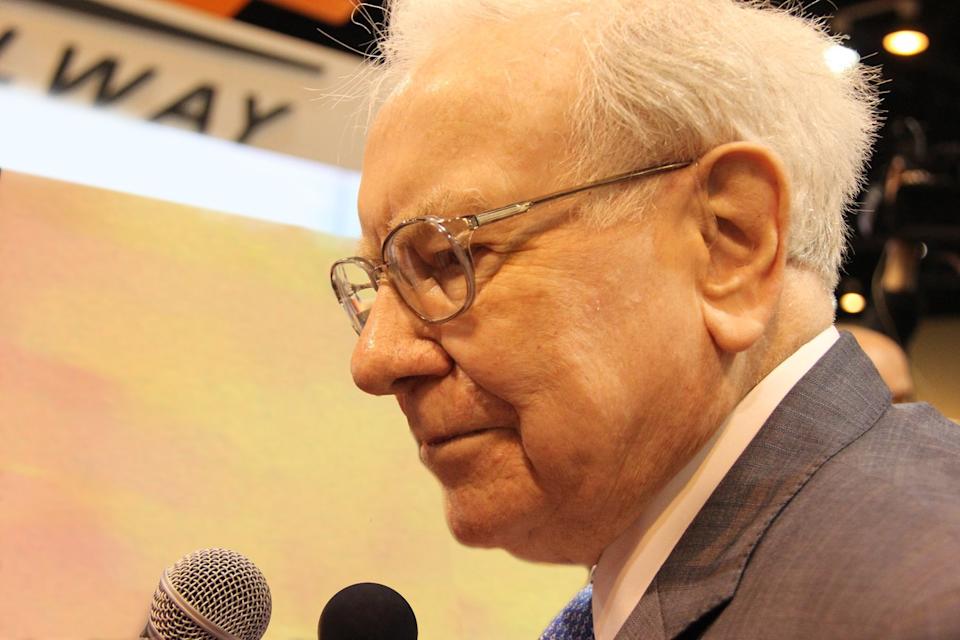
Warren Buffett has always been optimistic by nature. When he takes a negative stance on something, it warrants special attention.
Over 24 years ago, Buffett worked with Fortune magazine’s Carol Loomis on an article that was an eye-opener for some. In the article, he discussed a valuation metric that eventually was named after him — the Buffett indicator. This indicator is calculated by dividing the total stock market capitalization by gross national product (GNP), which was later replaced by gross domestic product (GDP).
Will AI create the world’s first trillionaire? Our team just released a report on the one little-known company, called an “Indispensable Monopoly” providing the critical technology Nvidia and Intel both need. Continue »
Buffett acknowledged that the ratio had “some limitations.” However, he said that “it is probably the best single measure of where valuations stand at any given moment.”
The “Oracle of Omaha” included a chart of this ratio in the article. He noted that in 1999 and early 2000, the ratio rose to an all-time high. Buffett warned that if the ratio approaches 200%, investors are “playing with fire.” Where does the Buffett indicator stand today? It’s above 219%.
Buffett’s warning to Wall Street is echoing louder than ever. Here are three steps investors should take now in response.
Image source: The Motley Fool.
Much has been written about Berkshire Hathaway‘s (NYSE: BRKA)(NYSE: BRKB) massive cash stockpile. When Buffett stepped down as the conglomerate’s CEO at the end of 2025, he left his successor, Greg Abel, with a whopping $373.3 billion in cash, cash equivalents, and U.S. Treasury bills.
This amount is only slightly below Berkshire’s record high cash position of $381.7 billion at the end of the third quarter of 2025. No publicly traded company in the U.S. has ever amassed more cash than Berkshire.
Why did Buffett build up so much cash for Berkshire Hathaway? He viewed the approach as a better bet than buying overpriced stocks.
Investors who aren’t billionaires might want to consider following Buffett’s lead. A solid cash position gives you ample dry powder to put to use when the stock market inevitably pulls back significantly.
When he turned the reins over to Abel, Buffett had been a net seller of stocks for 13 consecutive quarters. Perhaps Abel will break the streak, but I doubt it.
Importantly, though, Buffett still bought some stocks even while reducing Berkshire’s overall equity holdings. He found quality stocks to buy at a discount (or, at least, at a fair price). This is also a smart strategy for retail investors in the current market climate.
You don’t have to be a value investor to appreciate an opportunity to scoop up shares of well-run businesses when their stocks are struggling. But with the stock market trading at a historically high valuation, can such opportunities be found? Absolutely.
A good example (but not the only one) is the recent sell-off of SaaS stocks. Many investors were spooked by influential figures warning that artificial intelligence (AI) could disrupt the business models of software companies. While I don’t doubt they’re right, I think some SaaS stocks with a low risk of disruption were caught up in the frenzied selling. As a result, there is an opportunity to buy quality at a discount in the tech sector right now.
Buffett consistently emphasized throughout his career the importance of thinking about the long term. In Berkshire Hathaway’s 2020 annual meeting, he said:
You shouldn’t buy stocks unless you expect, in my view, to hold them for a very extended period, and you are prepared financially and psychologically to hold them the same way you would hold a farm and never look at a quote — you don’t need to pay attention to it.
I’d argue that thinking long term is the most critical thing for investors to do in light of Buffett’s warning from over two decades ago. A long-term perspective can help you avoid panicking during turbulent periods.
Buffett’s longtime business partner, Charlie Munger, perhaps summarized the wisdom of this principle best. He once said, “The big money is not in the buying and the selling, but in the waiting.” As Buffett has often stated, Charlie was right.
Ever feel like you missed the boat in buying the most successful stocks? Then you’ll want to hear this.
On rare occasions, our expert team of analysts issues a “Double Down” stock recommendation for companies that they think are about to pop. If you’re worried you’ve already missed your chance to invest, now is the best time to buy before it’s too late. And the numbers speak for themselves:
Nvidia:if you invested $1,000 when we doubled down in 2009,you’d have $447,961!*
Apple: if you invested $1,000 when we doubled down in 2008, you’d have $47,222!*
Netflix: if you invested $1,000 when we doubled down in 2004, you’d have $495,179!*
Right now, we’re issuing “Double Down” alerts for three incredible companies, available when you joinStock Advisor, and there may not be another chance like this anytime soon.
Keith Speights has positions in Berkshire Hathaway. The Motley Fool has positions in and recommends Berkshire Hathaway. The Motley Fool has a disclosure policy.