Key Points
-
Oil briefly touched $119 per barrel before pulling back, driven by the escalating conflict in Iran and the Strait of Hormuz.
-
Nvidia led declines on both the Nasdaq and S&P 500, but its 1.3% drop was modest given its outsized index influence.
-
Days like this are a reminder to check whether your portfolio allocation actually matches your risk tolerance.
- 10 stocks we like better than Dow Jones Industrial Average ›
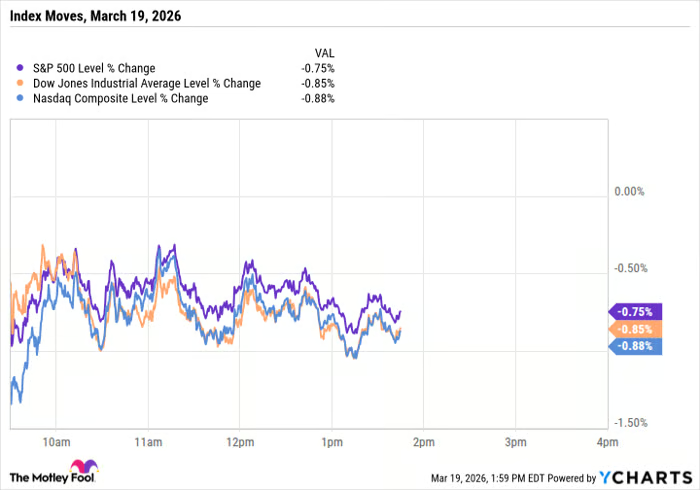
All three major U.S. indexes traded lower on Wednesday, with the Dow Jones Industrial Average (DJINDICES: ^DJI) and Nasdaq Composite (NASDAQINDEX: ^IXIC) taking the hardest hits at 0.9% retreats. The S&P 500 (SNPINDEX: ^GSPC) held up slightly better with a 0.8% cut. The culprit? Another flare-up in the ongoing Iran conflict, which sent oil prices on a wild ride during the session.
Crude oil spiked to $119 per barrel in early trading before pulling back to around $115. The Strait of Hormuz, through which roughly 20% of the world’s oil passes on a normal day, remains the focal point of concern. Any disruption to that chokepoint can have immediate ripple effects across global energy markets, and traders are pricing in that macroeconomic threat.
Will AI create the world’s first trillionaire? Our team just released a report on the one little-known company, called an “Indispensable Monopoly” providing the critical technology Nvidia and Intel both need. Continue »
The stocks that actually move these indexes didn’t make big splashes, though.
On the Dow, Caterpillar (NYSE: CAT) was the biggest decliner, falling 1.9% with a 9.2% weighting in that elite index. Heavy equipment makers tend to be sensitive to energy costs and global economic sentiment, so that reaction makes sense.
On the Nasdaq and S&P 500, Nvidia (NASDAQ: NVDA) led the losses, dropping 1.3%. The chipmaker carries a 10.1% weight on the Nasdaq and 7% on the S&P 500, making it the single most influential stock on both indexes. But a 1.3% decline is hardly a rout. It’s the kind of move that can happen on any given day without geopolitical drama. These small drops still erase roughly $50 billion of value from Nvidia’s enormous $4.3 trillion market cap.
The broader picture: this Thursday is a risk-off session, but not a panicked one. Investors trimmed positions gently and waited for more information.
Image source: Getty Images.
The bigger picture
The market’s measured response suggests that investors aren’t yet convinced this conflict will spiral into something that fundamentally disrupts the global economy. Oil at $115 is uncomfortable, but it’s not catastrophic. The real concern would be a sustained move above $120, which could start feeding into consumer prices and corporate margins in a more meaningful way. Some analysts expect the price to skyrocket to $200 or more if the output from Middle East oil fields stays off the market for too long.
Some of that concern is already showing up in other corners of the market. Mortgage rates climbed to their highest level in over three months on Wednesday, a sign that bond investors are starting to factor in the possibility of stickier inflation. Higher energy costs tend to work their way through the economy with a lag. First you see prices jump at the gas pump, then in transportation and logistics costs, and eventually in the prices of goods and services across the board.
Construction materials and industrial inputs are also ticking higher, which could weigh on sectors like homebuilding and manufacturing if the trend continues. Companies with thin margins or heavy fuel exposure will feel the squeeze first.
That said, the lack of dramatic moves among the largest index components is worth noting. When markets are truly spooked, you tend to see broad-based selling that hits everything indiscriminately. That didn’t happen today. The mega-cap tech stocks that dominate these indexes mostly drifted lower without any capitulation. Investors are cautious, but they’re not heading for the exits.
The long view
For long-term investors, days like this are mostly noise. The underlying fundamentals of the companies that make up these indexes haven’t changed because of a single day’s oil price swing. Crude oil prices are up 66% since the Iran conflict started, but none of the leading market indexes have fallen more than 7% in that period.
Nvidia is still selling every GPU it can make. Caterpillar still benefits from infrastructure spending. The investment thesis for most quality companies doesn’t hinge on whether crude is $110 or $119 on any given Thursday.
Should you buy stock in Dow Jones Industrial Average right now?
Before you buy stock in Dow Jones Industrial Average, consider this:
The Motley Fool Stock Advisor analyst team just identified what they believe are the 10 best stocks for investors to buy now… and Dow Jones Industrial Average wasn’t one of them. The 10 stocks that made the cut could produce monster returns in the coming years.
Consider when Netflix made this list on December 17, 2004… if you invested $1,000 at the time of our recommendation, you’d have $510,710!* Or when Nvidia made this list on April 15, 2005… if you invested $1,000 at the time of our recommendation, you’d have $1,105,949!*
Now, it’s worth noting Stock Advisor’s total average return is 927% — a market-crushing outperformance compared to 186% for the S&P 500. Don’t miss the latest top 10 list, available with Stock Advisor, and join an investing community built by individual investors for individual investors.
*Stock Advisor returns as of March 19, 2026.
Anders Bylund has positions in Nvidia. The Motley Fool has positions in and recommends Caterpillar and Nvidia. The Motley Fool has a disclosure policy.
The views and opinions expressed herein are the views and opinions of the author and do not necessarily reflect those of Nasdaq, Inc.

