The Hong Kong film industry is looking back even as it charts a course forward — and this week it has good reason to reflect. Filmart, the city’s annual entertainment industry gathering, is staging its 30th edition, while the Hong Kong International Film Festival prepares to mark its 50th in early April.
Both milestones deserve acknowledgment, even as the industry they serve navigates genuinely uncertain terrain: falling box office, the rising power of streamers, and the looming challenges posed by artificial intelligence and the boom in vertical short-form drama.
Through all of it, Filmart has soldiered on. The event has long positioned itself as a gathering with its finger on the pulse of Asian cinema — not just a marketplace where producers promote their latest projects, but a forum for debating where the industry is headed. This year, 790 exhibitors are on the floor, up from 75 when the event launched in 1997.
That growth tracks closely with the rise of the Chinese film market, which Filmart was early to recognize as a transformative force. When the first edition was staged — June 11 to 13, 1997, days before Hong Kong’s handover to China — the HKTDC framed the event as a bridge between the international film community and a mainland industry still finding its feet. The skeptics were eventually silenced: within a decade the Chinese market had exploded, and within 15 years it had become the second largest in the world. Major players flocked to Hong Kong looking for a way in.

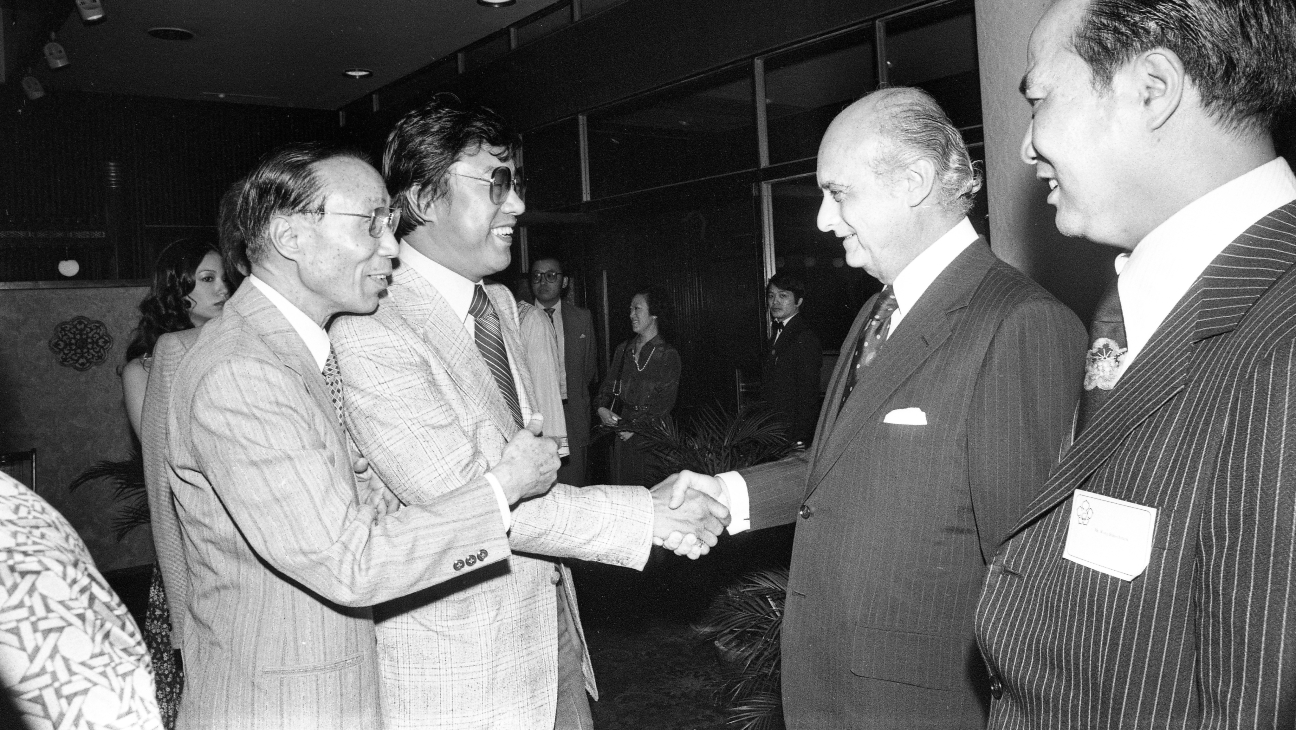
Movie magnate Sir Run Run Shaw (left) introduces film director Li Han-hsiang (center) to Arnaldo de Oliveira Sales (second right), Chairman of the Urban Council, at the opening of the first Hong Kong International Film Festival.
C. Y. Yu/South China Morning Post via Getty Images
“Despite the industry’s significant transformation, international companies continue to demonstrate remarkable ambition to expand their global footprint,” says Candas Yeung, associate director at the HKTDC. “Hong Kong industry players are also diversifying their content portfolios, exploring new formats — including short drama, streaming content, and AI-enhanced productions — and leveraging the city’s unique position as a bridge between East and West.”
That “super connector” framing, as the Hong Kong government likes to put it, has become something of a mantra. Along the way, Filmart has been quick to latch onto emerging trends — championing pan-Asian productions in the late 1990s alongside the likes of Peter Chan Ho-sun and his Applause Pictures, and absorbing the Hong Kong-Asia Film Financing Forum (HAF) in 2005, which has since helped generations of Asian filmmakers get projects off the ground. This year HAF received 414 submissions from 38 countries and territories, and is supporting more than 40 projects in various stages of production.
“HAF itself is a crucial partner of Filmart, and together we create a more comprehensive platform for the film and entertainment industry,” says Yeung. “The presence of HAF alongside Filmart attracts a wider spectrum of industry professionals — from buyers and distributors to financiers, producers, and creative talent.”
How much actual dealmaking is happening beyond these initiatives is, however, a matter of some debate. Filmart’s heavy focus on AI this year — 28 seminars feature it in some form — reflects both the technology’s momentum and the anxiety it is generating in an already weakened industry. Two local film companies who declined booth space this year told THR they couldn’t justify the cost, given the precarious state of Hong Kong cinema: box office in 2025 was the lowest in 13 years, and fewer than 40 local films were released. One international producer who has attended every edition since 1997 suggested that the pandemic simply changed the way business gets done — that Filmart has become “less about doing deals and more about doing meals.” None of those THR spoke to would go on the record, with the international veteran joking: “We all still want to come back.”
Hong Kong action star Jackie Chan speaks during a press conference at the 2009 Hong Kong International Film Festival.
MIKE CLARKE/AFP via Getty Images
The Hong Kong International Film Festival has its own story to tell. When its first edition ran from June 27 to July 10, 1977, Hong Kong essentially was Chinese cinema — Sammo Hung was dominating the local box office while emerging talents like John Woo were beginning to take the city’s filmmaking to the world. That inaugural edition screened 37 films. This year’s 50th features 215.
But the festival’s most enduring legacy may be the role it played in introducing Chinese-language and Asian cinema to the world — bringing together filmmakers from the mainland, Taiwan and Hong Kong at a time when few other platforms existed for that kind of exchange, and giving international festival programmers a place to discover what was happening across the region.
The 50th edition, running April 1-12, pays homage to some of the filmmakers it championed earliest, among them Chen Kaige and Ann Hui. It opens with the latest film from Singaporean director Anthony Chen — We Are All Strangers, a father-son drama and the third entry in his “Growing Up” trilogy. Chen, whose films have frequently featured at Filmart as well, reflects warmly on what Hong Kong cinema has meant to filmmakers across the region.
“I think they have been very pivotal for every Asian filmmaker,” he says. “Like it or not, you study Hong Kong at film school. It’s like everyone goes through a Wong Kar-wai phase in their life where they’re completely either addicted or mesmerized by him — and I just think Hong Kong cinema has shaped a lot of young filmmakers in the region.”
(L-R)HKIFFS Chairman Wilfred Wong; Director Johnny To Kei-fung; and Artist Lam Ka-tung at the 40th Hong Kong International Film Festival.
Nora Tam/South China Morning Post via Getty Images