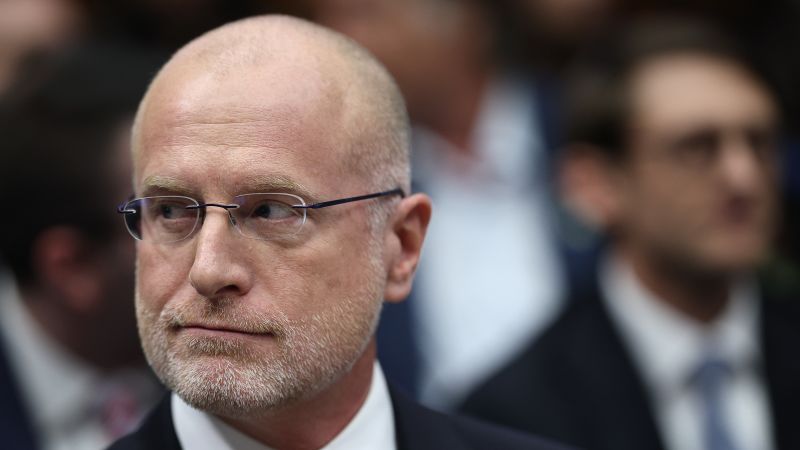
President Donald Trump’s attack dog atop the FCC, Brendan Carr, garnered lots of attention on Saturday for threatening the licenses of local broadcasters over news coverage he deemed to be “fake.”
Carr has very little power to follow through. Television stations are not at serious risk of being banned from the airwaves because of Carr’s crusade.
However, his comments still carry weight since Carr represents the US government and advances Trump’s policy agenda. The administration keeps taking extraordinary actions and applying extreme pressure to crack down on news content and entertainment that the president dislikes.
Thus, critics called Carr’s latest threat “authoritarian” and “unconstitutional,” and some suggested that he did it for attention, to publicly pressure local stations licensed by the FCC.
On Saturday, Carr followed up on one of Trump’s Truth Social posts complaining about news coverage of the Iran war by posting a warning on X.
“Broadcasters that are running hoaxes and news distortions — also known as the fake news — have a chance now to correct course before their license renewals come up,” Carr wrote.
“The law is clear. Broadcasters must operate in the public interest, and they will lose their licenses if they do not.”
In reality, the FCC has not denied a license renewal in decades. Any government action against a licensee would cause a protracted legal battle, even more so given the current media-bashing climate, because a station would likely cite Trump’s retributive streak and mount a First Amendment case.
“Chairman Carr’s threats are hollow,” public interest lawyer Andrew Jay Schwartzman told CNN. “He poses no genuine danger to any broadcasters’ licenses based on his unhappiness with their content.”
For those unfamiliar with the FCC: Cable channels like CNN and streaming platforms like Netflix are not licensed at all.
National networks like NBC are not licensed, either, but local stations are. Thus, big media companies like Disney, which owns ABC, and Paramount, which owns CBS, do hold FCC licenses for the local outlets they own.
Trump has repeatedly conflated the licensing process while attacking national networks for airing certain shows and asking him particular questions.
In response to a question about Jeffrey Epstein last fall, Trump said to an ABC News reporter, “I think the license should be taken away from ABC because your news is so fake and so wrong. And we have a great commissioner, a chairman, who should take a look at that.”
ABC shrugged off the threat. That’s what station owners have done, most of the time, knowing that Carr’s voice is expansive, but his enforcement power is limited.
Carr’s bully-pulpit strategy has been evident for more than a year now, as he has railed against alleged media bias and welcomed disputes with the likes of ABC’s Jimmy Kimmel.
Media advocacy groups have said Carr is trying to pressure media companies into submission and self-censorship, which would achieve some of what Trump wants without explicit government action.
“Again and again, Carr’s tenure as FCC chairman has been marked by his shameless willingness to bully and threaten our free press,” Will Creeley, legal director at the Foundation for Individual Rights and Expression, said in a statement.
Some station owners have acquiesced in specific circumstances, usually relating to big-money business deals. Nexstar and Sinclair were accused of cowering before Carr when the companies yanked Kimmel’s show from their ABC-affiliated stations last fall. Both companies had pending business before the FCC.
The FCC is involved every time a station owner wants to acquire or transfer a license. That’s why companies are uniquely vulnerable to government pressure while trying to complete a merger.
Paramount told the FCC it would install an ombudsman at CBS and eliminate diversity, equity and inclusion practices as a condition of its merger approval last year.
And now Paramount is pursuing a takeover of Warner Bros. Discovery, including CNN, and hopes the deal will take effect in about six months.
Notably, Paramount has been a critic of Carr’s approach at the FCC. The Free Press, a startup that Paramount acquired last fall, recently published a column titled “Brendan Carr Once Defended Free Speech. Now He Is Trump’s Chief Censor.”
Carr responded to a similar charge from Democratic Sen. Elizabeth Warren on Saturday by quoting an old Supreme Court case.
The nuts and bolts of station licensing show why, in Schwartzman’s words, Carr’s threats are “hollow.” For one thing, “TV licenses don’t even come up for renewal until late 2028,” Schwartzman said.
In a back-and-forth on X, Carr responded to that observation by telling CNN, “The Communications Act authorizes the FCC to call in licenses for early renewal.”
Doing so would trigger a hearing process, with many opportunities for stations to beat back the Trump administration’s pressure.
“Contested broadcast renewal and revocation cases must first go to an FCC judge for a hearing that can take months or even a year or two, after which an appeal must go to the full membership of the FCC,” Schwartzman explained. “Only then does the case even get to court, where the Communications Act gives licensees broad protection.”
Congress could move to change the Act and expand the FCC’s regulatory powers, though Republicans have historically been more often aligned with efforts in the opposite direction.
Carr’s recent moves have prompted renewed cries from libertarians and some conservatives to “abolish the FCC” altogether, given that the rules only apply to a narrow slice of the big media pie.
However, Carr has won cheers from Trump loyalists for what they call attempts to hold the press “accountable.”
Trump reposted a meme graphic on Saturday that celebrated him “reshaping the media,” including several changes (like the CBS ombudsman) that Carr has spearheaded.
But the significance of the “reshaping” is very much open to debate. News outlets, including those subject to FCC licensing, continue to vigorously cover the Trump administration.
The Radio Television Digital News Association, which represents local TV news executives and personnel across the country, said in a statement Saturday night that Carr’s “bully with a briefcase” approach won’t deter journalists: “They’ve faced far worse and kept reporting. They’ll keep reporting now.”
The association also said that “using federal regulatory power to threaten broadcast licenses over coverage decisions is unconstitutional — full stop. The First Amendment does not have a carve-out for news the FCC chair finds inconvenient.”