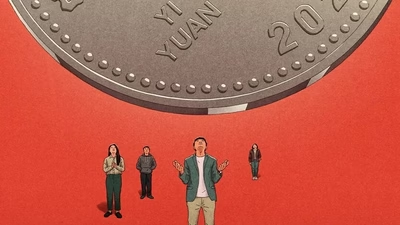
OVER THE past half-century, China has conjured vast wealth out of widespread poverty. Now comes the vexing part: how to pass it on to the next generation. For China, this poses a new and underappreciated risk. On its current trajectory, the first great intergenerational transfer in China’s modern history will widen inequality, cement privilege and breed resentment. The government, devoted to “common prosperity”, is shockingly insouciant about what that will mean.
Illustration: The Economist/Xinmei Liu
In 1978, on the eve of China’s economic take-off, the average household’s assets were worth barely $1,500 in today’s money. Now, that figure has reached about $170,000, a hundred-fold real increase. Alas, the fruits are uneven. The richest 10% of the population now own nearly 70% of China’s total private wealth, roughly equal with America and well above most advanced economies, according to the World Inequality Database. And the richest 10% are, like most of China, rapidly ageing. Their heirs are in line for windfalls.
Dig deeper
Across the rich world, increasing hereditary wealth is creating a class more inclined to search out tax loopholes than to strive or innovate. China will have those problems and more. First, its inheritocracy is brand new. It was only in the 1990s, when China allowed homeownership, that people started to accumulate a lot of assets. A business boom got going at the same time, minting millions of millionaires—and hundreds of billionaires. Of those worth at least 5bn yuan ($720m), 23% were over 60 in 2016. Today, 49% are that old.
Another uniquely Chinese feature is society’s demographic structure. Although some ultra-rich families flouted the government’s one-child policy, most urban dwellers abided by it. The assets of two parents are thus about to go to a single heir. New clubs and matchmakers have sprung up to help the richest couple with each other, magnifying their inherited advantage.
And a last factor is slowing economic growth. Even as wage gaps have narrowed slightly, wealth is starting to matter more. This represents an abrupt transition for China, from an era when people believed anyone could prosper through hard work to a bleaker acceptance that what really counts is the right “amniotic fluid”, as one person quips in our briefing this week. Meanwhile, steep declines in property prices have hurt almost all middle-class Chinese, for whom housing was their biggest asset. The uber-wealthy, with more diversified portfolios, have emerged in better shape.
The most severe consequence may be a new fault line in society. For years Chinese people were inveterate optimists, believing in the fundamental fairness of life, even when the poorest faced long odds. Recent surveys have shown a marked rise in pessimism—and, given the difficulties of monitoring public opinion in China, they may be understating that trend.
One concern for the government is social instability, though it has tools to suppress unrest. Another is that young adults may choose to withdraw from the rat race or sit back on their wealth. With youth unemployment over 16%, some are questioning the endless competition that can make life in China so stressful. As the great inheritance plays out, the go-getter spirit that fuelled the country’s rise may ebb. Persistent inequality will also add to economic imbalances: the tendency of the well-off to spend less of their income than the poor helps explain China’s low consumption rate.
Despite President Xi Jinping’s talk of greater equality, official thinking is woefully behind the curve on inheritance. The Communist Party, bizarre as it might sound, is opposed to a significant redistribution of wealth. It has a Thatcherite moral objection to handouts, worrying that they will make people lazy. It would instead prefer strong economic growth, whereby gains are more evenly shared. But ignoring accumulated wealth will ensure that deep inequality becomes ingrained.
The solution need not be radical. China should focus on taxing capital, a glaring hole in today’s fiscal system. It has neither an inheritance tax nor a recurring property tax, and its capital-gains tax is riddled with exemptions. Its income tax is also hobbled by complexity. Combined with cuts to consumption levies, the result is that China’s total tax revenue, excluding social-security contributions, has declined over the past decade, from 18% to 13% of GDP, about three-quarters the rate of peer countries. Observers fret that Mr Xi is returning China to Marxism; few notice that, perhaps unwittingly, he has made it a partial tax haven.
Since the early 1990s China has often promised to consider introducing an inheritance tax, yet has not done so. It has also moved at a glacial pace on levying a property tax. Why the delay? Some officials cite the fear that taxes may weigh on growth and that the wealthy may shift their fortunes abroad. Neither argument is persuasive. If inequality keeps rising, it can damage growth, too. And China is well-placed to stop an exodus of wealth with strict capital controls.
A more compelling explanation is that the Communist Party fears the political fallout. Taxing wealth requires assets to be reported. This has bedevilled the launch of a property tax, in part because many corrupt officials own several homes. Forcing political elites to come clean would expose pervasive graft—and trigger a pre-emptive wave of home sales when the property market is weak. Beyond officialdom, there is a need to justify higher taxes to the public, particularly to the rich who stand to lose the most. Mr Xi’s inaction on taxes is a reminder that, for all his power, he is still wary of stirring up resistance.
Piketty to Peking
China’s leaders, sometimes celebrated for their technocratic brilliance, have consistently been slow to correct obvious mistakes. They were too hesitant to end the one-child policy, to deflate the property bubble and to retreat from their zero-covid strategy. Once again, they face a slow-moving but easily visible problem: the transfer of vast riches. The danger is that they wake up in a decade or two to see that they have nurtured a permanent wealthy elite on top of a disillusioned society.
Subscribers to The Economist can sign up to our Opinion newsletter, which brings together the best of our leaders, columns, guest essays and reader correspondence.