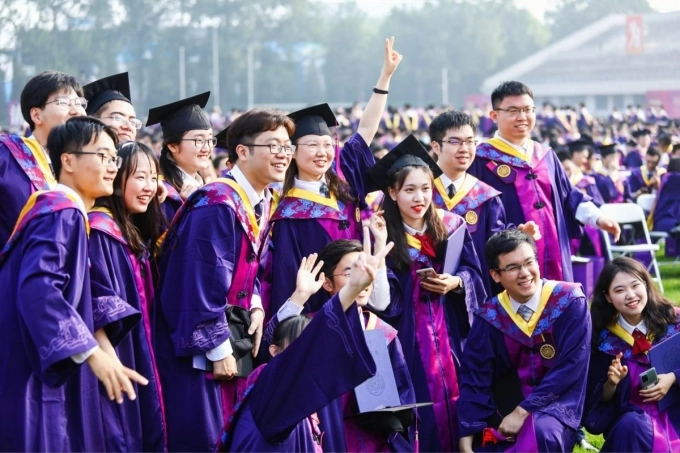
A report from Tsinghua University shows the share of its graduates entering manufacturing and energy has risen for six consecutive years, with the number joining those sectors increasing 19.1% for the Class of 2025 and 11% year on year for the Class of 2024.
Manufacturing jobs were once viewed as blue-collar work by graduates from China’s top universities, but today they are associated with advanced industries such as semiconductors, electric vehicles and energy storage, according to the South China Morning Post.
Major employers recruiting graduates from Tsinghua include Huawei, BYD, State Grid Corporation of China and China National Nuclear Corporation.
Tsinghua graduates are often seen as an indicator of where China’s top talent is heading, and similar shifts are emerging at other leading universities.
Employment data released in January by Huazhong University of Science and Technology showed that among its Class of 2025 graduates about 2,000 entered the information technology sector and around 1,500 joined manufacturing. By comparison, about 300 entered finance and 240 went into construction.
According to MyCOS Institute, a consultancy specializing in China’s education, the share of graduates entering manufacturing rose from 17.9% in 2020 to 22.5% in 2024.
 |
|
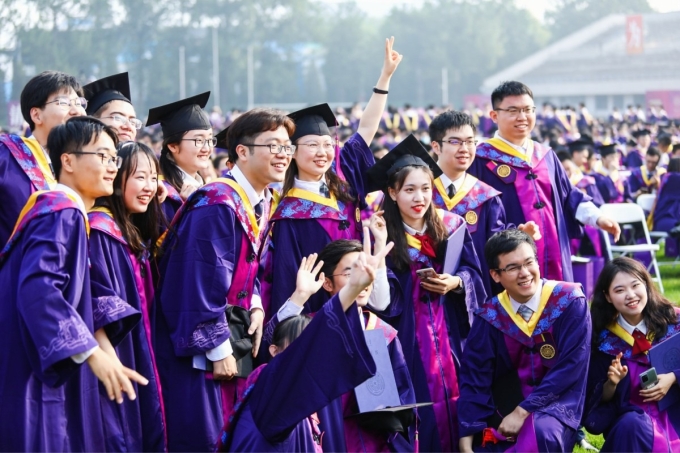
Graduates at Tsinghua University in China. Photo courtesy of the university |
Experts say several factors are driving the shift.
China’s industrial sectors, especially semiconductors, electric vehicles, batteries and renewable energy, have become “highly technology-intensive and now demand top engineering talent,” Fu Fangjian, associate professor of finance at Singapore Management University, told Business Insider.
Many graduates now view these industries as “opportunities to work on cutting-edge technologies rather than traditional factory work,” he said, adding that such roles can offer “very competitive” salaries.
Zhao Litao, senior research fellow at the East Asian Institute, told Business Insider that sectors such as electric vehicles, power equipment and nuclear energy increasingly require expertise in engineering, data science and systems integration. Highly technical engineering and research roles in these fields “carry considerable prestige among engineering students,” he added.
At the same time, technology jobs, once known for rapid growth and high pay, have become less appealing as hiring slows and regulatory pressures increase, Fu said. “Investment attention has shifted toward HALO sectors —hardware, industrial technology, and energy— redirecting both capital and talent,” Fu added.
China’s technology sector has reduced headcount in recent years as companies focus on cutting costs and improving efficiency. Alibaba’s workforce fell from about 250,000 full-time employees in March 2022 to roughly 124,000 in March 2025, according to a report by Chinese newspaper Caixin. Baidu had 35,900 employees at the end of 2024, down 21.1% from its peak in 2021, the report added.
Meanwhile, demand for manufacturing talent remains strong. A government manufacturing talent development plan projected that nearly 30 million skilled manufacturing jobs could go unfilled by 2025.
Government policies prioritizing sectors such as EVs, renewable energy, power equipment and advanced materials are also reshaping the job market, Zhao said. Universities, research institutes and state-backed firms are increasingly aligned with these national priorities, encouraging more graduates to enter these fields, Fu added.