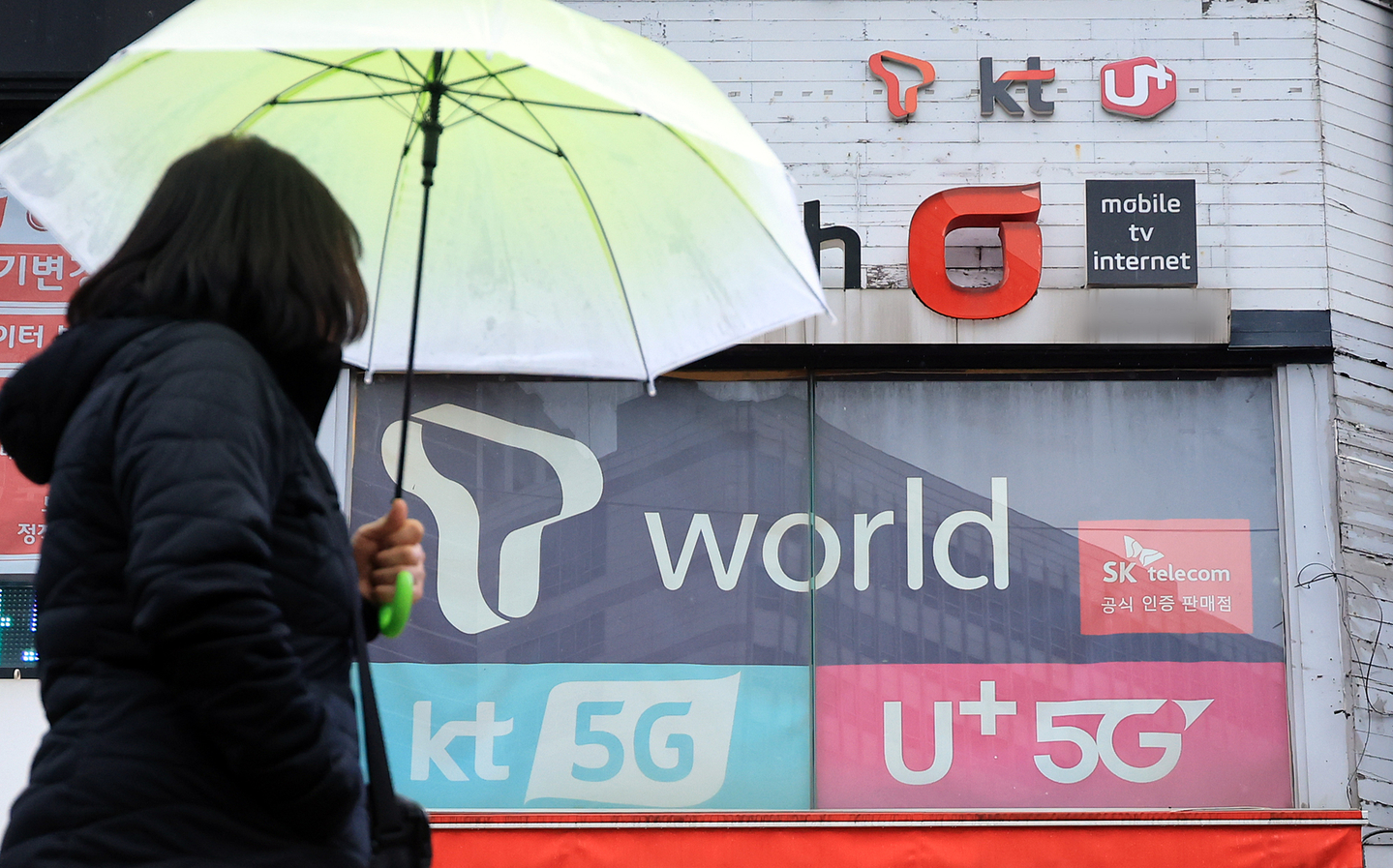
![A pedestrian walks by mobile phone stores in Seoul on Dec. 23, 2024. [NEWS1]](https://koreajoongangdaily.joins.com/data/photo/2026/03/13/48a4428a-8d48-402f-a470-474149fb89e6.jpg)
A pedestrian walks by mobile phone stores in Seoul on Dec. 23, 2024. [NEWS1]
Korea’s human rights watchdog has requested the government review the upcoming mandate for facial recognition when opening up a new mobile phone subscription.
The National Human Rights Commission of Korea
recommended on Friday that the Minister of Science and ICT reconsider a new policy that requires facial recognition when activating mobile phones and called for preparations of alternative methods of authentication.
The Science Ministry has been pushing to introduce facial recognition as part of the process of activating a new phone for the country’s three major telecommunications companies — SK Telecom, KT and LG Uplus — as well as for budget mobile carriers, as financial crimes including voice phishing using so-called burner phones have become a growing social problem.
The system began a pilot program on Dec. 23 last year and is scheduled for full implementation on Monday.
As smartphones have become essential infrastructure used across everyday life for financial transactions and mobile identity verification, the commission warned that making facial recognition mandatory could affect not only the right to informational self-determination but also a range of fundamental rights including freedom of communication, freedom of expression and the right to know.
![The logo of the National Human Rights Commission of Korea [YONHAP]](https://koreajoongangdaily.joins.com/data/photo/2026/03/13/643bb0a6-80c8-4a51-9d57-1b3869d4ffba.jpg)
The logo of the National Human Rights Commission of Korea [YONHAP]
The commission also pointed out that while laws such as the Immigration Act and the Electronic Financial Transactions Act provide legal grounds for the collection and use of biometric data, the Telecommunications Business Act contains no such provisions.
For that reason, a clear legal basis should be established before the policy is implemented, the commission said.
“Biometric information is unique identifying data based on an individual’s physical characteristics and is extremely difficult to change,” the commission said. “It therefore requires stricter protection than ordinary personal information.”
Authorities should provide detailed explanations about the collection and use of biometric data before implementing the policy and disclose information about the stability and reliability of facial recognition technology after the system takes effect, the commission said.
This article was originally written in Korean and translated by a bilingual reporter with the help of generative AI tools. It was then edited by a native English-speaking editor. All AI-assisted translations are reviewed and refined by our newsroom.
BY JEONG JAE-HONG [[email protected]]