Key Insights
- China’s researchers are racing to close the country’s gap with the US in chemistry-related advancements and secure the next frontier of innovations in materials, energy, and biomedicine.
- Increasing funding pools, investments in health-system reforms, and innovation-driven policies, such as integrating medical insurance data into R&D, are accelerating the rate of China’s gain in developing novel drugs, according to Chinese biochemists.
- Shortages in basic research and interdisciplinary talent remain relatively weak spots for China but may improve with rising state investments.
China’s leading scientists and research laboratories are racing to deliver the country’s next breakthroughs in chemistry and other fields, fueled by record investment in research and development as well as an aggressive push for scientific self-reliance. From battery materials to biomedicine development, China is focusing on advancements in chemistry that often lead to industrial applications and major commercial gains.
“China’s basic research has made great progress—it still lags behind the United States to some extent, but we will catch up in the future,” says Tianjing Deng, CEO and cofounder of Pyrotech Biotechnology, a Beijing-based biotech company developing original therapies for inflammatory diseases and tumors.
The country’s research spending has seen exponential growth in the past 3 decades, reaching 3.9 trillion yuan ($568.6 billion) in 2025 in current yuan, an 8.1% increase over the previous year, and accounting for 2.8% of China’s gross domestic product. By one measure, China surpassed the US in terms of overall R&D spending in 2024.
US-China R&D spending gap shrinks
These countries are the top five biggest spenders on research and development. The spending gap on R&D between the US and China narrowed significantly between 2008 and 2022. In 2024, China surpassed the US in terms of total domestic spending on R&D, when measured in terms of 2015 US dollar purchasing power parity, according to the World Intellectual Property Organization.
Sources: National Science Board, “Discovery: R&D Activity and Research Publications,” National Science Foundation, July 23, 2025, fig. DISC-18; Davide Bonaglia et al., “End of Year Edition-Despite the Odds, Global R&D Spending Grew Again in 2024, Inching Closer to the USD 3 Trillion Mark,” World Intellectual Property Organization, Dec. 23, 2025.
Amid a current economic slowdown compared with economic trends before the COVID-19 pandemic, China is betting on its science, technology, engineering, and mathematics (STEM) sector to grow what it calls the “new economy,” which it hopes will be driven by high-value industries, including advanced manufacturing, biotech, and new materials.
“China’s basic research has made great progress—it still lags behind the United States to some extent, but we will catch up in the future.”
On March 5, China laid out a 5-year road map at its annual parliamentary meeting, setting broad-based overarching goals for the country’s economy. In the new plan, the 15th so far, China has once again emphasized the need for self-sufficiency in science and technology. Among other objectives, the plan puts forth a goal to foster new industries and make biotech and alternative energy options like hydrogen among the new growth points of its economy.
This drive for self-sufficiency will include working to enhance innovation capacity, achieving breakthroughs in bottleneck technologies such as the semiconductor materials behind artificial intelligence chips, and becoming a leading creator of new technologies in strategic sectors including materials and energy, according to the plan.
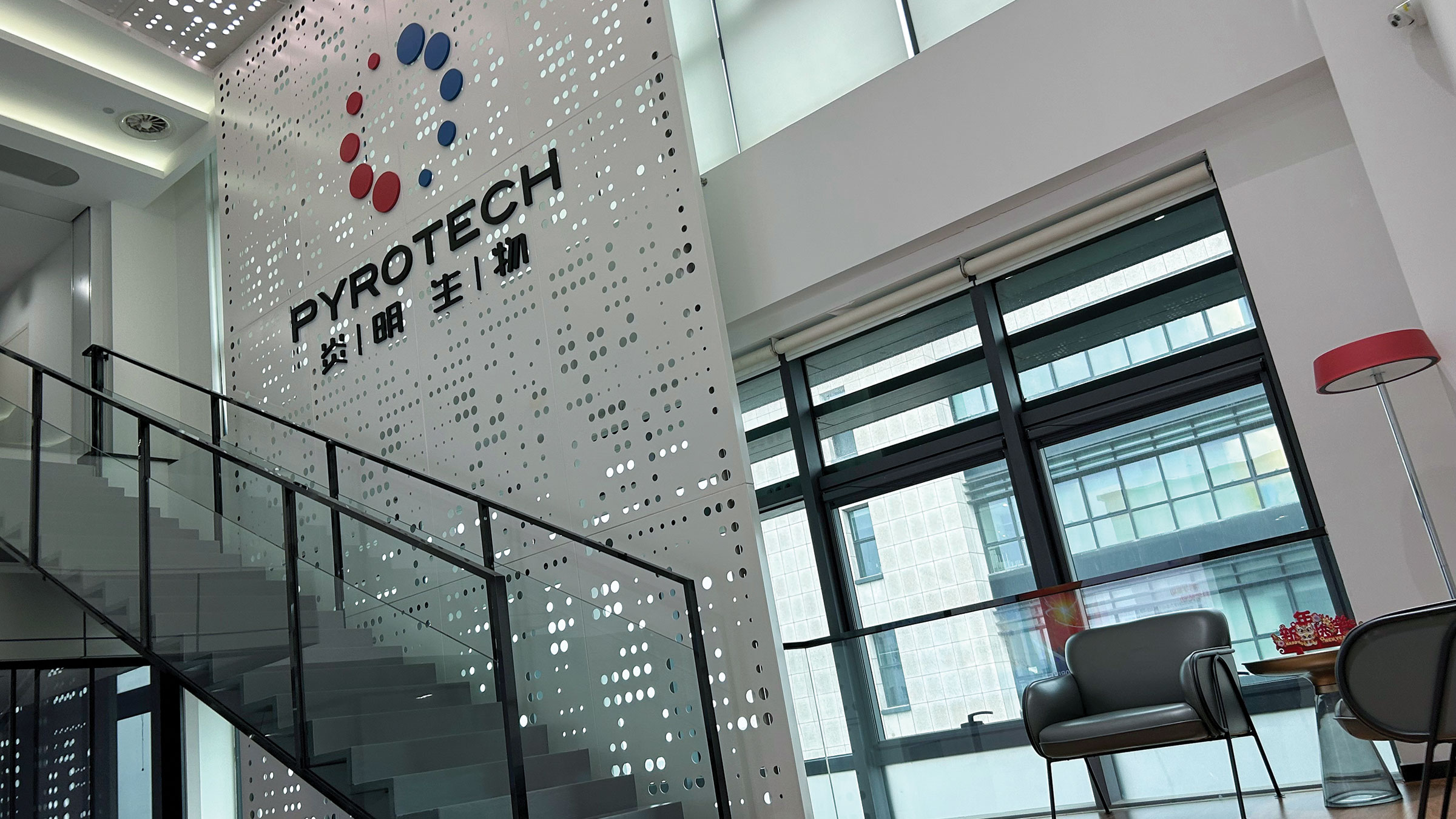
A view of Pyrotech Biotechnology’s lobby at its Beijing office. Pyrotech is one of China’s leading biotech firms developing innovative drug candidates. Credit:

Nick Ishmael-Perkins/C&EN
Spending on basic research rises
The Chinese government is increasing stable, long-term support toward basic research in various sectors as part of its strategy to achieve self-sufficiency. Basic research has been a long-standing weakness in the country’s science, according to experts C&EN spoke to.
“If we look at where we are today, what we need most is basic new research in chemistry,” says Yao-Chang Xu, founder and CEO of Shanghai-based biotech Abbisko Therapeutics. “[We are] more about engineering and applications, not about original concept and novelty.”
In 2025, China spent nearly 280 billion yuan ($40.6 billion) on basic research, up more than 11% from the year before, accounting for 7.1% of its total spending on R&D—the first time the basic research proportion has been above 7%. China’s new 5-year plan also pledges to further increase spending on basic R&D and explore a long-term funding system for selected teams and researchers, supporting frontier areas and interdisciplinary studies in particular. In addition, China has placed a growing emphasis on cultivating and attracting STEM talent, both domestically and from other countries. One such effort involves rewriting textbooks for undergraduate students with cutting-edge research from leading professors to help train future scientists, according to Peng Chen, a chemical biologist at Peking University. China also recently introduced the K visa targeting scientists from other countries.
“There are a lot of reforms going on,” says Chen, adding that this increased focus on basic research could help drive innovations after decades of underfunding of basic studies.
“If we look at where we are today, what we need most is basic new research in chemistry. [We are] more about engineering and applications, not about original concept and novelty.”
Chen, who earned his PhD in chemistry from the University of Chicago in 2007, now heads China’s first interdisciplinary graduate program in science. The program was founded in 2006 and has expanded into one with more than 260 people and over 10 research centers that focus on nanotechnology, life sciences, and machine learning, among other subjects, to bring together students of different science disciplines for collaborative research.
In addition, China’s top funder for basic research, the National Natural Science Foundation of China (NSFC), restructured its funding system in 2023 to support early-career researchers, even extending calls to lure top young scientists from abroad, partly aiming at US-based researchers facing budget restraints. Previously, in 2020, it had set up a department supporting interdisciplinary projects on artificial intelligence, materials, and biology to facilitate collaboration among experts working on different subjects of cutting-edge science. The department was the only new addition in 11 years in the state agency’s largely static bureaucratic hierarchy. In January, the NSFC released its annual guideline for project applications, emphasizing funding support toward interdisciplinary research.
It would be ideal if this increase in basic research funding could be guided by the government, says Abbisko Therapeutics’ Xu. “Basic research usually takes time . . . The government has to support this, with more money available and support for students and professors to do groundbreaking work.”
The NSFC did not respond to requests for comments about this story.
A biotech research lab at Pyrotech in Beijing. Chinese researchers, like these scientists, work amid an increasingly competitive environment. Credit:

Nick Ishmael-Perkins/C&EN
Corporate support for research still lags government investments
China’s research-funding system is still predominantly supported by the government. But some of the country’s deep-pocketed tech companies are also spending significant sums on original research.
Tencent, the major tech conglomerate behind China’s all-in-one social-media platform WeChat, has committed 10 billion yuan ($1.41 billion) over 10 years to fund scientific innovations in “exploratory and high-risk basic research” by the country’s leading scientists, prioritizing two fields: mathematical and physical sciences, and biological and medical sciences.
Chen, who was selected as a grantee in Tencent’s New Cornerstone Investigator program in 2022, says this program has given him unprecedented autonomy to conduct original research. In 2024, the NSFC also received a donation of 100 million yuan ($14.47 million) from smartphone company Xiaomi—the first time the foundation ever accepted a donation from a non-state source.
The corporate sector remains largely behind the government when it comes to basic research funding, accounting for just under 4% of the country’s total research spending, despite the rise of some incubators in major cities.
Meanwhile, the race among research teams to deliver the next applicable breakthrough in the commercial market has prompted fierce competition for increasing product innovation and market share in advanced materials, new energy, and other sectors, affecting even the old-guard state enterprises that historically enjoyed monopolies.
Representatives from PetroChina Shanghai Advanced Materials Research Institute, a new subsidiary created in 2021 by one of China’s top three national oil and gas giants, tell C&EN that PetroChina set up the institute and told them to “abandon the old system,” explore with greater freedom, and develop research that is “more advanced and with global views” to keep the company’s lead status. “If you are following the existing systems, it means you are failing,” says a spokesperson from the institute, referring to their strategic operations.
According to the spokesperson, the institute is actively recruiting global talent to help PetroChina’s transition from a traditional commodity operator into a high-tech materials supplier.
PetroChina’s pivot is part of a broader national trend that endorses novelty and prioritizes fast-action, fueled by a cutthroat national environment amid an economic downturn where even the most established players in a sector face the pressure of “involution,” a popular term in China used to describe a society-wide race-to-the-bottom competition.
“How do we keep up with that? Not just internationally, even domestically, there are lots of places that are doing very well. We feel the pressure all the time,” says Zhiwei Zuo, professor of organometallic chemistry at the Shanghai Institute of Organic Chemistry, a noted state-owned science institute under the Chinese Academy of Sciences.
Looking for the next breakthrough
Perhaps no other area’s advances better capture the push for innovation than those of China’s biotech sector, which is quickly catching up to the US in terms of its R&D pipeline.
Once a generics-dominated market, China is now seeing an increasing number of homegrown innovative drugs getting recognized by pharmaceutical giants, according to analysts from Morgan Stanley. As of June 2025, Chinese companies’ share of global pharmaceutical licensing deals jumped to 26%, according to a Bloomberg analysis, including a $1.2 billion upfront deal with China’s 3SBio to license an experimental cancer drug by Pfizer.
“In the past, [pharma companies] wouldn’t come to China to look for first-in-class assets, because such innovations usually happen in places like Boston, San Francisco, or London,” says Pyrotech’s Deng.
These breakthroughs in developing new therapies are partly thanks to the vast amount of potential patients available in the country, says Deng. China has become the top location for clinical research since 2021, with cheaper clinical trials conducted at a faster pace than in the US. Its per-patient trial cost remains stable compared with increasing costs elsewhere in the world, according to market intelligence firm Global Data, though experts warn this could change if either the US or China imposes stricter standards for drug review.
The Chinese government has been stepping up support for its drug developers, launching innovation-driven policies such as encouraging medical insurance data be integrated into pharmaceutical R&D to help pool government and commercial resources toward developing new treatments.
Specifically, China’s health authorities have been cultivating its domestic ecosystem through a dedicated major project supporting high-stakes drug discovery since 2008. Applications for funding opened again last year, with an earmarked preliminary R&D fund of 1.75 billion yuan ($250 million) from the central government. To accelerate the development of new drugs, China last year halved the time for reviewing clinical trial applications for innovative medicines to 30 days, similar to that in the US.
Still, Chinese novel-drug developers face challenges in accessing consistent financial investment and specialized talents in basic research, says Deng. A lack of sufficiently trained physician-scientists in the country, according to him, could be holding back Chinese biotech companies’ ability to develop next-generation drugs.
“There is a lack of physician-scientists, like those in the US, who understand both what patients need and how to connect therapeutic areas with a scientific [biomedical] target,” he says, adding that this could create challenges in translating research results into clinical development.
To tackle this issue, the NSFC has increased funding to support physician-scientists in recent years. In addition, more hybrid programs to train clinical scientists have opened up in China’s top medical schools.
A necessary international component
As China’s research labs increasingly benchmark themselves against international peers, scientists say that continued breakthroughs depend not just on China’s own spending and capacity to develop domestic talent, but on international cooperation, its ability to attract both researchers from other countries and Chinese-born researchers who’ve left the country, and further integration with the international scientific community.
The importance of this approach is clear: many of the country’s leading research labs have been built by scientists who trained in the US and then returned amid China’s continued efforts to pull them back. This trend has accelerated in recent years as the US has increased scrutiny of Chinese researchers.
“The government has put a lot of effort to recruit talent back to China—I was trained in the US and then came back to China,” says Chen from Peking University.
“I think it still has to be open,” Chen says, referring to the US’s policy toward researchers from other countries. “But this also has to be done on both sides. And the US has to be also more open [to collaboration], at least on some kind of basic research that will [allow us to] build up a win-win situation,” he adds.
Chemical & Engineering News
ISSN 0009-2347
Copyright ©
2026 American Chemical Society