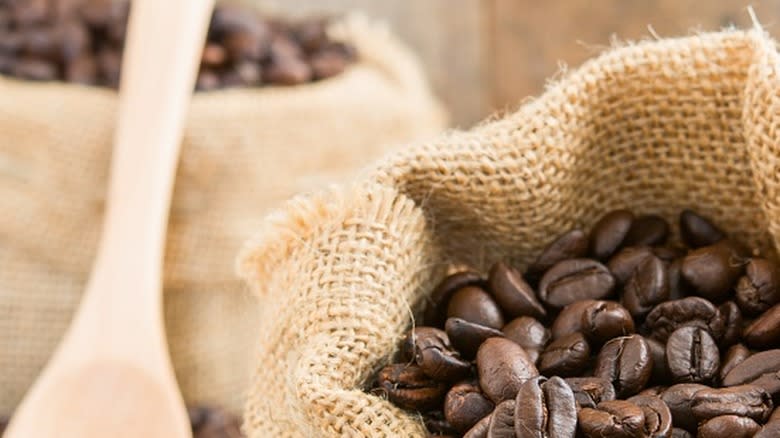

Specialty coffee bags – Viorela Cristescu/Getty Images
Thirty years ago, a good cup of coffee was one that didn’t taste burnt. The café renaissance has thankfully left us with a more refined palette for this drink, and also opened up the market for specialty coffee. But what exactly does this label mean? The Takeout spoke to Matt Woodburn-Simmonds, coffee expert and founder of Home Coffee Expert, to explain this sought-after product.
“Generally, [specialty coffee] is a coffee that has flavor and aroma characteristics that clearly separate it as superior to the average coffee,” says Woodburn-Simmonds. Although taste is subjective, this label is earned through an intense evaluation. “There is a strict tasting process called ‘cupping,’ where certified Q graders will give a coffee a score out of 100, with over 80 required for it to be considered ‘specialty,'” he explains.
He adds that graders take into account multiple factors: the quality of the beans before they’re roasted; characteristics like aroma, intensity, and acidity; how good the coffee tastes; and the processes used to grow and harvest it. “All of this is then put into the ‘combined form’ to try and give a single page overview of the coffee as graded,” states Woodburn-Simmonds. Of course, if any defects are noted in the coffee during evaluation, it will lose points. Some people claim that the “specialty” coffee label is just a marketing ploy, but this rigorous evaluation underscores the fact that coffee with that title is actually worth the premium price.
Read more: 13 Things From ’70s Kitchens That Totally Vanished
Specialty coffee is about more than just taste

A person’s hands picks arabica beans from a tree branch – S.I.A. Studios/Shutterstock
Taste and quality may be the main elements separating specialty coffee from regular coffee. But as Matt Woodburn-Simmonds notes, “There are also factors such as growing location, processing method, bean varietal, and sustainability practices in the farming and processing that can make a coffee ‘specialty.'” He says that this inclusivity is fairly recent, as the industry recognizes there is more to coffee than taste: “There are amazing farmers doing regenerative agriculture, cultivating rare varietals, and experimenting with new processing methods [who] also deserve recognition for elevating their coffee above the standard marketplace offering.”
With countless specialty coffees now available on the market, it can be easy to have choice paralysis. Woodburn-Simmonds recommends personalizing your decision. His own main consideration is whether the coffee is fair trade, as he wants to make sure everyone involved in the supply chain is well compensated. As for taste, he’s a fan of Ethiopian brews, which makes sense, given that this African nation may have been the place where the first cup of coffee was made. “You can look for interesting processing methods, maybe growing regions you’ve not tried, regenerative agriculture if the environment is the most important thing to you. It’s very personal,” he elaborates.
Once you’ve chosen a specialty coffee, make sure that you’re also picky about your brewing method. Even the highest-quality beans can be ruined by small mistakes like using unfiltered water or water that’s too hot. Careful brewing takes time, but it’s worth it for a perfect cup of coffee.
For more food and drink goodness, join The Takeout’s newsletter and add us as a preferred search source. Get taste tests, food & drink news, deals from your favorite chains, recipes, cooking tips, and more!
Read the original article on The Takeout.