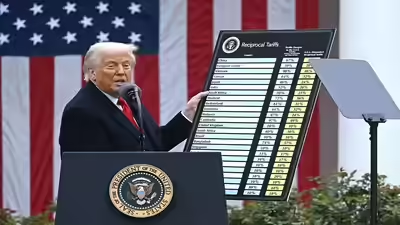
Chinese PC maker Lenovo and other tech companies have sued the US government. In these lawsuits, the companies are seeking refunds for tariffs imposed by US President Donald Trump, which the US Supreme Court recently declared unconstitutional. On February 20, the US Supreme Court issued its opinion in Learning Resources, Inc. v. Trump, finding that the Trump administration lacked authority under the International Emergency Economic Powers Act (IEEPA) to impose tariffs. The decision could mandate that the government reimburse importers who incurred those tariffs. The world’s biggest PC maker by market share sued the US government at the United States Court of International Trade on the same day.
What Lenovo said in its lawsuit against the US tariffs
In the lawsuit, Lenovo and Motorola said they import products such as computers, servers, monitors, mobile phones, and accessories from countries including China and Mexico and that they were required to pay duties under these orders.Lenovo argues that the IEEPA does not authorise the US President to impose tariffs, and therefore the duties collected by US Customs and Border Protection (CBP) are unlawful. The company has already deposited the tariffs but is seeking a court order declaring the duties invalid, stopping further collection, and requiring CBP to refund the payments with interest.The complaint states that the US Constitution gives Congress the authority to impose tariffs and regulate foreign commerce, and any delegation of that power must be clearly defined. Lenovo claims the executive orders imposing tariffs on goods from countries including Canada, Mexico, China, India, and others exceed the authority granted under IEEPA.The case also references earlier court rulings that found similar tariffs unlawful. Lenovo argues that, as the importer of record, it has suffered financial harm and therefore has standing to bring the lawsuit. The company is asking the court to rule that the tariffs are unconstitutional and order refunds of the duties already paid.Apart from Lenovo, other tech companies, including Nintendo of America, vacuum cleaner maker Dyson, fitness wearable outfit Whoop, home security camera company Wyze, and printer producer Epson have also filed similar lawsuits against the US tariffs. The filings follow a similar structure, noting that the plaintiffs are importers and referring to the outcome of the Learning Resources case. They also state that the Supreme Court’s jurisdiction does not include the power to order refunds. As a result, the plaintiffs are asking the United States Court of International Trade to determine that they are entitled to refunds of the duties paid, along with interest. The plaintiffs are also seeking legal costs.However, the filings didn’t mention how the plaintiffs plan to use any refunds they may receive, The Register reports. This matter has become a debated issue because several companies increased prices or changed their pricing structures after the tariffs were introduced, leading consumers to pay higher prices. Last week, Law firm Arnold & Porter told The Register that consumer class actions may follow, noting that some cases have already begun.The law firm described these class actions as “untested and in their early stages,” but said they could have “sweeping implications on businesses across virtually every industry.”“Any company that imposed tariff-related fees or increased prices in response to the now-invalidated IEEPA tariffs faces new, sprawling exposure that should be evaluated promptly,” the law firm added.

