
Key Points
-
Dividend stocks have more than doubled the average annual return of non-payers, when looking back more than half a century.
-
Wall Street’s premier nominal-dollar dividend payers are brand-name businesses with well-defined competitive advantages.
-
Among these companies, you’ll find Wall Street’s largest share repurchase program, as well as two companies sporting respective annual dividend increase streaks of 63 and 39 years.
- 10 stocks we like better than Microsoft ›
There are countless ways for investors to make money on Wall Street, but few are as consistently successful as buying and holding high-quality dividend stocks. Based on a study by Hartford Funds, in collaboration with Ned Davis Research (“The Power of Dividends: Past, Present, and Future”), dividend stocks have more than doubled the annualized return of non-payers over more than half a century (1973-2024): 9.2% vs. 4.31%.
While it’s probably not a surprise that dividend stocks have a track record of outperforming, you might be shocked to learn that some of the biggest dividend payers on the planet aren’t necessarily the highest-yielding stocks. You can find higher yields than Microsoft (NASDAQ: MSFT), ExxonMobil (NYSE: XOM), and JPMorgan Chase (NYSE: JPM), but you’d struggle to find public companies with more generous dividend programs on a nominal-dollar basis than this trio.
Will AI create the world’s first trillionaire? Our team just released a report on the one little-known company, called an “Indispensable Monopoly” providing the critical technology Nvidia and Intel both need. Continue »
Collectively, seven of Wall Street’s most influential businesses are returning more than $114 billion annually to their shareholders through dividends.
Image source: Getty Images.
1. Microsoft: $27.05 billion in annual dividends paid to shareholders
Even though Microsoft’s quarterly payout of $0.91 ($3.64/annually) equates to just a 0.9% yield, it’s on track to dole out more than $27 billion to its shareholders from dividends over the next year.
Microsoft’s ability to pay Wall Street’s largest nominal dividend reflects the duality of its operating model. On the one hand, it’s enjoying lightning-fast growth potential from cloud computing, its cloud infrastructure service platform, Azure, and the incorporation of artificial intelligence (AI) solutions into Azure and other platforms. AI has reaccelerated Azure’s growth rate to nearly 40% on a constant-currency basis.
But Microsoft is still generating exceptional operating cash flow from its legacy segments, such as Windows and Office. Even though Windows is no longer, by itself, a growth catalyst, it remains the dominant global desktop operating system and can generate robust margins for Microsoft.
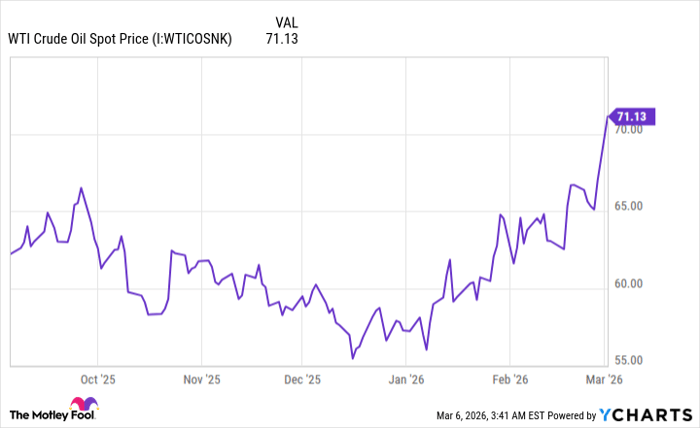
The spot price of crude oil has been rapidly climbing since the Iran war began. WTI Crude Oil Spot Price data by YCharts.
2. ExxonMobil: $17.18 billion in annual dividends
Although it’s quite the gap down after Microsoft, oil and gas goliath ExxonMobil is no dividend slouch. Based on a $1.03-per-quarter dividend ($4.12/annually), it’s pacing nearly $17.2 billion in outlays over 12 months.
The beauty of ExxonMobil’s operating model is that it’s integrated. While drilling generates the most favorable margins for oil and gas companies, ExxonMobil also oversees midstream assets, such as pipelines and terminals, as well as downstream assets, including refineries and chemical plants. Midstream and downstream assets can hedge against weakness in the price of crude oil and help steady the company’s operating cash flow.
But let’s be honest: commodity prices matter, too! The recent start of the Iran war, and the closure of the Strait of Hormuz to most oil exports — roughly 20% of the world’s daily liquid petroleum travels through the Strait of Hormuz — is boosting the spot price of crude and lifting ExxonMobil’s outlook.
3. JPMorgan Chase: $16.2 billion in annual dividends
When the U.S. economy is firing on all cylinders, bank stocks offer some of Wall Street’s steadiest capital-return programs. The $1.50/quarter ($6/annually) being paid by JPMorgan Chase equates to $16.2 billion in annual dividend outlays.
Banks are inherently cyclical, meaning they usually struggle during recessions and thrive during periods of economic expansion. The good news is that periods of growth last considerably longer than downturns. This allows JPMorgan Chase and its peers to spend most of their time prudently expanding their loan portfolios.
Furthermore, bank stocks benefited immensely from the Federal Reserve’s aggressive rate-hiking cycle from March 2022 to July 2023. To combat the highest inflation rate in four decades, the central bank ultimately increased its federal funds target rate by 525 basis points, leading to a sizable increase in interest income for JPMorgan Chase and its peers.

Image source: Apple.
4. Apple: $15.27 billion in annual dividends
In addition to Apple (NASDAQ: AAPL) sporting the best share repurchase program on the planet ($841 billion spent on buybacks since fiscal 2013 began), it has one of the largest nominal-dollar dividend payments. The $0.26/quarter ($1.04/annually) it’s paying shareholders equates to nearly $15.3 billion annually.
The lion’s share of Apple’s profits still derives from its physical devices, led by the iPhone. The incorporation of AI-driven solutions through Apple Intelligence into its physical devices appears to have reignited sales growth in recent quarters. Apple also has an incredibly loyal customer base, giving the company exceptional pricing power.
But Apple’s future is all about its pivot to subscription services. Placing added emphasis on subscriptions should boost the company’s operating margin over time, minimize sales fluctuations during iPhone replacement cycles, and further enhance its already impressive customer loyalty.
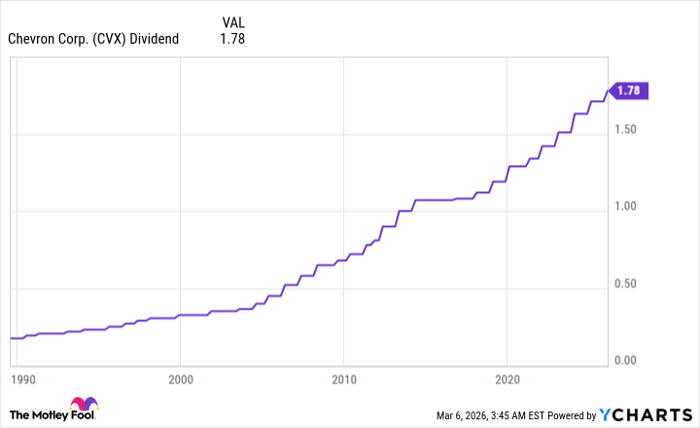
Chevron has increased its dividend for 39 consecutive years. CVX Dividend data by YCharts.
5. Chevron: $14.1 billion in annual dividends
Did I mention that big oil companies and jaw-dropping dividend payouts often go hand in hand? The $1.78-per-share payout ($7.12/annually) that Chevron (NYSE: CVX) declared in its most recent quarter works out to $14.1 billion in annual dividends to its investors. Chevron has hiked its base annual payout for 39 consecutive years.
Many of the same catalysts that are fueling ExxonMobil’s growth are also at play for Chevron. In particular, the integrated operating model is paramount to its success. Chevron’s refineries, chemical plants, and pipelines provide hedges in the event that the spot price of crude oil declines.
However, drilling is still Chevron’s bread-and-butter. It’s expanding its production capacity in the oil-rich Permian Basin, as well as integrating its $53 billion acquisition of Hess, which closed last July and gave Chevron a 30% stake in the Stabroek Block offshore Guyana. The Guyana Stabroek Block is estimated to contain more than 11 billion oil-equivalent barrels.
6. Johnson & Johnson: $12.53 billion in annual dividends
Another elite dividend stock that’s been even steadier than Chevron in raising its base annual payout is healthcare conglomerate Johnson & Johnson (NYSE: JNJ). “J&J,” as Johnson & Johnson is more commonly known, has raised its dividend for 63 consecutive years. Its $1.30/quarter payout ($5.20/annually) results in the company doling out approximately $12.5 billion yearly to its shareholders.
The stability of J&J’s cash flow is a function of its management team steadily shifting toward juicier-margin opportunities. It spun off its consumer health division, now known as Kenvue, in 2023 and plans to spin off its orthopedics segment (DePuy Synthes) in the quarters to come. J&J’s focus has been on high-margin novel drug development and medical devices with long growth runways.
Johnson & Johnson’s success also derives from continuity in the executive suite. You only need two hands to count the number of CEOs J&J has had since its founding in 1886. Long-tenured leadership means growth initiatives and strategic shifts are being seen through from start to finish.
7. Verizon Communications: $11.94 billion in annual dividends
Last but certainly not least is telecom titan Verizon Communications (NYSE: VZ), which is paying out one of the largest nominal-dollar dividends on Wall Street — $0.7075/quarter ($2.83/annually), working out to $11.94 billion annually — and sports an ultra-high yield of 5.5%. Verizon has raised its base annual dividend for 20 straight years.
Despite mediocre sales growth in the low-to-mid single digits, Verizon has benefited from wireless services, broadband access, and smartphones, effectively evolving into a basic necessity. It’s enjoying a relatively low wireless churn rate, which is translating into highly predictable operating cash flow year after year.
What’s more, broadband has been a cash flow bright spot. The closing of Verizon’s acquisition of Frontier in January 2026 scaled its “fiber footprint to over 30 million homes and businesses,” according to the company. Even though broadband isn’t the double-digit growth story it was a quarter century ago, it serves as the perfect dangling carrot to encourage high-margin service bundling.
Should you buy stock in Microsoft right now?
Before you buy stock in Microsoft, consider this:
The Motley Fool Stock Advisor analyst team just identified what they believe are the 10 best stocks for investors to buy now… and Microsoft wasn’t one of them. The 10 stocks that made the cut could produce monster returns in the coming years.
Consider when Netflix made this list on December 17, 2004… if you invested $1,000 at the time of our recommendation, you’d have $534,008!* Or when Nvidia made this list on April 15, 2005… if you invested $1,000 at the time of our recommendation, you’d have $1,090,073!*
Now, it’s worth noting Stock Advisor’s total average return is 949% — a market-crushing outperformance compared to 190% for the S&P 500. Don’t miss the latest top 10 list, available with Stock Advisor, and join an investing community built by individual investors for individual investors.
*Stock Advisor returns as of March 8, 2026.
JPMorgan Chase is an advertising partner of Motley Fool Money. Sean Williams has no position in any of the stocks mentioned. The Motley Fool has positions in and recommends Apple, Chevron, JPMorgan Chase, Kenvue, and Microsoft and is short shares of Apple. The Motley Fool recommends Johnson & Johnson and Verizon Communications. The Motley Fool has a disclosure policy.
The views and opinions expressed herein are the views and opinions of the author and do not necessarily reflect those of Nasdaq, Inc.