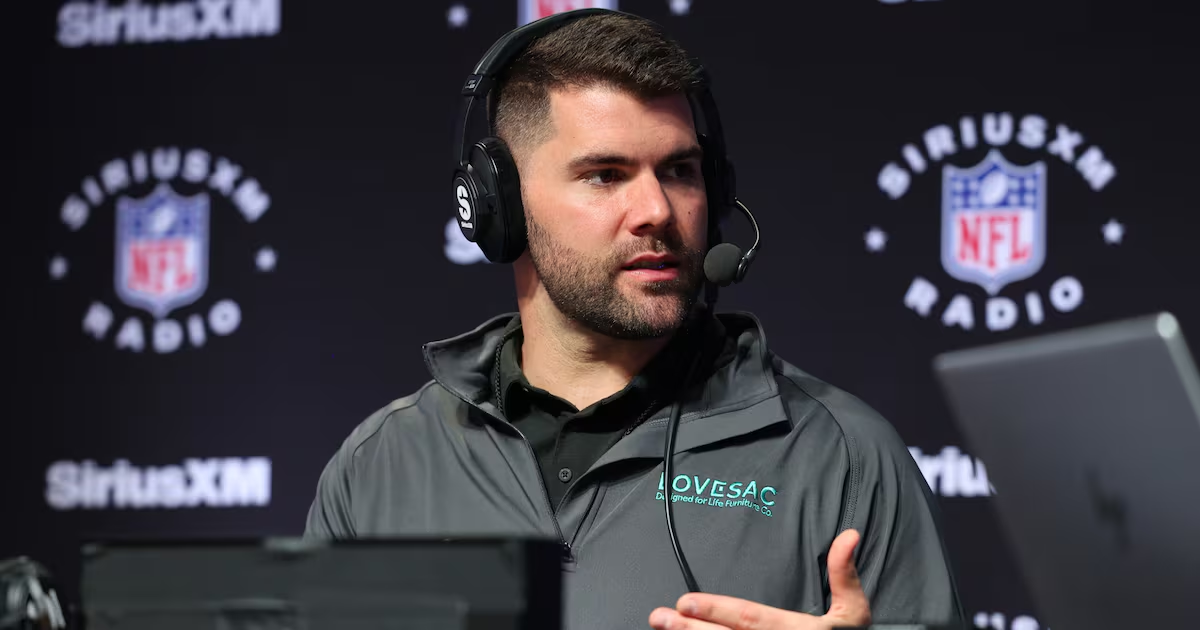
Last week’s headline that former Giants and Cardinals OL Justin Pugh is now the commissioner of the Italian Football League seemed like novelty news, but it’s another sign of how the NFL’s international push is generating meaningful knock-on investment activity far away from 345 Park Ave.
Pugh’s appointment was part of a comprehensive restructuring and capitalization of the 48-year-old Italian Football League, orchestrated by team owners and the Italian Federation of American Football to better position it for commercial growth. Pugh is an investor in the league, and he agreed to become commissioner in an open-ended arrangement as it seeks to improve its product and build a business and more ties with the NFL.
Pugh is not moving to Italy, and “commissioner” isn’t quite what it sounds like. Chief Operating Officer Edoardo Cammi will handle day-to-day operations, and Andrea Fimiani will hold the title of chief business officer (incidentally, he is also the league MVP quarterback of the reigning IFL champion, Guelfi Firenze.)
“It’s an ambassador, strategic advisory role,” Pugh told me. “I’m on calls every week. I’m in the group chat with the teams, the owners, and CEO and some others. We’re speaking daily. Part of my job is building bridges between the U.S. and Italy, and because of that, it obviously makes more sense to be stateside. But I’ll be over for all the major games and major events outside of football season.”
Pugh isn’t the only IFL bigwig based in the U.S. The CEO is Nick Eyde, a former IFL player who works in Ohio as a real estate developer. He helped the league play two of its last three championship games at the University of Toledo’s Glass Bowl.
All these titles are new for the IFL, which is now a freestanding for-profit company that manages the league’s commercial interests, runs events and provides central services for the teams. (Until now, the IFL was just an association of participating clubs under the auspices of the national federation.) But on Feb. 25, the federation created three new entities: the for-profit commercial company to run the business; the IFL Alliance, a nonprofit association of teams to hold the championship rights; and IFL Partners, which manages the equity and investment interests of the owners. Meanwhile, the Federation will continue to perform typical national-governing body roles, including running the national flag teams heading into the LA28 Olympics.
Why Italian gridiron investors think the time is now
Italy is a dark spot on the NFL’s global expansion map, with no teams holding commercial rights there and no known plans of playing a game there. But in the esoteric world of European semi-pro American football, the IFL is one of the more established properties. (John Grisham wrote a novel set in the IFL in 2007, “Playing For Pizza.”) “Italy has everything to be able to compete with anyone in the world, outside the U.S. and the NFL,” said Pugh, who is not of Italian heritage but considers himself “Italian by osmosis” through his wife, Ange, and her family.
In the short term, Pugh’s goals are modest and decidedly semi-pro in nature. He wants to ensure game clocks are visible on IFL action on YouTube, to make sure every venue has prominent play clocks and a field that’s actually 100 yards long (not all do). But in the long term, they’re focused on developing Italian football stars. “The biggest initiative I will take on is growing our hometown heroes in Italy,” Pugh said.
The Italian gridiron enthusiasts are thinking big for three reasons, Pugh said: The NFL’s investment in global popularity, the inclusion of flag football in the LA28 Olympics and paying players in NCAA football. All of those steps enable the IFL to sell American football is a legitimate pathway for Italians, not just a hobby.
“All those incentives never existed in NFL Europe,” Pugh said. “That was subsidized by the teams. Now, you can subsidize with the actual capitalistic market that is college football and dollars that are being spent to support these Olympic programs.”
The Italians’ announcement came three months to the day after Mexico’s American football league announced a big investment from a U.S. private equity firm.