If you are wondering whether AeroVironment’s current share price reflects its underlying worth, you are not alone. Many investors are asking if the stock still offers value after recent moves.
The stock last closed at US$226.48, with returns of an 11.3% decline over 7 days, a 16.1% decline over 30 days and an 11.6% decline year to date, while the 1 year and 3 year returns stand at 66.9% and 141.7% respectively and the 5 year return is 108.5%.
Recent headlines around AeroVironment have focused on the company’s role in defense and unmanned systems, which often shapes how investors think about its long term prospects and risk profile. These themes help frame why the stock can see sharp moves over shorter periods even when the core story feels steady to some investors.
On our valuation checks, AeroVironment scores 2 out of 6 for potential undervaluation, and you can see the full breakdown in its valuation score. Next we will look at what different valuation methods say about that score and finish with a deeper way to think about what the market is really pricing in.
AeroVironment scores just 2/6 on our valuation checks. See what other red flags we found in the full valuation breakdown.
A DCF model takes projected future cash flows, discounts them back to today using a required return, and sums them to estimate what a business might be worth right now.
For AeroVironment, the model uses a 2 Stage Free Cash Flow to Equity approach based on cash flow projections. The latest twelve month free cash flow is a loss of $244.72 million. Analysts provide explicit forecasts for the next few years, and Simply Wall St then extends those out to a full 10 year path, with projected free cash flow reaching $966.53 million in 2035, all expressed in $ and discounted back to today.
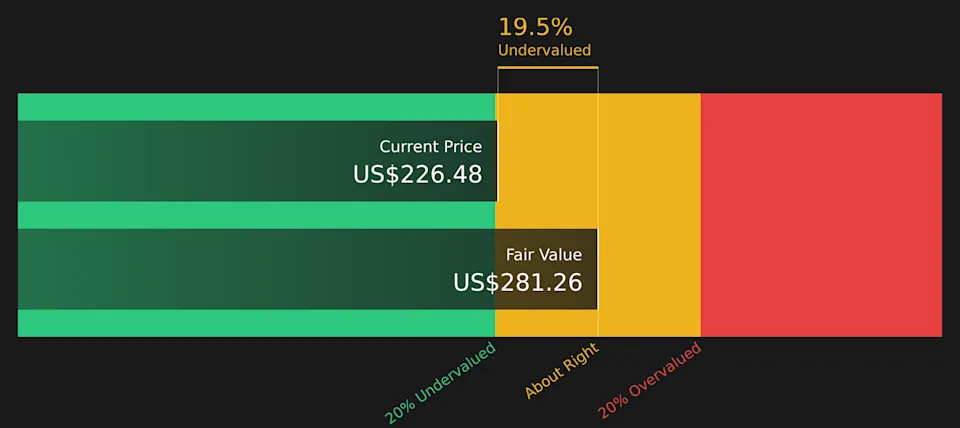
When all those discounted cash flows are added up, the model arrives at an estimated intrinsic value of about $281.26 per share. Compared with the recent share price of $226.48, this implies the stock trades at roughly a 19.5% discount to that DCF estimate. This suggests the market is pricing in a weaker cash flow path than this model assumes.
For profitable companies where earnings can be volatile or temporarily distorted, the P/S ratio is often a useful cross check because it compares the share price to the company’s revenue base, which tends to be more stable than earnings.
What investors usually pay on a P/S multiple reflects their expectations for future growth and the risk they see in those expectations. Higher expected growth or lower perceived risk can justify a higher “normal” or “fair” P/S, while slower growth or higher uncertainty often lines up with a lower multiple.
AeroVironment currently trades on a P/S of 8.22x. That is above the Aerospace & Defense industry average of 4.83x, but below the peer group average of 11.96x. Simply Wall St also provides a proprietary “Fair Ratio” of 4.28x for AeroVironment, which is the P/S level it estimates based on factors such as earnings growth, profit margins, industry, market cap and company specific risks. This Fair Ratio can be more informative than a simple peer or industry comparison because it adjusts for the company’s own profile rather than assuming it should match the group.
Compared with this 4.28x Fair Ratio, the current 8.22x P/S suggests AeroVironment is trading above that fair multiple estimate.
Earlier we mentioned that there is an even better way to understand valuation. On Simply Wall St you can use Narratives, where you set out your story for AeroVironment, link it to your assumptions for future revenue, earnings and margins, and see how that story translates into a fair value that you can compare with the current price. This is all available within an easy tool on the Community page that updates as new news or earnings arrive. One investor might anchor on a higher fair value such as US$450 based on a view that AeroVironment could be a primary vehicle for unmanned and AI driven defense, while another might lean toward a lower fair value closer to about US$191 if they are more focused on budget pressure, contract risk and regulation. Narratives simply make those different perspectives explicit and comparable.
This article by Simply Wall St is general in nature. We provide commentary based on historical data and analyst forecasts only using an unbiased methodology and our articles are not intended to be financial advice. It does not constitute a recommendation to buy or sell any stock, and does not take account of your objectives, or your financial situation. We aim to bring you long-term focused analysis driven by fundamental data. Note that our analysis may not factor in the latest price-sensitive company announcements or qualitative material. Simply Wall St has no position in any stocks mentioned.