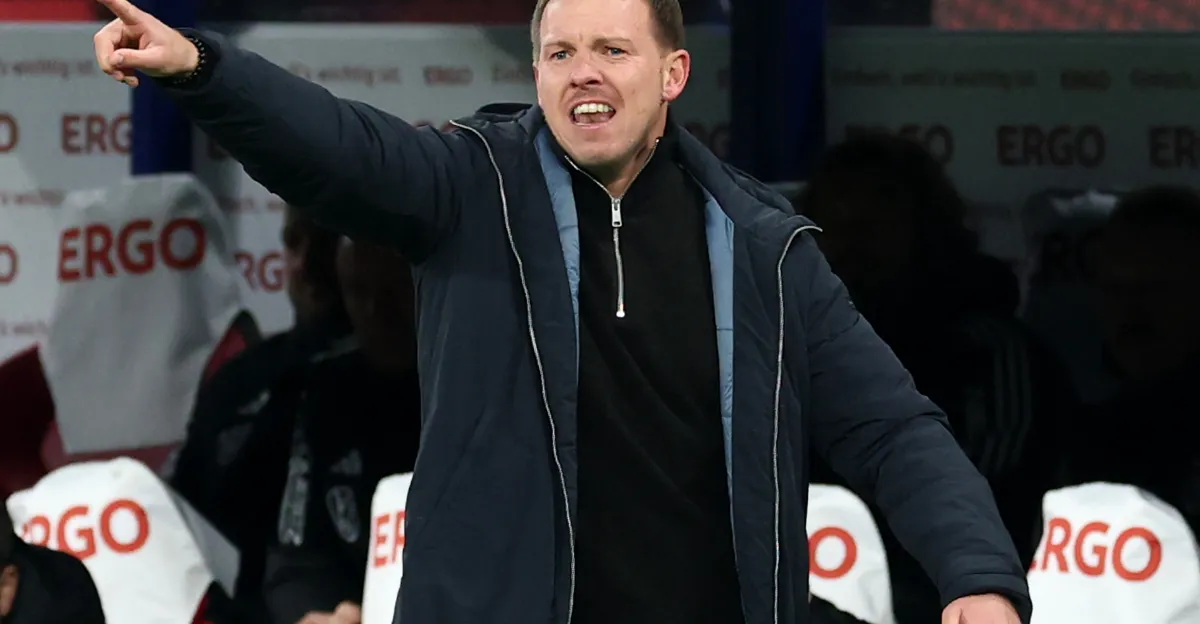
Julian Nagelsmann recently gave a lengthy interview with kicker where he discussed a wide variety of details pertaining to the German national team as this summer’s World Cup in the United States, Canada and Mexico broaches ever so closer. Prior to the tournament kicking off, Germany has a handful of friendly matches before Nagelsmann ultimately has to finalize his roster and there will certainly be some difficult decisions he’ll have to make that will leave some players exuberant, and others incredibly disappointed.
What was particularly striking about the interview was how brazen and open Nagelsmann was on certain details. He confirmed that Bayern Munich’s Joshua Kimmich will be Germany’s starting right back this summer and that Hoffenheim’s Oliver Baumann is currently the number one keeper barring any changes that could occur between now and this summer. He also made a point of saying Leon Goretzka is very much planned to be a starter in midfield alongside Aleksandar Pavlović despite the former not getting starts in key matches for Bayern under Vincent Kompany.
On the other side of the token, Nagelsmann spoke about Lennart Karl and how the youngster needs to find more of his rhythm amidst a patchy run of form before he can be considered a regular feature in the German senior setup. Likewise, he put more pressure on FC Köln phenom Said El Mala — another young player in the Bundesliga that has experienced a bit of a slump after a fiery start to the season. Pundits across Germany have put added pressure on both the pair players and Nagelsmann with their calls for the former Bayern, RB Leipzig and Hoffenheim manager to give both players a chance in the national team.
With everything Nagelsmann openly discussed with kicker, sports psychologist Matthias Herzog explained that he felt there was some method to the madness, so to speak, but it might even be a bit counterintuitive. “This is not normal squad politics. This is psychology on the open stage,” Herzog explained (via Tz).
Giving certain signals to certain players and different signals to others can be relatively misleading and give players certain ideas far too early. National team places should be something fought for and earned every time selections are made, and nothing should be a given in that sense. “Nagelsmann wants harmony. He wants a team that works. No egos, no theater. That’s understandable. But you don’t win world championships only with harmony. You win them with inner hunger, competition, greed and the fear of losing your place. If everyone knows where they stand too early, this hunger can disappear,” Herzog highlighted.
Herzog even posed the idea that some players might feel they’re being overlooked and they’re unsure of what else they can even do to get a callup from Nagelsmann. Leeds United’s Anton Stach was an example that he used — a player who’s tackling numbers are better than Goretzka’s both on the ground and in the air. “If Stach performs week after week in England and is still hardly noticed, it can break something inside. This is dangerous. Not loudly. But quietly. And quiet doubts eat up energy,” Herzog stressed.
Outward expression is also something Herzog feels can be analyzed. German football heritage has a long, rich history of expressive, bold, and loud characters like Kimmich, Manuel Neuer, Thomas Müller, Stefan Effenberg, Oliver Kahn, and Lothar Matthäus among many others. When there’s not a lot of that type of expressiveness and more internalization of emotions, that can be a negative signal in Herzog’s eyes. “The current national team in particular consists of many rather quiet, introverted types. To deduce from this that a lack of cheering is a sign of internal problems falls short. Emotion has to be real. As soon as players start pretending just to please the coach, they lose authenticity. And that is extremely important in high-performance sport,” he explained.
Keeping a level head and not getting over-animated unnecessarily is one thing with a level of professionalism, but emotional muteness doesn’t exactly exude pride, confidence, and forwardness.