European leaders will not send troops to monitor a ceasefire in Ukraine without first securing permission from Russian leader Vladimir Putin, Britain’s Telegraph reports. The news represents a significant political victory for Russia and comes following a coordinated Kremlin campaign of intimidation designed to deter any European military deployment to Ukraine.
This informal Russian veto over European troops in Ukraine places a key element of the current peace process in jeopardy. Ever since the so-called Coalition of the Willing began to take shape in early 2025, participating countries led by Britain and France have been developing plans to send a significant number of troops to Ukraine following a ceasefire in order to monitor adherence and serve as a reassurance force. However, Putin has consistently signaled that he will not agree to a European military presence, with Kremlin officials stating that any European soldiers sent to Ukraine would be “legitimate targets.”
These threats appear to have worked. With the Coalition of the Willing reportedly unwilling to act unless Putin gives them the green light, the entire concept of a reassurance force is now in doubt. This means that a viable and independently monitored ceasefire in Ukraine looks to be unattainable. All Putin need do to block the process is withhold his approval indefinitely.
Stay updated
As the world watches the Russian invasion of Ukraine unfold, UkraineAlert delivers the best Atlantic Council expert insight and analysis on Ukraine twice a week directly to your inbox.
Europe’s reluctance to sanction a military mission to Ukraine without Russia’s prior agreement is the latest setback to a faltering peace process. After more than a year of false starts and fruitless talks, many now believe that Russia has no intention of agreeing to a ceasefire and does not genuinely seek peace.
Critics argue that Putin is using the current US-led negotiations to buy time and as an opportunity win over the Trump administration. The Kremlin dictator remains adamant that despite the slow progress of his invasion, Russia will still ultimately achieve its goals in Ukraine. It came as no surprise when reports emerged recently claiming that Russian officials are privately mocking Trump for his naivety about Putin’s true intentions.
With little prospect of progress toward a negotiated peace settlement, Western leaders should be focusing their energies on steps to secure Russia’s defeat in Ukraine. Unfortunately, however, there currently appears to be little chance of this happening. Since 2022, the West has largely wasted Ukraine’s sacrifices while failing to arm Kyiv for victory or impose sufficiently stiff sanctions on Moscow. As the invasion enters a fifth year, there are now some signs of growing European resolve, but much more needs to be done in order to stop Russia.
Eurasia Center events

Putin’s ability to intimidate European leaders on the issue of troop deployments to Ukraine underlines Europe’s continued lack of credibility in the international security arena. While there has been plenty of talk in European capitals over the past year about the need for greater strategic autonomy, this has yet to translate into concrete action. European governments are still not ready to provide credible deterrence against Russia and suffer from an absence of overall leadership that makes decisive action in the security sphere particularly challenging.
The Trump administration’s efforts to step back from transatlantic security commitments have highlighted the need for increased European defense spending, but Europe remains reliant on the US and has no practical alternative to NATO. It is therefore important to reinvigorate rather than undermine the alliance. Instead, the oppose is happening, with faith in NATO’s collective security commitment presently at all-time lows. This only emboldens Putin. Meanwhile, US President Donald Trump is actually validating European fears by demanding that Ukraine and not Russia make concessions to end the war.
Intelligence agencies and Western government officials increasingly acknowledge that Russia is preparing for a wider European war. This makes it all the more vital to increase backing for Ukraine and integrate the country deeper into Europe’s defense architecture. There are signs this is well understood, with encouraging recent developments including the co-production of weapons in a number of European countries for use in Ukraine.
Putin has long since made clear that he will only negotiate under duress. The Kremlin dictator remains committed to erasing Ukrainian statehood and will not enter into serious talks to end the war until the alternative is defeat. In order to reach that point, Europe must continue to rearm while incorporating the lessons learned on the battlefields of Ukraine and developing the drone capabilities that will define the wars of the future.
Crucially, European leaders must also recover their political nerve and demonstrate to Putin that he cannot hope to intimidate them indefinitely. They can begin by declaring that Russia does not get to decide whether European troops are deployed to a sovereign and independent Ukraine.
Stephen Blank is a senior fellow at the Foreign Policy Research Institute.
Further reading
The views expressed in UkraineAlert are solely those of the authors and do not necessarily reflect the views of the Atlantic Council, its staff, or its supporters.

The Eurasia Center’s mission is to enhance transatlantic cooperation in promoting stability, democratic values, and prosperity in Eurasia, from Eastern Europe and Turkey in the West to the Caucasus, Russia, and Central Asia in the East.
Follow us on social media
and support our work
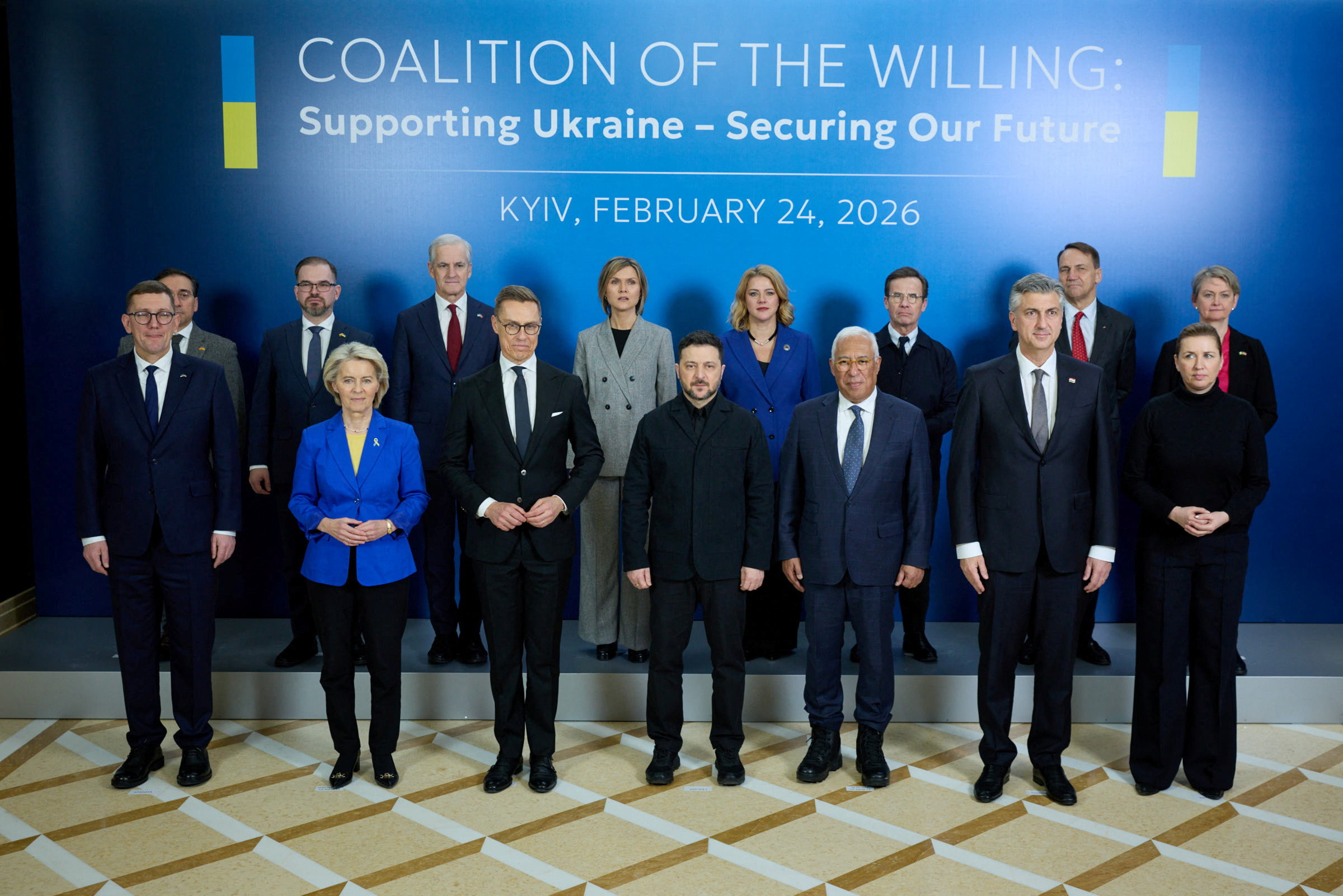
Image: Ukrainian President Volodymyr Zelenskiy and EU leaders pose for a picture before a meeting of ‘Coalition of the Willing’, amid Russia’s attack on Ukraine, in Kyiv, Ukraine February 24, 2026. (Ukrainian Presidential Press Service/Handout via REUTERS)