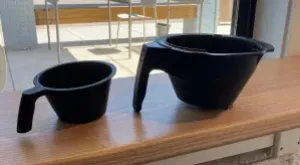
Today I finally ran an experiment I’ve wanted to try for a long time.
If you’re a professional barista—or you run a busy café—this may save you some time.
Most coffee shops use 1–1.5 gallon batch brewers (Bunn, Curtis, Fetco, etc.). When I opened Short Sleeves Coffee, I intentionally avoided brewing full 1-gallon batches. I had seen too many shops brew a gallon and let it sit for hours—continuing to extract, flattening, and slowly losing sweetness.
Instead, we brewed 1-liter batches.
Using Scott Rao’s 1-liter conversion kit and custom rail system, we were able to keep coffee within one hour off brew for customers. The quality was noticeably better.
But once we got busy, 1-liter batches became difficult to maintain. During peak hours, we simply couldn’t brew fast enough.
So we adjusted:
Over time, though, it became clear we needed something in between.
One liter often lasted 15 minutes.
One gallon sometimes sat for two hours.
And I don’t like dumping coffee.
The Half-Gallon Problem
The obvious solution is simple:
Use the 1-gallon basket.
Cut the dose in half.
Adjust the brew recipe.
But I struggled with that.
With half the coffee in a full-sized basket, the bed depth becomes shallow. A shallow bed increases bypass. Increased bypass changes extraction dynamics. The cup often feels thinner, sometimes drier, occasionally tannic.


I searched for a dedicated half-gallon basket but couldn’t find one I liked. And from a workflow perspective, introducing a third basket (1L, ½ gallon, 1 gallon) felt inefficient.
So I decided to test it properly.
The Baseline
Our standard 1-gallon recipe for this medium-light blend:
-
210g coffee
-
EK43 grind setting: 12.8
(Grind numbers won’t translate directly to your setup, but they provide context.)
A strict half recipe would call for 105g.
But because of the shallow bed, I suspected we would need:
-
A higher dose to compensate for bypass
-
Possible grind adjustments to manage flow
-
Potentially double filters to slow drawdown
Josh from Chill Wave Coffee and I also wondered whether double filtering might help reduce bypass and increase extraction in a shallow bed.
So I tested six variations.
The Test Batches
| Batch | Dose | Grind | Filters |
|---|---|---|---|
| A | 115g | 12.2 | 1 |
| B | 115g | 12.2 | 2 |
| C | 120g | 12.4 | 1 |
| D | 120g | 12.4 | 2 |
| E | 125g | 12.6 | 1 |
| F | 125g | 12.6 | 2 |
Observations
Double Filters
Every double-filter batch was noticeably thinner.
Cups were:
-
Drier
-
More tannic
-
Less sweet
-
Tea-like in body
Whether technically over-extracted or simply stripped of oils and fines, they lacked the texture we want in batch brew.
Conclusion: double filtering is not a viable solution for us.
Dose & Grind
As dose increased, overall cup quality improved.
At 115g:
-
Slightly thin
-
Mild dryness
At 120g:
-
Better structure
-
Still some drying
At 125g:
-
Best sweetness
-
No noticeable dryness
-
Balanced extraction
However, as dose increased, body thickened. Adjusting grind slightly coarser improved clarity—but the change didn’t need to be dramatic.
Interestingly, the cups improved more from increasing dose than from altering grind.
The Final Recipe
After six batches, I landed here:
-
125g coffee
-
Grind: 12.8
-
1 filter
Yes—the grind setting is identical to our full-gallon batch.
The only meaningful adjustment was increasing the coffee dose and changing the brew volume accordingly.
No double filters.
No significant grind shifts.
Just more coffee.
What This Suggests
Half batches are not simply half recipes.
When brewing a half-gallon in a full-sized basket:
Increasing dose appears to compensate for this more effectively than adjusting grind or adding filters.
And from a workflow perspective, keeping grind consistent with your full batch simplifies bar flow—which matters during service.
The Takeaway
If you’re brewing half-gallon batches in a 1-gallon basket:
Increase the dose.
Keep grind stable.
Use a single filter.
This was only a six-batch experiment—not definitive science—but it clarified something for me:
Half batches require intention, and need to be dialed in themselves.
However, maybe save yourself the trouble of variable fatigue…and just try different doses.
If you’ve approached this differently, I’d genuinely love to hear your experience.
Coffee is better when we compare notes.
Thanks pals,
-Daniel Lancaster