President Donald Trump claimed Iran posed an “imminent” threat to the US and its allies as he joined Israel in launching an operation to topple the Iranian regime.
Trump said Saturday that Iranian Supreme Leader Ayatollah Ali Khamenei was killed, although Tehran said he was alive and that its government continued to function. Iran responded with attacks on US bases, Israel, and targets across the Middle East.
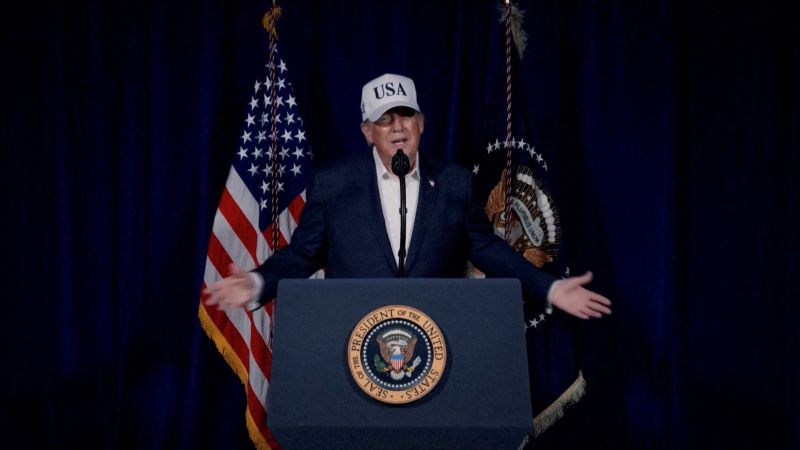
Trump announced the major military action, which so far has relied on US air and naval power, in a video posted to his social media account at 2:30 a.m. ET in which he wears a white USA ball cap.
Bracing Americans for the likelihood of US casualties, Trump also warned that Iranian forces will be killed unless they lay down weapons.
Here are his remarks, annotated with context:
(While the US and Israel launched this attack without obvious provocation, Trump argues it was an act of self-defense. Iran does have nuclear capabilities, but Trump says, without specifics, the threat from Iran is “imminent.” It’s important for him to claim Iran is an imminent threat because he launched this war using emergency powers and without authorization from Congress. Critics will say an unprovoked attack violates international law and usurps the role of Congress.)
(Trump does not mention here that the US and CIA were involved in the coup that toppled a democratically elected leader in Iran in 1953, something that sparked anti-American sentiment in Iran. The US supported the authoritarian shah who ruled until he was overthrown in the 1979 revolution, when hostages were taken from the US Embassy. The hostage crisis, which featured a failed rescue attempt by US special forces, played a major role in the 1980 presidential election, when Ronald Reagan defeated Jimmy Carter. The hostages were released by Iran in the moments after Reagan was sworn in as president.)
(Oil-rich Iran has long supported Hamas with money and training, but Tehran’s government claimed no direct involvement in the October 7, 2023, attacks. CNN reported in the aftermath of the attack on Israel that initial US intelligence suggested senior Iranian officials were surprised by it.)
(Iran claims not to be seeking a nuclear weapon, but rather energy. Last March, the US intelligence assessment was that Iran is not seeking to build a nuclear weapon. Trump struck Iran’s nuclear sites last year anyway. Iran insists that it has the right under international law and the Nuclear Nonproliferation Treaty to which it is a party to develop its own nuclear material for an energy program. The US and Israel, along with other countries, do not trust the Iranian regime. Trump during his first term ended a complicated deal negotiated by the Obama administration through which Iran said it would set aside nuclear ambitions in exchange for unlocking sanctions against its oil wealth.)
(Read CNN’s report about Trump’s decision to bomb Iran’s nuclear sites last June, when Trump said the operation had destroyed Tehran’s nuclear program. That boast now seems to have been premature, given the massive new military operation.)
(US intelligence does not back up Trump’s claim that Iran is building long-range missiles. Here’s the key line from CNN’s report: “An unclassified assessment from the Defense Intelligence Agency (DIA) from 2025 said that Iran could develop a ‘militarily-viable’ intercontinental ballistic missile by 2035 ‘should Tehran decide to pursue the capability.’”)
(The words “massive” and “ongoing” are important here. This is not a one-off strike like the bombing of Iranian nuclear sites in June or the snatching of Venezuelan leader Nicolás Maduro in January. This sounds similar to a war, even though Congress has not authorized it or written a check to pay for it.)
(Trump has asked Congress to spend $1.5 trillion on the defense next year, a massive increase.)
(This is an important warning for Americans: US service members may be killed in this operation. Most Americans opposed using military force to attack Iran, according to recent polls, although most Republicans approve of the idea. There is broad concern about the US getting entangled in a long-term war.)
(In Venezuela, the Trump administration is working with the remnants of the Maduro regime, which are still in charge of the country. It’s not clear who the US would like to see take over in Iran.)
(Interestingly, Trump does not call on Iranians to rise up against the authoritarian regime, but rather to let the US take out their leaders.)
(If recent history from US adventures in Iraq, Afghansistan and Libya is any guide, it is after military action and regime change that things can truly fall apart.)