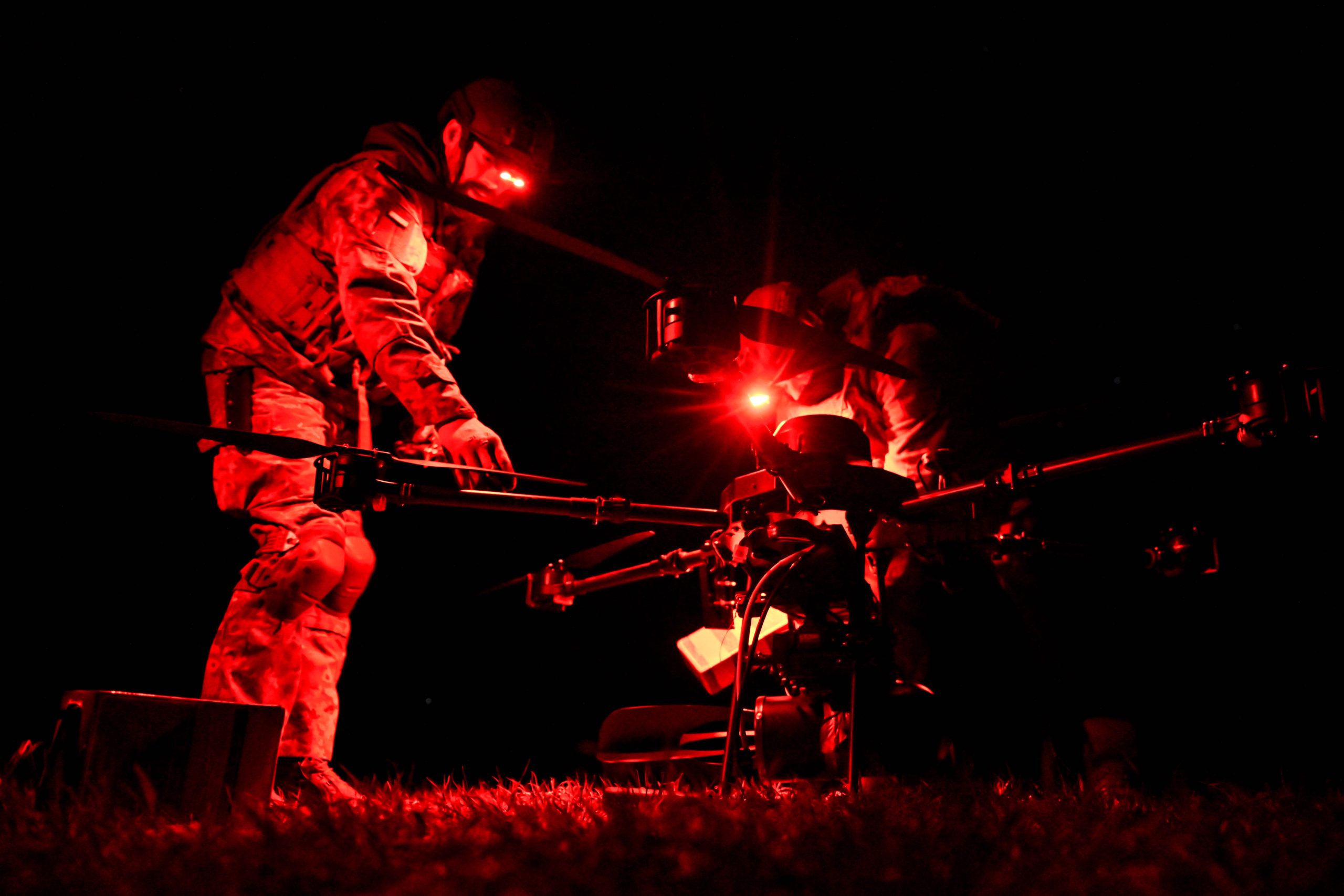
Despite pouring vast resources into its defense sector and flooding the frontline with attack drones using Iranian and Chinese technology, Moscow still cannot match Kyiv’s heavy-lift capability. Putin was forced to admit his administration’s failure during his pre-Christmas TV broadcast.
“We are still short of heavy drones like the adversary’s Baba Yaga, but with respect to the number of drones, we are ahead of our adversary in almost all the segments of the frontline,” Putin said.
Ukraine’s Baba Yaga drones — the nickname for the heavy-lift class, and named after a witch in Slavic folklore — have served a vital role in the fighting, while smaller, mass-produced first-person-view (FPV), drones have taken the headlines.
Originally adapted from agricultural devices for spreading fertilizer, the heavy bombers perform numerous functions, from mining roads with anti-tank mines and resupplying soldiers to attacking Russian positions. Once near a target, within a few seconds, they can eliminate a group of soldiers by dropping several munitions in succession.
This heavy drone class includes models such as the Vampire and Kazhan, which are used on the frontline. Most have six or more large rotors and could originally carry about 15kg (33 lbs.) over distances of up to 20km (12 miles), but Ukrainian teams have gradually increased their capability.
Heavy lift multicopters have been developed that can carry as much as 40kg over 35-40km to resupply frontline units. Engineers are even working on a version that could evacuate wounded soldiers from the battlefield.
“Ukrainian ‘Vampire’ type heavy drones have a complementary role to FPVs,” said Roy Gardiner, an open-source weapons researcher and former Canadian officer. “While FPVs attack Russian logistics vehicles during the day, heavy drones attack the same vehicles at night by precision mining roads.”
At night, DJI Mavic drones with thermal cameras hunt for Russian soldiers, and once a large cluster is identified, the heavy bombers move in to drop explosives. The Vampire drone is also used to attack high-priority targets, such as Russian drone operators, when they are spotted.
“They’re both effective, but each has its nuances,” said Danylo Makarov, a drone pilot from Ukraine’s 108 Territorial Defense Brigade who has worked with both systems. “FPVs are more effective against pinpoint targets, where the scale of damage doesn’t matter but accuracy does.”
When it comes to hardened positions such as fortified bunkers, entrenched infantry, or reinforced structures, “a Vampire drone can drop a couple of TM-62 mines and take care of it,” Makarov said. But there are drawbacks: “It’s a big drone, bulky, and requires a crew. It’s harder to work with,” he added.
Get the Latest
Sign up to receive regular emails and stay informed about CEPA’s work.
The Vampire heavy bomber was one of Ukraine’s most effective strike platforms during last year’s fighting. According to data presented at the Army of Drones 2025 event, and figures from the ePoints program, the system ranked at or near the top across several operational categories, including enemy casualties, the number of bomber strikes, and being the most ordered bomber system.
Since spring 2023, Vampire drones have carried out more than 2.5 million combat missions. Equipped with a GNSS antenna, a bispectral camera, and strong resistance to electronic warfare, they can operate both day and night.
SkyFall, the company behind the Vampire drone, said production capacity has doubled to as many as 100,000 units a year. Vulnerable foreign components have been replaced with domestic alternatives, and the company expects the drone to be fully Ukrainian-made by the end of this year.
Costs have also fallen sharply, to about $8,500 per drone compared to about $20,000 in 2022.
Russian forces have attempted a range of countermeasures, including attaching long sticks to FPV drones in an effort to intercept the bombers midair. In one engagement, a Ukrainian heavy drone under pursuit could be seen emitting a bright flash just as a Russian FPV closed in, overwhelming the attacker’s sensor so the operator momentarily lost visual contact.
In November, the development of a killer drone that could disable the Baba Yaga was reported in Russian media, reflecting how important and high profile the task of countering Kyiv’s heavy-lift superiority has become.
Russian pro-war Telegram channels have also acknowledged the scale of the problem. One Russian blogger known as “Military Manager” described Ukrainian heavy drones as “literally ubiquitous,” performing “a huge amount of incredibly important and complex work.”
He warned that the drones have become the “backbone” of Ukraine’s FPV operations by acting as aerial relay stations to extend the connectivity and effectiveness of smaller strike drones.
With the Russians lacking an equivalent heavy platform of their own, units often retrieve and repair downed Ukrainian drones for reuse. “We have captured Baba Yaga drones . . . Some crews use them to deliver provisions, ammunition, and fuel,” one Russian soldier told state media.
Moscow has blamed component shortages and the time required to localize production for its inability to keep up with Kyiv, according to Samuel Bendett, an adjunct senior fellow at the Center for a New American Security.
At the end of January, Russia’s Defense Ministry finally announced its first heavy-duty “Koschei” FPV drones had been assembled, tested, and prepared for delivery to frontline units.
While Russia has narrowed the gap, it has yet to replicate Ukraine’s success with heavy bombers. Moscow has often taken proven Ukrainian innovations and produced them on an industrial scale, but the heavy-lift segment has proved harder to copy.
David Kirichenko is a freelance journalist and an Associate Research Fellow at the Henry Jackson Society. He can be found on X/Twitter @DVKirichenko.
Europe’s Edge is CEPA’s online journal covering critical topics on the foreign policy docket across Europe and North America. All opinions expressed on Europe’s Edge are those of the author alone and may not represent those of the institutions they represent or the Center for European Policy Analysis. CEPA maintains a strict intellectual independence policy across all its projects and publications.


Europe’s Edge
CEPA’s online journal covering critical topics on the foreign policy docket across Europe and North America.