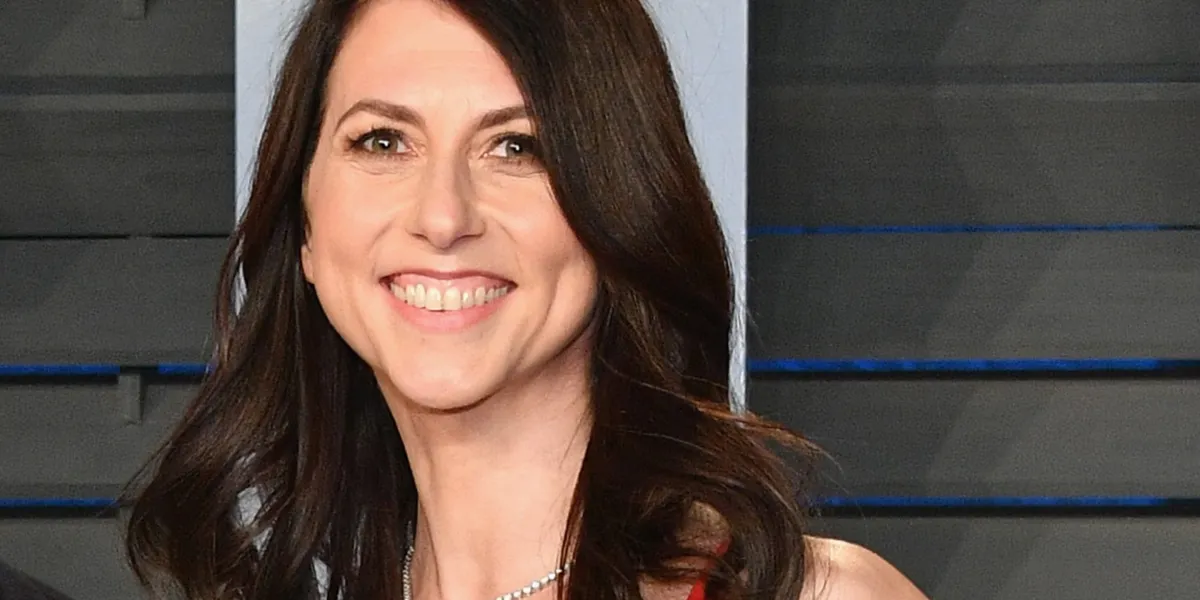
Billionaire philanthropist MacKenzie Scott had a banner year in 2025: She donated $7.2 billion, bringing her cumulative philanthropic giving through her organization, Yield Giving, to an eye-popping $26 billion across more than 2,700 gifts in just the past five years.
In fact, Scott’s philanthropic giving in 2025 alone sum exceeds what many of the world’s wealthiest individuals have contributed across their entire lives—including her ex-husband, billionaire Amazon founder Jeff Bezos, the world’s fourth-richest man.
Forbes currently estimates that Bezos and his wife, Lauren Sánchez Bezos, have given about $4.7 billion to charity over their lifetimes. That’s only about one-fifth of what Scott has donated since her 2019 divorce from Bezos, when she received about 4% of Amazon stock, amounting to roughly $36 billion to $38 billion at the time. Scott’s net worth continues to be buoyed by the ever-increasing upward trajectory of Amazon shares, though. Year-to-date, Scott has seen her net worth increase $268 million, according to the Bloomberg Billionaires Index, now standing at an estimated $39.2 billion. This means Scott has given away $26 billion and can afford to do that again. In January 2019 (when Bezos and Scott got divorced) Amazon’s market cap was about $830 billion. Today, Amazon’s market cap is $2.24 trillion, and it’s the No. 1 company on the Fortune 500, overtaking Walmart.
Scott, at the time of the divorce, promised to give away the majority of that fortune by signing the Giving Pledge, a campaign launched by Bill Gates, Melinda French Gates, and Warren Buffett in 2010 that encourages the world’s wealthiest people to commit most of their wealth to philanthropic causes.
Most of the signers to that pledge have not lived up to it, with Warren Buffett’s son recently explaining that it was very hard to give away money effectively. “There’s a lot of things you can fund that will go nowhere,” Howard Buffett, the 71-year-old son of Warren Buffett, recently told CNBC. “If you’re not addressing the real issue of rule of law then you just can’t have success.”
While Bezos has not signed the giving pledge, he and Sánchez Bezos have recently ramped up their philanthropic giving, committing $102.5 million to organizations combating homelessness across the U.S. The gifts are part of the Bezos Day 1 Families Fund, which has donated more than $850 million to organizations in all 50 states, Washington, D.C., Puerto Rico, and Guam.
That’s part of a $2 billion commitment, but even that entire giving plan is dwarfed by Scott’s giving. While Bezos has also pledged billions toward climate efforts and other causes—primarily through his Bezos Earth Fund—his verified disbursements remain in the low billions, most of which are earmarked rather than spent. Scott, by contrast, has already moved vast sums directly into the hands of grantees, many of whom had never before seen a gift of that scale.
Many of the gifts that Scott makes are the largest donations grantees have ever seen, including historic donations to HBCUs and organizations focused on climate and DEI.
Scott’s average annual giving has average more than $5 billion per year since her divorce, with 2025 being her banner year. According to Forbes, Scott is the third-most generous philanthropist, having given away 46% of her net worth.
Scott even dwarfs the most philanthropic members of the billionaire class, including Michael Bloomberg, George Soros, Steve Ballmer, and Mark Zuckerberg and Dr. Priscilla Chan.
A radical model of trust
Scott’s style of giving upends the traditional philanthropic playbook. She writes few press releases, operates without a large foundation staff, and gives primarily through a model known as trust-based philanthropy. The approach allows recipients to decide for themselves how best to use the funds, without the usual strings or reporting requirements attached.
“Unlike traditional funding processes that often involve lengthy applications, specific restrictions, and reporting requirements, her style empowers organizations like ours to determine how best to direct funds quickly and innovatively to address pressing issues,” Noni Ramos, CEO of Housing Trust Silicon Valley, told Fortune in late 2024, when her organization received a $30 million gift from Scott.
In a 2021 post on her Yield Giving website last year, Scott described her approach simply: “Because we believe that teams with experience on the front lines of challenges will know best how to put the money to good use, we encouraged them to spend it however they choose.”
“Many reported that this trust significantly increased the impact of the gift,” Scott continued. “There is nothing new about amplifying gifts by yielding control. People have been doing it in living rooms and classrooms and workplaces for thousands of years. It empowers receivers by making them feel valued and by unlocking their best solutions.”

This is really interesting, You’re a very skilled blogger. I’ve joined your feed and look forward to seeking more of your magnificent post. Also, I’ve shared your site in my social networks!