
General Motors CEO Mary Barra has issued a warning about cheap Chinese EVs entering North America.
It comes after Canada approved a plan to let thousands of Chinese-built electric vehicles into the country at a sharply reduced tariff rate.
For shoppers, that sounds like more affordable options in a market that desperately needs them.
For Detroit, it feels more like the first domino tipping over.
DISCOVER SBX CARS – The global premium auction platform powered by Supercar Blondie
General Motors CEO says cheap Chinese EVs are a ‘slippery slope’
Canada will now allow up to 49,000 Chinese-built EVs per year at a tariff of 6.1 percent instead of the 100 percent rate that previously kept them out.
Speaking at an employee all-hands meeting, General Motors CEO Mary Barra didn’t mince words.
“I can’t explain why the decision was made in Canada,” she said.
“It becomes a very slippery slope.”

Her concern centers on the deeply intertwined North American auto industry, where parts, plants, and jobs flow across the US-Canada border daily.
Barra argued that lowering barriers for Chinese EVs runs counter to building a strong industrial base on the continent and protecting long-term jobs.
Under the deal announced by Prime Minister Mark Carney’s office, at least half of the imported EVs must be priced below CAD $35,000 – roughly $26,000 – by the end of the decade.
That squarely targets the affordable EV segment, an area US automakers haven’t exactly dominated.
Critics, however, were quick to point out the irony.
GM recently wound down its BrightDrop commercial van line in Canada, idling the CAMI plant in Ingersoll, Ontario, and is ending a shift at Oshawa Assembly.
If investment shrinks, some argue, governments will naturally look elsewhere.
There’s also a technical wrinkle.
Canadian vehicle safety standards are closely aligned with US rules, meaning cars certified in Canada could potentially move south with fewer hurdles.
Add Mexico’s growing role in EV manufacturing, and suddenly the regional chessboard looks a lot more complicated.
Click the star icon next to supercarblondie.com in Google Search to stay ahead of the curve on the latest and greatest supercars, hypercars, and ground-breaking technology
Meanwhile, Chinese EV makers and AI pressures are reshaping the market
While this debate plays out, Chinese automakers aren’t standing still.
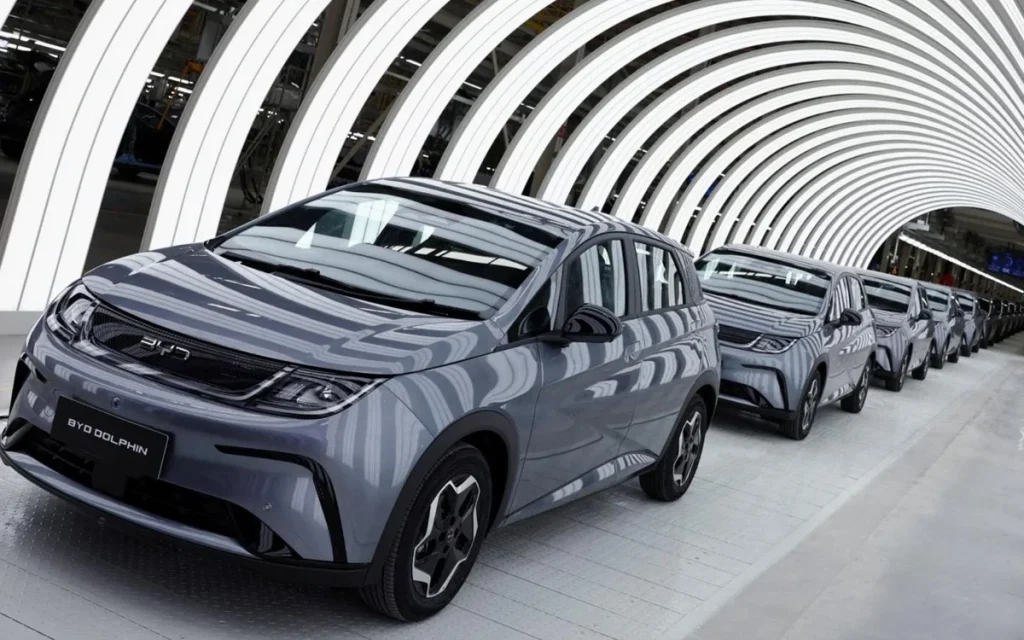
BYD expects to sell 1.3 million vehicles outside mainland China this year, expanding its dealer network across Europe and other markets.
Even that figure is reportedly lower than earlier projections, which shows how fast the numbers are shifting.
Still, the direction is clear: global push, not retreat.
At the same time, another headache is brewing.
Analysts warn that booming AI data centers are snapping up dynamic random-access memory chips, squeezing supply for automakers.
Car companies typically use older memory tech, but even that capacity is tightening as chipmakers prioritize higher-margin AI contracts.
If shortages deepen by the second quarter of 2026, production could feel the strain again – not a full shutdown, but enough to pinch supply.
So while cheap Chinese EVs promise lower sticker prices, the bigger story is about competition, supply chains, and who controls the next era of electric mobility.
Because once the door opens, it rarely closes on its own.
DISCOVER SBX CARS:
The global premium car auction platform powered by Supercar Blondie
