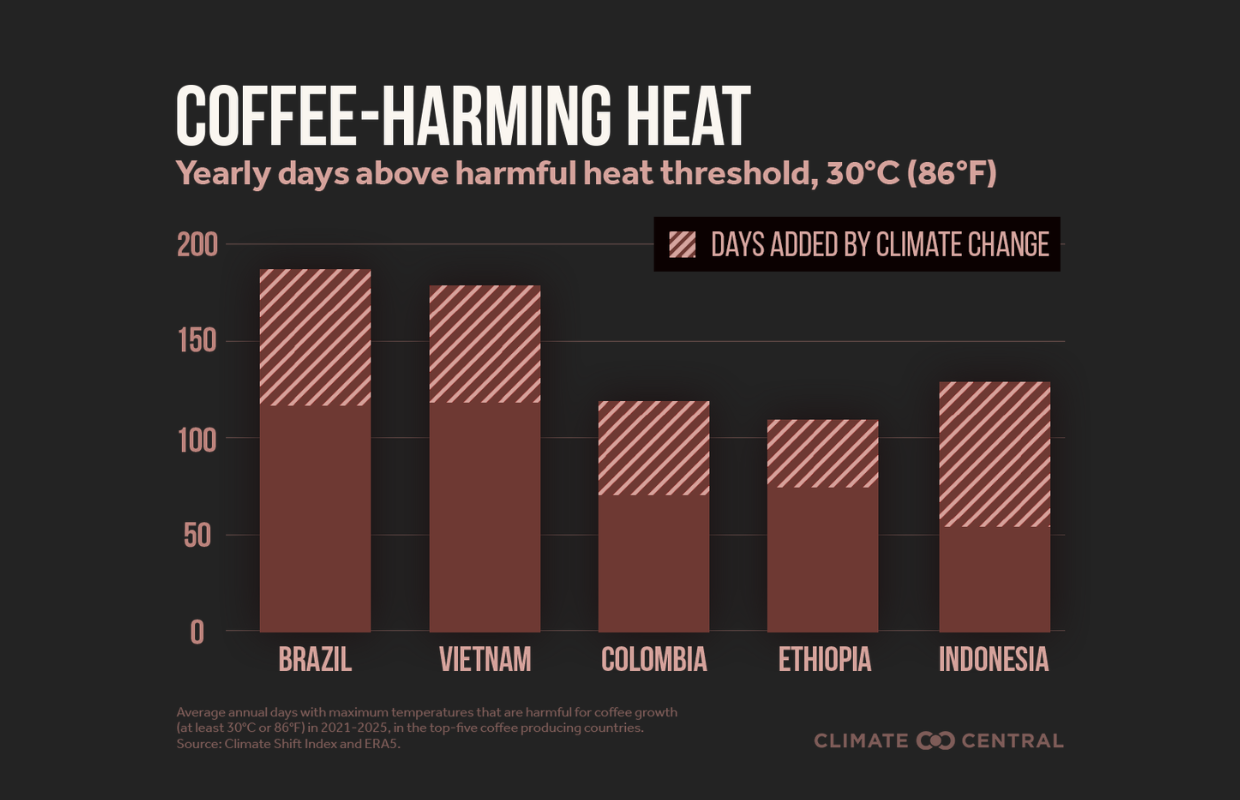
A new analysis found that climate change has already added weeks of “coffee-harming” heat to the world’s main coffee-producing regions, threatening future supply and the livelihoods of millions of smallholder coffee farmers.
Released today by the policy-neutral nonprofit Climate Central, the analysis found that the number of days topping the heat-stress threshold increased across all 25 coffee-producing countries studied, representing 97% of global coffee production.
Using temperature observations from 2021 through 2025, the analysis focused on days when maximum temperatures exceeded 30°C (86°F), a threshold the group described as “extremely harmful” for arabica plants and suboptimal for robusta. Heat stress at those levels can reduce yields, affect bean quality and increase vulnerability to pests and disease.
“Coffee farmers in Ethiopia are already seeing the impact of extreme heat,” Dejene Dadi, general manager of Oromia Coffee Farmers Cooperatives Union (OCFCU), said in a statement shared by Climate Central. “To safeguard coffee supplies, governments need to act on climate change. They must also work with, and invest in, smallholder coffee farmers and their organizations so we can scale up the solutions we need to adapt.”
Among the top five coffee-producing countries — Brazil, Vietnam, Colombia, Ethiopia and Indonesia — Climate Central calculated an average of 57 additional days per year above the 30°C threshold that would not have occurred without climate change. Together, those five origins supply roughly three-quarters of the world’s coffee.
Brazil, the world’s largest coffee producer, saw an average of about 70 additional coffee-harming hot days per year due to climate change, including about 67 days per year in Minas Gerais, according to the analysis. Indonesia averaged about 73, followed by Vietnam (59), Colombia (48) and Ethiopia (34).
Across all 25 countries, Climate Central said the average was about 47 added coffee-harming days per year. The largest increases were in El Salvador (about 99), Nicaragua (about 77) and Thailand (about 75), according to the dataset.
Methodology
Climate Central analyzed observed temperatures using ERA5 reanalysis data, then compared those to data from the Climate Shift Index (CSI) system that estimates “temperatures that would have occurred in a world without carbon pollution.”
The 30°C temperature threshold was based on peer-reviewed research from Naik et al. (2021) and Cheserek and Gichimu (2012) showing that temperatures above 30°C are growth-limiting or extremely harmful for arabica and suboptimal for robusta.
Climate and Coffee in Context
Coffee markets and consumer prices have been sensitive to weather-driven supply shocks in recent years, and the Climate Central analysis notes that increased heat has also been associated with shifting rainfall patterns and more pest pressure.
Past research has also indicated that climate change is making large swaths of existing coffee lands unsuitable for coffee production, primarily due to increased heat, drought and inconsistent rains.
Supporting materials in the Climate Central report point to potential adaptation strategies such as expanding shade tree canopies, improving soil health, protecting water resources and reducing deforestation.
“Our on-ground sensors show longer hot periods, warmer nights and faster soil moisture loss, all of which place increasing stress on coffee plants and soils,” Akshay Dashrath, the co-founder of South India Coffee Company, said in an announcement of the report. “Coffee depends on a narrow balance of shade, moisture and cool recovery time. As that balance shrinks, adapting through better soil health and climate-resilient farming is no longer a choice.”
Comments? Questions? News to share? Contact DCN’s editors here. For all the latest coffee industry news, subscribe to the DCN newsletter.
Related Posts
Nick Brown
Nick Brown is the editor of Daily Coffee News by Roast Magazine.