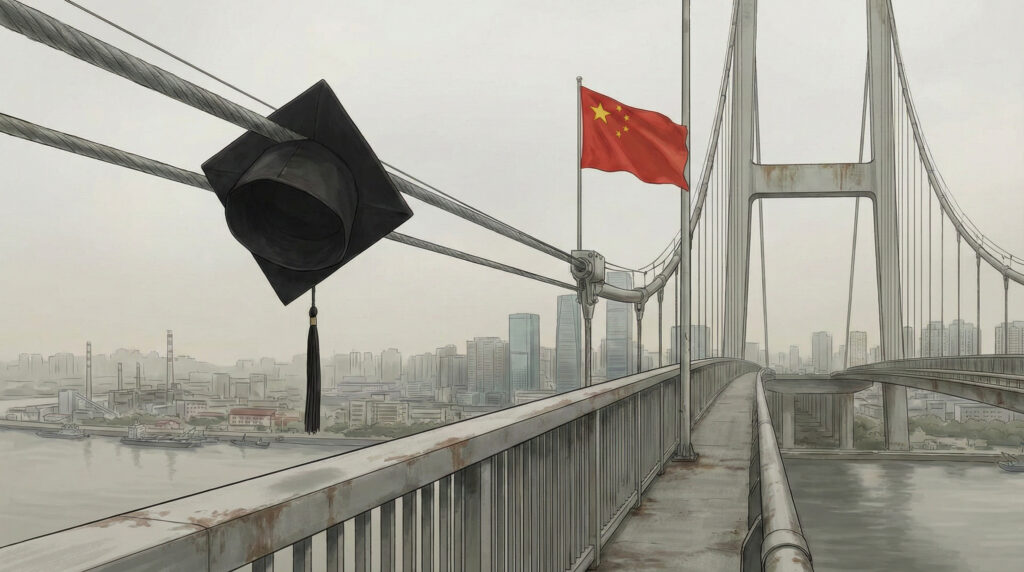

Last month, Zheng Hehui stood before a panel at Southeast University in Nanjing to defend his PhD. But unlike generations of doctoral candidates before him, Zheng didn’t hand over a thick, leather-bound thesis on route to gather dust on a library shelf. Instead, he presented the university’s committee with a product: a set of reinforced steel, Lego-like blocks designed to snap together to form a massive bridge pylon.
His invention is already supporting a massive cable-stayed rail and road bridge spanning the Yangtze River.
Zheng represents a radical shift in how the world’s second-largest economy thinks about higher education. He is part of a pilot wave of “practical PhD” students who are bypassing the traditional dissertation. Under a law passed in 2024, universities can now award doctorates in engineering based on physical prototypes, new techniques, or major project installations.
This is a strategic maneuver on China’s part. Faced with technological blockades and a fierce trade war with the United States, China is basically re-engineering its engineers. The goal is to prioritize function and real-world application over theory.
Publish or Perish
To understand why China is radicalizing its PhD requirements, you have to look at the mountain of paper it is trying to climb out from under.
For years, Chinese academia has been obsessed with a single metric: volume. In 2022, reports confirmed that China had overtaken the United States as the world leader in both scientific research output and “high impact” studies. On the surface, this looked like a victory. But beneath the impressive citation counts lay a systemic rot that the government is now frantically trying to excise.
The pressure to “publish or perish” in China — where cash rewards and professional titles were often directly tied to publication counts — birthed a sprawling black market known as “paper mills.” These shadow organizations sell ghostwritten articles, fabricated data, and authorship slots to researchers desperate to meet quotas. Investigations have revealed that these firms operate like legitimate businesses, charging thousands of dollars to guarantee publication in recognized journals.
In 2020, the Chinese central government announced that publication count would no longer be used as the “only” basis for promotions across the country, simultaneously ending cash rewards for published papers and instituting a three- to five-year ban on applying for national funding for researchers involved in such misconduct.
But the scale of the problem is staggering, and there aren’t enough resources to clean up the potentially hundreds of thousands of fraudulent studies out of China from the past decade.
The End of “Paper Generals”?
In 2023 alone, more than 10,000 academic papers were retracted globally — a record-breaking number. According to analyses of these retractions, a significant portion involved Chinese co-authors. The situation became so dire that in early 2024, a genetics journal retracted 18 papers from China in a single swoop due to ethical concerns regarding DNA collection, while other publishers have had to shutter entire special issues overrun by fake science.
This era created a generation of what critics call “Paper Generals” (zhishang tanbing). These are researchers who can command impressive h-indices and win grants, but whose work collapses the moment it leaves the theoretical realm.
The “practical PhD” is the government’s direct counter-attack. It is a signal that the state is no longer interested in funding “zombie science,” research that exists only to be cited by other research. By allowing students to graduate with a bridge pylon or a vacuum welding system, the Ministry of Education is effectively demonetizing the paper mill industry. New regulations are already punishing those who engage in this misconduct, but the PhD reform goes a step further by removing the incentive entirely. If you can build the machine, you don’t need to buy the paper.
Bridging The Gap
It makes sense. China is a nation trying to achieve self-sufficiency in semiconductors and quantum computing, but a high h-index doesn’t necessarily translate to hardware on the ground.
Li Jiang, an information scientist at Nanjing University, notes the disconnect that has plagued the sector. “There is a big gap between the theoretical knowledge they learn from books and the hands-on ability our society needs from them,” Li told Nature.
The new evaluation model is designed to close that gap. Since September, at least 11 engineers have secured their doctorates through this new, all-practical route. Their output ranges from Zheng’s bridge blocks to a new fire-fighting system for large seaplanes.
Another trailblazer is Wei Lianfeng, a researcher at the Nuclear Power Institute of China. In September, he became the first student at the Harbin Institute of Technology (HIT) to graduate under this scheme. His “thesis” was the development of vacuum laser welding processes and the manufacturing of the associated equipment.
Wei is a prime example of the “elite engineer” the government wants to cultivate. He didn’t stay in the ivory tower; he worked his way up from a technician to a technical expert over a decade. Then later, he returned to school to solve specific problems he encountered on the factory floor.
Hard Tech and Geopolitics
The drive for practical PhDs is explicitly linked to national security. The program targets “bottleneck” problems, such as technological choke points where China relies heavily on foreign imports.
Since 2022, the Ministry of Education has launched pilot programs in 18 critical fields, including electronics, information technology, and semiconductors. This is the culmination of the National Excellence Engineer Training Program.
Zong Yingying, executive vice-dean of the graduate school at HIT — one of the “Seven Sons of National Defence” universities known for military research — argues that the old ways held innovation back. “Many engineering problems are unsuitable for the thesis format or are simply not suitable for publication at all,” Zong told China Science Daily, noting that for some issues, “the solution lies solely in the technology itself.”
The scale of this mobilization is massive.
- 50 graduate colleges for engineers have been established in the last three years.
- 20,000 engineering students have been enrolled in the initiative.
- 60 universities and over 100 enterprises are participating.
Tsinghua University alone has partnered with 56 companies, with its vice-president Wu Huaqiang stating that their 1,430 graduate students have already secured more than 100 patents.
While the program provided the training, the degree law of 2024 provided the exit strategy. It legalized the “practical PhD,” allowing some of these 20,000 students to submit their industrial work — like a new welding technique or a microchip design — instead of a written thesis.
A New Teaching Model
To ensure these degrees aren’t just “easy As,” the universities have restructured how supervision works. Students in these programs are not guided by a single professor. Instead, they operate under a dual-mentor system. One supervisor provides academic rigor, while the other offers solid practical experience from the industry.
“Many engineering professors in Chinese universities have always been academics and never worked in the industry. That is why it is important to pair them up with experts from the industry to teach those PhDs,” Li Jiang explains Nature.
According to Sun Yutao, a researcher of innovation policy at Dalian University of Technology, candidates must prove their prototypes are viable in real-life scenarios. This is a sharp divergence from “industrial PhDs” seen in Europe or the US, where students might work with a company but are generally still expected to produce a traditional written thesis that contributes to the scientific literature.
Assessing the Intangible
While the program addresses a clear economic need, it introduces new headaches for the academic establishment. Evaluating a welding technique is objectively harder than grading a dissertation.
“It is relatively easy to judge whether a thesis is good, but much harder to evaluate a real-life product, let alone decide whether it equates to a leap for an industry,” Sun says.
There is also the risk of quality control regarding the mentors. Li warns: “If the industry experts hired by the university are not good enough, then that will affect the quality of the PhDs.”
Currently, the numbers remain small relative to the massive output of Chinese academia. In 2024, China graduated over 97,000 PhD students; the “practical PhD” cohort is a tiny fraction of that. However, the first cohort suggests a high uptake rate, with 67 students from the pilot program applying for degrees based on designs, proposals, and case reports.
While Sun believes the program is unlikely to expand to foundational sciences — where theory remains king — Guo sees potential for it to bleed into hybrid fields. Future practical doctorates could emerge in disciplines like advanced medical device design and intelligent diagnosis, where the line between engineering and science blurs.