This originally appeared in the Thursday edition of The A Block, Awful Announcing’s daily newsletter with the latest sports media news, commentary, and analysis. Sign up here and be the first to know everything you need to know about the sports media world.
I live in Seattle, a city that has been transformed in part by Jeff Bezos.
Amazon, the online book seller that became a multinational technology company, had a seismic impact on the city and region as an economic driver. Multiple neighborhoods have transformed around their corporate headquarters and continue to evolve even today. The company’s financial impact and its many employees have spread across the entire city and beyond.
As it became the behemoth it is now, Amazon exerted great power over the city. It still does. And sometimes, Seattle pushes back. The company started to be seen as a blight in the way it consumed everything around it, remaking the city in its own image. And there were many battles over whether it was paying its fair share to care for the community it had absorbed.
Seattle is not the hellhole that Fox News would have you believe, but it’s not perfect either. We’re dealing with a severe housing shortage and affordability gap that’s led to a rise in homelessness and a lack of resources for those in need. The issues have piled up, but the most widely accepted understanding is that if we could build more housing, many of these issues would subside.
I often think about how Jeff Bezos could have helped solve those issues. The Amazon founder, who made so much money while here, could have shared a fraction of it to help the city and region offset the affordability inequalities that came about in large part because of his and other tech companies. He could have been seen as a hero and a champion. We would have built a statue of him overlooking Lake Union. And due to those efforts, he probably would have gotten whatever he wanted from the Seattle and Washington State governments.
With an estimated wealth of $250 billion, it would have cost him nothing (relatively speaking) and earned him the adulation and respect of a city that doesn’t hand that out often to people like him.
Instead, presumably because he was upset with Seattle and Washington State tax proposals, as well as frustrations that he couldn’t always get what he wanted, he left for Miami. In doing so, he undercut the effort meant to generate tax revenue to help his neighbors and community, which would have been a drop in the bucket to his personal wealth.
Causing Jeff Bezos to flee our state should be a point of pride for Washington.
— Ryan Packer (@typewriteralley.bsky.social) February 4, 2026 at 1:08 PM
That’s Jeff Bezos to me. Greedy, miserly, and selfish to the end. Hoarding wealth while those around him suffer just because he can. And when he gets any pushback, he takes his ball and goes home without feeling the need to answer for anything.
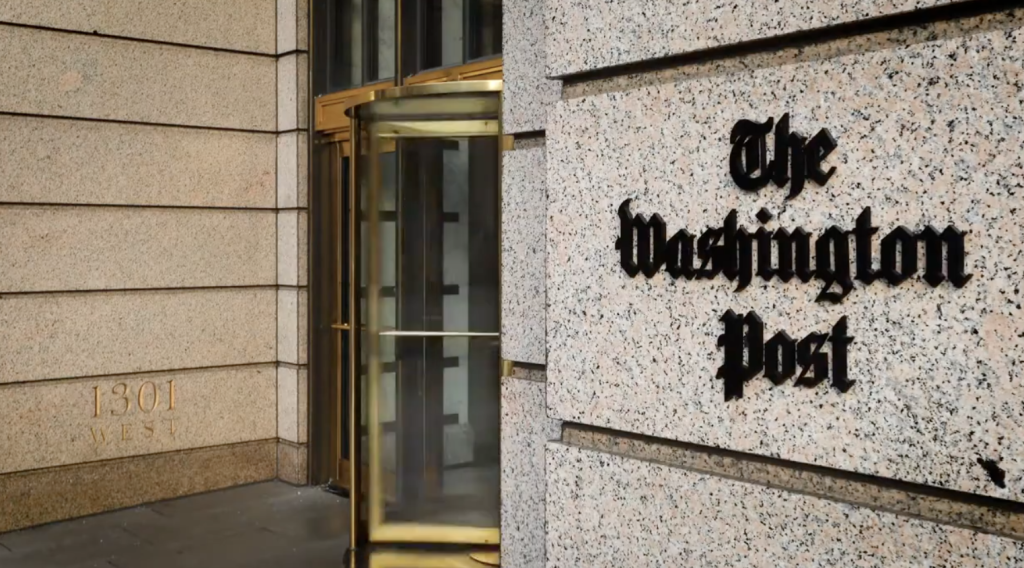
That Jeff Bezos was on full display Wednesday when the long-rumored Washington Post layoffs finally came down. The company reportedly laid off about 30 percent of its employees, including people on the business side and more than 300 journalists in the newsroom. The move will decimate the paper’s sports, local news, and international coverage.
Bezos wasn’t involved in the announcement to employees and hasn’t said anything publicly either. As usual, he feels no need to explain himself to the rest of us.
No one denies that business has been rough for the Post in recent years. And doing nothing is not a solution. But this is the Washington Post we’re talking about. One of the pillars of American journalism and great writing. With a sports department long considered one of the cornerstones of the industry. And a who’s who of alumni that set the tone for American thought on just about every topic.
It would have been so incredibly easy for Bezos to solve the problem. One only need look to the New York Times, which has worked hard to make itself profitable through diversification and technology. They’ve proven it’s possible for an institution like theirs to survive and even thrive in the modern media landscape.
Bezos couldn’t get in there and make similar fixes himself, but he could have bankrolled them without breaking a sweat. For a price that would have amounted to a rounding error in his bank account, he could have turned the Post into a similar multimedia juggernaut.
again we do not really do a good job of explaining how wealthy people like Jeff Bezos are
his net worth is $253.2 billion.
so he could take one million dollars, and just light it on fire
and then do it again tomorrow
and again the day after that
and then do it every day for 693 years and 8 months— Rodger Sherman (@rodger.bsky.social) February 4, 2026 at 9:41 AM
But, he didn’t. He let the Post die, or devolve into whatever it’s about to become. He refused to do what he could. And that is a hell of a choice to make, especially at this moment in America.
“My stewardship of The Post and my support of its mission, which will remain unswerving,” Bezos wrote in 2019, “is something I will be most proud of when I’m 90 and reviewing my life.” He echoed a similar sentiment in 2024, saying, “The advantage I bring to the Post is when they need financial resources, I’m available. I’m like that. I’m the doting parent in that regard.”
The thing about doting parents is that, sometimes, when they have an expectation of unwavering fealty and appreciation they think they deserve, and then don’t get enough to fill the hole inside them, they turn into a very different kind of parent.
“He bought the Post thinking that it would give him some gravitas and grace that he couldn’t get just from billions of dollars, and then the world changed,” Former WaPo writer David Maraniss said of Bezos. “Now I don’t think he gives us—I don’t think he gives a flying fuck.”
So what does Bezos want? What does he want the Washington Post to be? We probably already knew the answer when he killed the paper’s endorsement of Kamala Harris for president. That move led to mass subscriber cancellations, just as his most recent move is likely to as well. And if all of this ends up killing off the Post for good, it’s not hard to imagine Bezos won’t lose much sleep over it.
As in Seattle, Bezos thought he would be hailed as a conquering hero simply for showing up. It’s true that he found success with both Amazon and in the initial years with WaPo, but none of that grants you a lifetime of adulation, especially when you do so little to lift up those around you.
Bezos isn’t destroying the Washington Post because it isn’t profitable. He’s destroying the Washington Post because he’s calculated that a robust free press threatens the ability of his class to warp society around their interests
— Brian Phillips (@brianphillips.bsky.social) February 4, 2026 at 6:24 AM
Bezos is one of a handful of people who, unfortunately, control the state of American media and other industries with their whims. None of them seems particularly interested in helping people anymore, if they ever really did in the first place. They are all wealth-hoarders with little concern for the impacts of their decisions on regular people and the world around them, except when it benefits them personally.
Something like the Washington Post, long a beacon of journalism and truth, is just a plaything to Bezos. Always has been, even when he’d say otherwise. Because as soon as things went bad, or it started to ruffle feathers for his ever-increasing bank account, he gave up on it. And he gave up without feeling the need to explain himself, because he is unaccountable to any of us.

That’s what always made him so unfit to lead a company like The Washington Post. It’s why he’s not welcome in Seattle anymore. It’s why he’s cultivated a reputation as a greedy man who lacks empathy and accountability.
There was a time when he was seen as a visionary and a leader, but those days are long gone. Now, he’s the rich guy who killed the Washington Post just because he could (or because he couldn’t care less).
He never had any desire to be a hero or a champion, and he certainly will never be seen as one. So, in that way, Jeff Bezos got what he wanted after all.