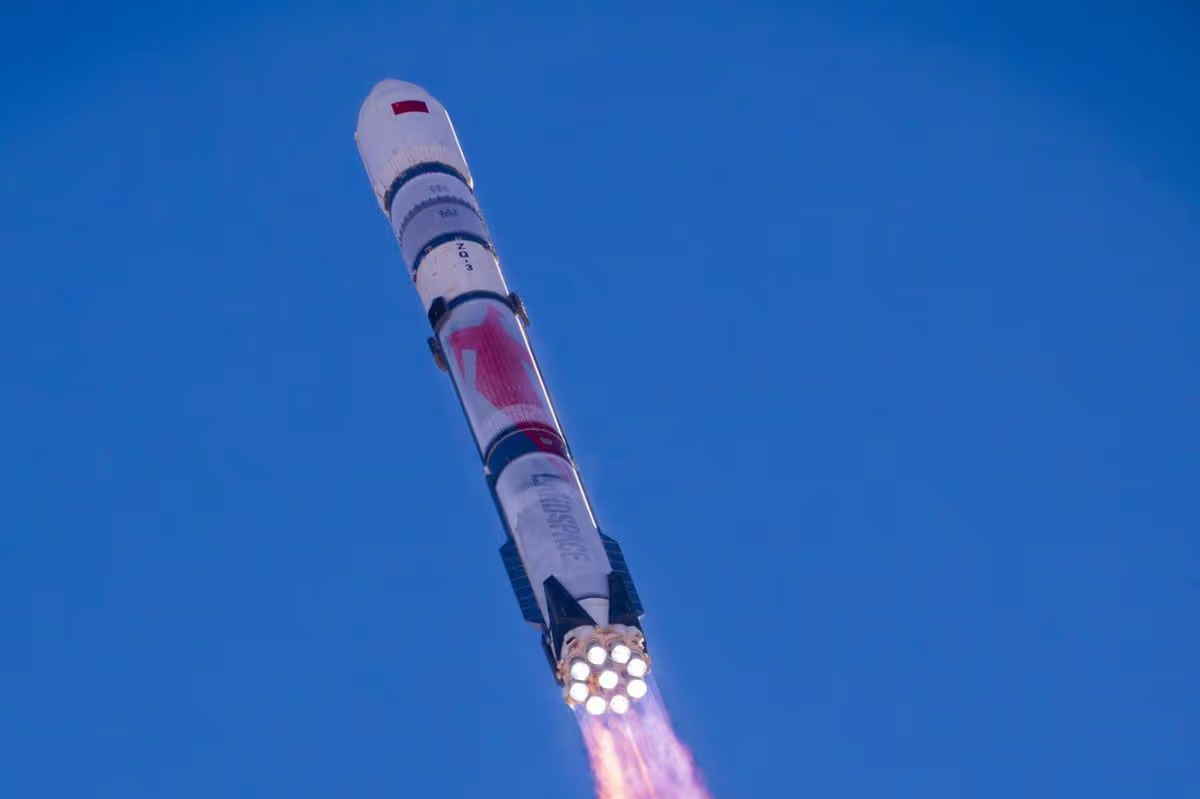
Whitehall officials are tracking debris from a Chinese rocket hurtling towards Earth, though the government says it is ‘extremely unlikely’ to hit Britain

Government experts are monitoring debris from rocket, which is due to enter atmosphere on Friday(Image: Getty)
Mobile network operators have been ordered to ensure the UK’s emergency alert system is operational, due to concerns that debris from a Chinese rocket could potentially crash into Britain.
Whitehall officials are currently monitoring the rocket wreckage as it speeds towards Earth, with a chance it could hit the UK. In an unusual step, British telecoms firms have been directed to confirm their emergency alert systems are primed and ready for action, in case the debris lands in Britain and warnings need to be issued to residents near the impact site.
However, officials have emphasised that it is ‘extremely unlikely’ that the debris will hit the UK. A spokesperson sought to allay fears by highlighting how “extremely unlikely” it is that the space debris will penetrate British airspace.
READ MORE: Brooklyn Beckham called ‘spoiled brat’ by GB News host Nana Akua in fierce rant
READ MORE: Maya Jama ‘devastated’ after gang of callous burglars ransack £4million home
They also reassured that emergency systems are “tested routinely” in collaboration with partners, including mobile networks.
Despite these assurances, it is understood that officials are closely monitoring the Chinese Zhuque-3 (ZQ-3) rocket, which launched in early December and was predicted to re-enter the atmosphere around midday on Friday. The rocket fragments are expected to pass over Europe while Sir Keir Starmer is in China to boost trade and investment, reports the Express.
The Prime Minister met with Chinese premier Xi Jinping on Thursday, with British officials announcing that relations between the two nations were “no longer in an ice age.”
Poland’s space agency has warned that fragments of the rocket are anticipated to “pass over a large part of Europe, including Poland” according to The Telegraph.
The EU’s Space Surveillance and Tracking (SST) agency announced on Wednesday that it was “monitoring the re-entry” of the Chinese rocket, which could potentially carry a “dummy payload” in the form of a large metal tank.
Around 70 pieces of space debris whizz past the UK every month, while an average of three sizeable chunks of space junk plummet to Earth daily. Most of this debris either burns up over uninhabited areas or plunges into the ocean.
UK emergency preparedness teams keep a vigilant eye on space junk, preparing for the unlikely event that it lands on British soil, where it could cause damage or pose a risk to lives.
Telecoms companies regularly communicate with the government about the emergency alert infrastructure, but industry insiders have revealed that it’s unusual for Whitehall to specifically request operators to confirm the system is functioning correctly.
A spokesperson for the UK Government stated: “It is extremely unlikely that any debris enters UK airspace. These events happen approximately 70 times a month and the vast majority of debris breaks up upon entry and lands in the oceans.
“As you’d expect, we have well-rehearsed plans for a variety of different risks including those related to space, that are tested routinely with partners.”
The rocket was launched in early December. The Zhuque-3 Y1 mission took to the skies from the Jiuquan Satellite Launch Center in China on 3 December 2025. Designed to transport payloads such as spacecraft or satellites beyond Earth’s atmosphere, the vehicle functions as an orbital launch system.
While the rocket successfully reached orbit, the reusable booster – modelled after SpaceX designs – plummeted back to Earth and exploded upon impact. Northern UK earmarked as probable impact zone.
Prof Hugh Lewis, a specialist at Birmingham University’s Space Environment and Radio Engineering research group, suggested that the Chinese rocket body was most likely to pass over Northern Ireland, northern Scotland or northern England.
The Aerospace Corporation’s tracker indicated a predicted re-entry time for the Chinese rocket of 12.30pm on Friday, with a margin of error of plus or minus 15 hours. Prof Lewis highlighted the “very large” degree of uncertainty regarding where the debris might land.
He explained: “Most space objects burn up on re-entry so we don’t tend to worry too much, but if it’s a bigger object, or made of materials that are highly resistant to heat, like stainless steel or titanium, they can make it through.
“If there was a strong possibility of it landing in the UK, then an emergency alert would make sense but, as far as I can tell, we just don’t have that certainty yet.”