Hello from California, this is Yifan, your #techAsia host this week.
If you haven’t heard, 2026 is all about physical AI. Just like everyone was talking about AI agents in Silicon Valley around this time last year, almost every conversation I have had in the new year has always pivoted to how artificial intelligence will move from chatbots into the real world.
As a tech journalist, I’m usually sceptical of new buzzwords, but this time around I do see AI’s potential in sectors such as transportation, manufacturing and healthcare. This feeling comes not only from talking to various industry participants every day, but also from personal experience. When I first took a Waymo taxi in Phoenix back in 2022, it was a novel yet bumpy ride. Fast forward to 2026, and Waymo is now almost my default ride choice in San Francisco, and it’s hard to notice any difference between it and an Uber. Except that Waymo cars are usually cleaner.
But I’m hardly a believer compared to the likes of Elon Musk.
The Tesla CEO announced on Wednesday that the company will end production of its high-end model S and X vehicles and convert the space in its Fremont, California, factory to make Optimus humanoids.
Instead of rolling out new car models, Musk is also betting that Tesla’s future is providing robotaxis as a service.
It stands to reason why the company needs to find a new growth area. The US giant lost its crown as the world’s top-selling EV brand to China’s BYD in 2025, with the gap between the two widening over the past few quarters.
The problem? Chinese players are crowding the robotics space as well.
But Musk seems to be determined not to make the same mistake he made when he laughed at BYD’s first entry into EVs back in 2011. After stating that the Optimus is still ahead of any Chinese rival, he warned that China will surely prove tough to beat.
“I always think people outside of China always kind of underestimate China,” Musk said on Wednesday. “China is [an] ass-kicker next level.”
EVs out, robots in
Tesla is taking another step away from the electric vehicle business and towards robotics, announcing Wednesday that it will stop making Model S and X vehicles at its California factory and convert the space to production of Optimus robots, Nikkei Asia’s Yifan Yu reports.
The announcement came as the US electric vehicle leader released earnings. Full-year revenue for 2025 dropped 3 per cent to $94.8bn, the first yearly revenue drop in five years.
The company ceded the global EV sales crown to China’s BYD after annual vehicle deliveries fell for a second year amid intensifying competition and an end to US tax credits.
Tesla delivered 1.6mn vehicles in 2025, down 9 per cent from 2024. BYD, meanwhile, saw deliveries of its battery-powered cars rise nearly 28 per cent to 2.3mn last year.
Crop inspection
Concern among China’s leadership with what officials called “selling young crops” spurred a review of Meta’s $2bn purchase of Chinese-founded AI start-up Manus, write the Financial Times’ Cheng Leng, Zijing Wu and Ryan McMorrow.
China’s commerce ministry launched an evaluation of the deal after officials at the highest levels of government demanded an assessment of whether the transaction would result in the loss of cutting-edge technology and talent, said two people familiar with the discussions.
One of the people said top officials were particularly focused on the danger of “selling young crops”, a euphemism for the cross-border transfer or sale of emerging technologies and talent.
The commerce ministry this month confirmed an FT report that it was reviewing Meta’s acquisition of Manus. Any formal investigation, if launched, could last up to a year.
The team behind Manus built the AI agent in Beijing and Wuhan but moved to Singapore last summer after receiving a major investment from US venture capital firm Benchmark.
China’s commerce ministry, the National Development and Reform Commission, the State Administration for Market Regulation, Manus and Meta did not respond to requests for comment.
An AI vision of the future

Meta made a splash in 2023 with its first AI glasses developed in partnership with sunglass brand Ray-Ban. Several generations of smart glasses later, the Facebook parent kicked the race into higher gear when it unveiled AI glasses with a built-in, full-colour display in September of last year.
Chinese companies, however, are not standing aside and letting Meta have the market all to itself, Nikkei Asia’s Cissy Zhou and Yifan Yu write.
Backed by China’s strong supply chain, sizeable domestic consumer market and abundant choice of open-source AI models, tech giants and start-ups alike in the country are racing to launch their own AI glasses while Meta struggles to keep up with demand.
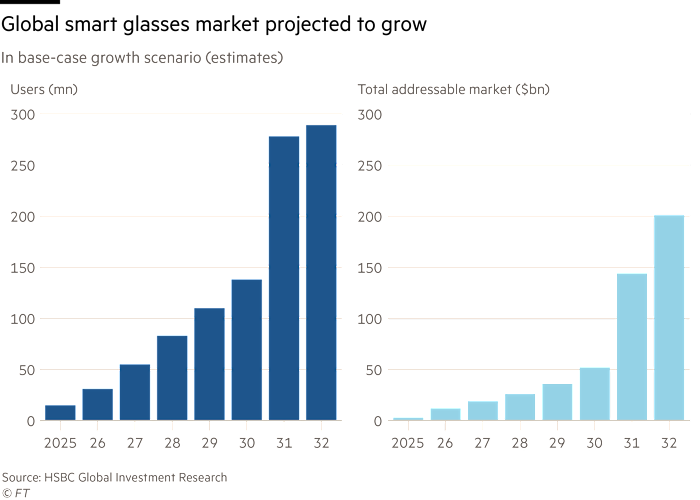
Buoyed by the strong performance of Meta’s latest smart glasses, HSBC raised its forecasts for both shipment volumes and average selling prices. It now estimates the total addressable market for smart glasses could reach about $200bn by 2040, a 33 per cent increase from its previous forecast.
Hello, are you dead?
An app that cost less than $200 to create and caused a stir in China this month has provided a glimpse into the mindset and fears of young people who live alone in the world’s second-largest economy, Nikkei Asia’s Cissy Zhou reports.
The app, originally called Are You Dead?, was created in Henan province by three Chinese, all born after 1995, in their spare time. The concept is simple: If a user fails to check in for more than two days, the app automatically notifies a preset emergency contact.
One of the creators told Chinese media that the app was mainly aimed at women aged 25 to 35 who live on their own in major cities. While download numbers are murky, the app and its provocative name have clearly captured attention and resonated with people living alone, shining a rare spotlight on their concerns.
China’s latest national census showed that single-person households had surpassed 125mn by the end of 2020. Research in 2021 by Beijing News projected that the number of people living solo could jump to 150mn to 200mn by 2030, driven by factors such as greater population mobility, longer education cycles and delayed marriage and childbirth.
Suggested Reads
-
Inside Japan’s long battle to ‘de-Chinafy’ its rare earth supply chain (Nikkei Asia)
-
Memory chip crunch to hit TVs and consumer devices hardest in 2026 (Nikkei Asia)
-
Robots only half as efficient as humans, says leading Chinese producer (FT)
-
ASML sees AI chip and memory growth exceeding 20% in coming years (Nikkei Asia)
-
India’s informal workers go digital as ‘blue-collar LinkedIn’ apps expand (Nikkei Asia)
-
Temu, Shein suspend sales as Turkey scraps online duty-free trade (Nikkei Asia)
-
Russia, Ukraine and the race for Chinese drone components (FT
#techAsia is co-ordinated by Nikkei Asia’s Katherine Creel in Tokyo, with assistance from the FT tech desk in London.
Sign up here at Nikkei Asia to receive #techAsia each week. The editorial team can be reached at techasia@nex.nikkei.co.jp